FundingLatest Deals5 MIN READ

TotalEnergies and KKR Add 700 MW of Texas and Ohio Solar to US Renewables Venture in $1.2 Billion Deal

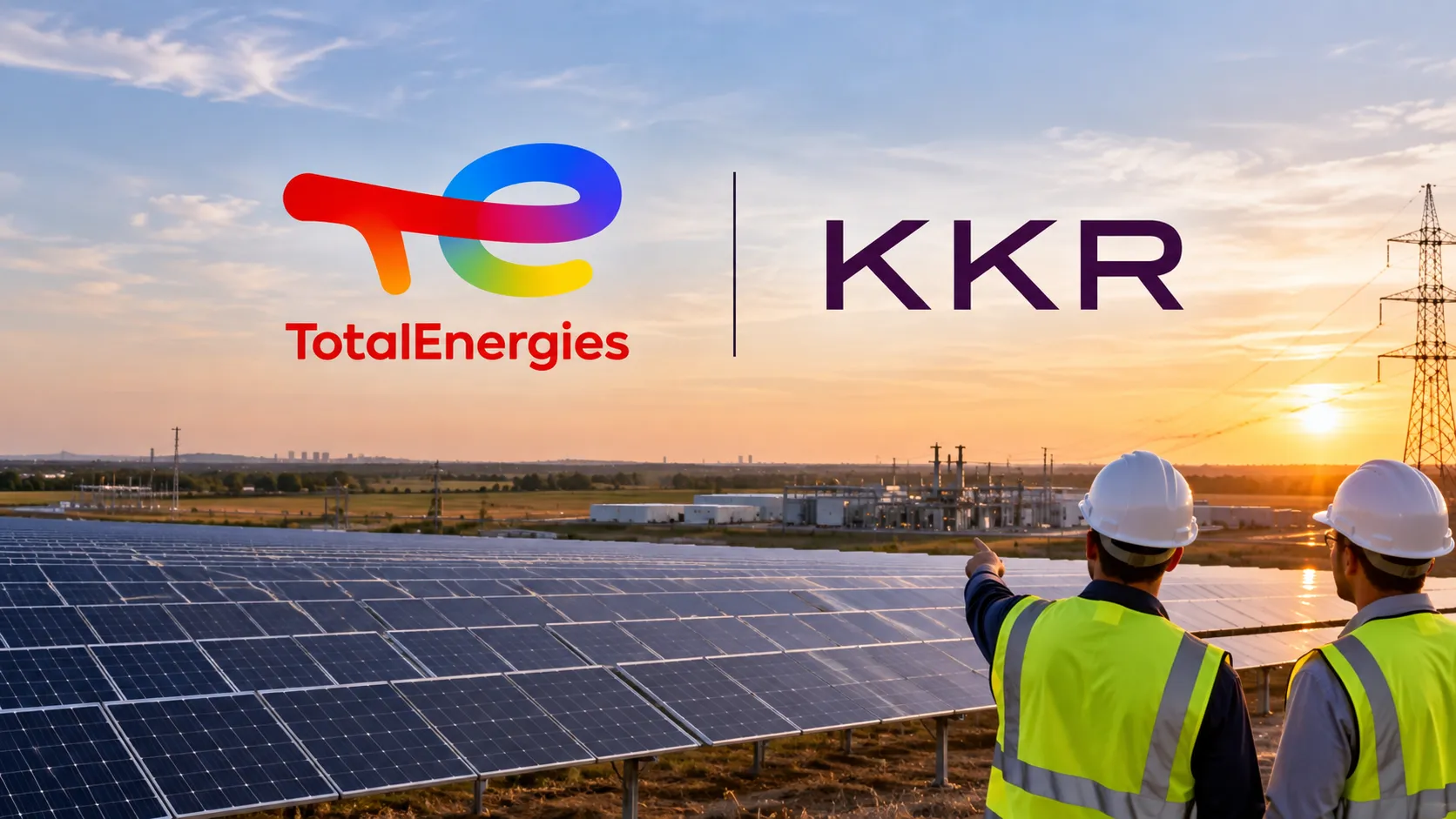
TotalEnergies is expanding its 50/50 US renewables joint venture with KKR by adding three utility-scale solar assets in Texas and Ohio worth $1.2 billion, lifting the venture’s capacity from 1.4 GW to about 2.1 GW.

By Aravind Kumar · Author13 October 2026New
TotalEnergies and KKR Add 700 MW of Texas and Ohio Solar to US Renewables Venture in $1.2 Billion Deal

TotalEnergies is expanding its US renewable-energy partnership with KKR, adding a portfolio of three utility-scale solar projects in Texas and Ohio with an enterprise value of $1.2 billion. The French energy group announced the agreement on October 12.

The deal adds 700 megawatts of capacity to the 50/50 joint venture the two companies created in the United States in 2025, which currently holds 1.4 gigawatts. Once completed, the venture’s portfolio will total about 2.1 gigawatts.

The projects are expected to begin commercial operation by the first quarter of 2027. Electricity from the portfolio has either already been sold to third parties or will be marketed by TotalEnergies, which will continue to operate the assets after the transaction closes. Completion is expected in 2026, subject to customary conditions.

A familiar model

The transaction follows a strategy that TotalEnergies has used repeatedly: develop and build renewable projects, then sell a large stake to a financial partner to recycle capital while retaining operational control and a share of the returns.

The approach allows the company to grow its renewable portfolio faster than its balance sheet alone would permit. Developers typically earn their best returns during the development and construction phases, when risk is highest. Once projects are operating and contracted, their steady cash flows appeal to infrastructure investors such as KKR, which accept lower returns in exchange for long-term, predictable income.

TotalEnergies and KKR have deepened their relationship this year. In August, TotalEnergies acquired Shell’s renewables business and sold a 50% stake in a portfolio of developed assets in Europe to KKR. The latest deal extends that template to the United States.

The deal shows how energy majors are learning to grow in renewables without carrying the full weight of the capital on their own balance sheets.

Why Texas and Ohio

Texas has become the leading US state for new solar and battery capacity, thanks to abundant land, strong solar resources, fast permitting and a competitive, largely deregulated power market run by ERCOT. Demand is rising fast, driven by population growth, industrial expansion and a surge of energy-hungry data centres.

Ohio, part of the PJM grid that spans 13 states and the District of Columbia, has also emerged as a data-centre hotspot. Utilities and grid operators across PJM have warned of tightening supply as electricity demand climbs for the first time in decades, creating opportunities for new generation that can be built quickly. Utility-scale solar remains among the fastest types of generation to deploy.

TotalEnergies’ integrated power strategy

The deal fits TotalEnergies’ broader ambition to build an integrated electricity business alongside its oil and gas operations. The company’s power portfolio combines renewables, including solar, onshore wind and offshore wind, with flexible assets such as gas-fired combined-cycle plants and battery storage. That mix lets it supply customers with reliable power around the clock rather than depending solely on intermittent generation.

As of the end of June 2026, TotalEnergies had more than 37 gigawatts of gross renewable generation capacity, and it targets more than 100 terawatt-hours of net electricity production by 2030. Chief executive Patrick Pouyanné has argued that integrated power can deliver returns comparable to traditional energy businesses, provided the company maintains discipline on capital and pricing.

“The deal shows how energy majors are learning to grow in renewables without carrying the full weight of the capital on their own balance sheets.”
— The Impactful Global Indian

TotalEnergies stands apart from some European peers on this front. While rivals such as BP and Shell have scaled back renewable ambitions in recent years to refocus on oil and gas, TotalEnergies has maintained its push into electricity, though it too has emphasised returns and selective growth.

6ba4c56e-1d55-45dc-8e5c-d0c7a76c5ac6.png

Private capital’s growing role

For KKR, the deal adds contracted, operating assets in a market with strong demand fundamentals. Private infrastructure funds have poured capital into energy-transition assets globally, attracted by long-term contracts, inflation linkage and the scale of investment needed to modernise power systems.

Policy uncertainty in the United States has not deterred these investors. Changes to federal clean-energy tax credits have created headwinds for some projects, but rising electricity demand, particularly from AI data centres, has strengthened the commercial case for new generation of all types, including solar.

Why scale and operations matter

TotalEnergies’ decision to keep operating the assets after the sale is a key feature of the deal. Operational control allows the company to apply its standards for maintenance, safety and grid integration across its portfolio and to optimise how the plants’ output is sold. It also generates fee income and preserves relationships with offtakers and grid operators.

Selling the electricity is itself a growing business. Where output has not already been contracted to third parties, TotalEnergies will market the power, drawing on its trading operations. In markets such as ERCOT, where prices can swing sharply with demand and weather, the ability to manage merchant exposure and pair solar with storage or flexible generation can significantly affect returns.

The 1.4-gigawatt base portfolio that the joint venture already holds gives the partners scale in the US market, and the addition of 700 megawatts increases it by half. Scale brings advantages in procurement, financing and operations, and makes the platform more attractive to future co-investors or buyers should either partner seek to recycle capital again.

The timing, with commercial operation targeted by the first quarter of 2027, means the assets are close to completion. That limits construction risk for KKR while allowing TotalEnergies to crystallise value from its development work before the plants enter service.

Implications for India

The deal carries lessons for India, which has set a target of 500 gigawatts of non-fossil power capacity by 2030 and is among the world’s fastest-growing solar markets. Indian developers such as Adani Green, ReNew and Tata Power Renewables, as well as global companies including TotalEnergies itself, which holds a significant stake in Adani Green Energy, rely heavily on partnerships with financial investors to fund their expansion.

Asset recycling, selling stakes in operating projects to pension funds, sovereign wealth funds and infrastructure investors, has become a central strategy in Indian renewables too. Global capital managers including KKR, Brookfield and Canadian pension funds are active investors in Indian clean-energy platforms.

The TotalEnergies-KKR expansion underlines a point Indian policymakers and investors know well: the energy transition is as much a financial engineering challenge as a technological one. The companies that grow fastest will be those that can build projects efficiently and attract the patient capital needed to own them for decades.

TagsTotalEnergiesKKRSolar EnergyRenewable EnergyJoint VentureTexasOhioClean EnergyEnergy TransitionInfrastructure InvestmentPrivate EquityUtility-Scale SolarSustainabilityPower Markets

Reader reviews

Sign in to rate and review this article.
Loading reviews…

