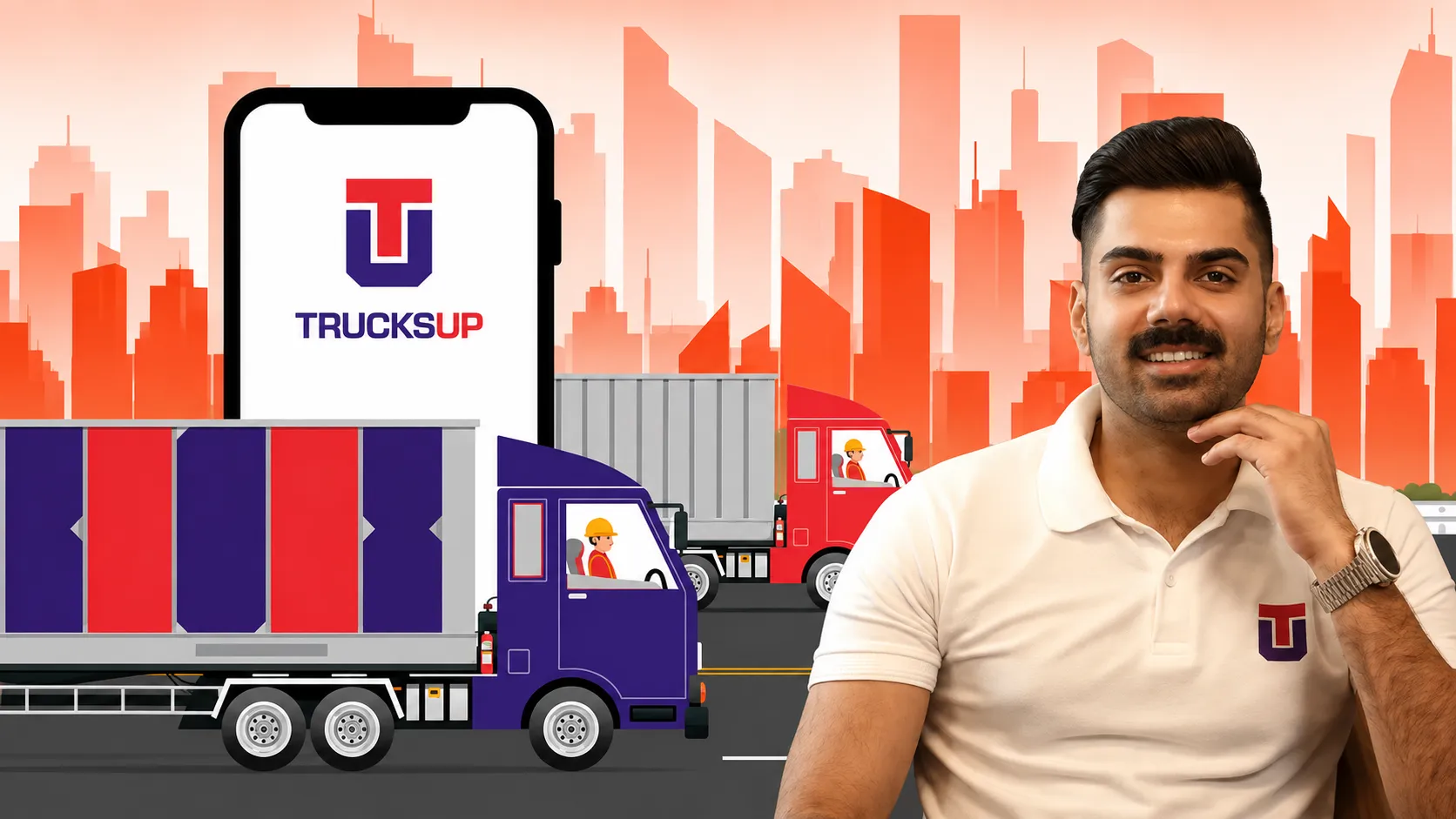
TrucksUp, a Gurugram-based digital freight marketplace, has raised $8.2 million in a growth funding round at a post-money valuation of $42.3 million, drawing capital from institutional investors and family offices alongside continued commitment from its own leadership team. Co-founders Sarthak Shah Elwadhi and Aviraj Singh Chadha increased their personal stakes in the company as part of the round, a signal of founder conviction that often carries weight with institutional co-investors evaluating growth-stage logistics businesses.
Founded in 2022, TrucksUp operates an AI-driven digital marketplace connecting truck owners, fleet operators and drivers with businesses that need freight moved across India's famously fragmented and largely informal trucking sector. The platform layers technology onto a supply chain that has historically relied on relationship-based broking, offering FASTag toll solutions, fuel programmes, vehicle insurance, financing and a marketplace for buying and selling commercial vehicles.
India's road freight market remains one of the largest and least digitised logistics segments globally, with millions of small fleet operators and independent truck owners still coordinating loads through informal networks rather than structured platforms. That fragmentation has long been viewed as both the sector's greatest inefficiency and its largest opportunity for technology-led disruption, a thesis that has attracted a wave of freight-tech startups over the past decade with mixed commercial outcomes.
TrucksUp's decision to bundle financial services — insurance, fuel programmes and vehicle financing — alongside its core marketplace reflects a strategy increasingly common among Indian logistics-tech companies: rather than competing purely on load-matching efficiency, where margins are thin and competition intense, the company is positioning itself to capture higher-margin financial services revenue from the same customer base it already serves for freight matching.
The fresh capital will be directed toward scaling both the company's underlying technology stack and its physical fleet solutions, according to details shared around the raise. For a sector where trust and reliability remain paramount — a truck owner extending credit or purchasing insurance through a digital platform is making a meaningful financial commitment — technology alone is unlikely to be sufficient; execution on customer service and claims handling will likely prove equally important to TrucksUp's growth trajectory.
The round adds TrucksUp to a lengthening list of Indian freight-tech companies attracting growth capital in 2026, even as broader venture funding for logistics startups has moderated from the peak years of 2021 and 2022. Investors backing the sector appear increasingly selective, favouring platforms that can demonstrate genuine unit economics and diversified revenue streams over those pursuing growth through subsidised pricing alone.
India's road freight sector moves the overwhelming majority of the country's domestic goods, yet remains dominated by an estimated several million individual truck owners, many operating a single vehicle with minimal access to formal credit, insurance or fuel financing on competitive terms. That fragmentation has historically left small operators paying higher effective costs for fuel, financing and insurance than larger fleet operators, a gap that platforms like TrucksUp are explicitly designed to close by aggregating demand and negotiating better terms on behalf of their network.
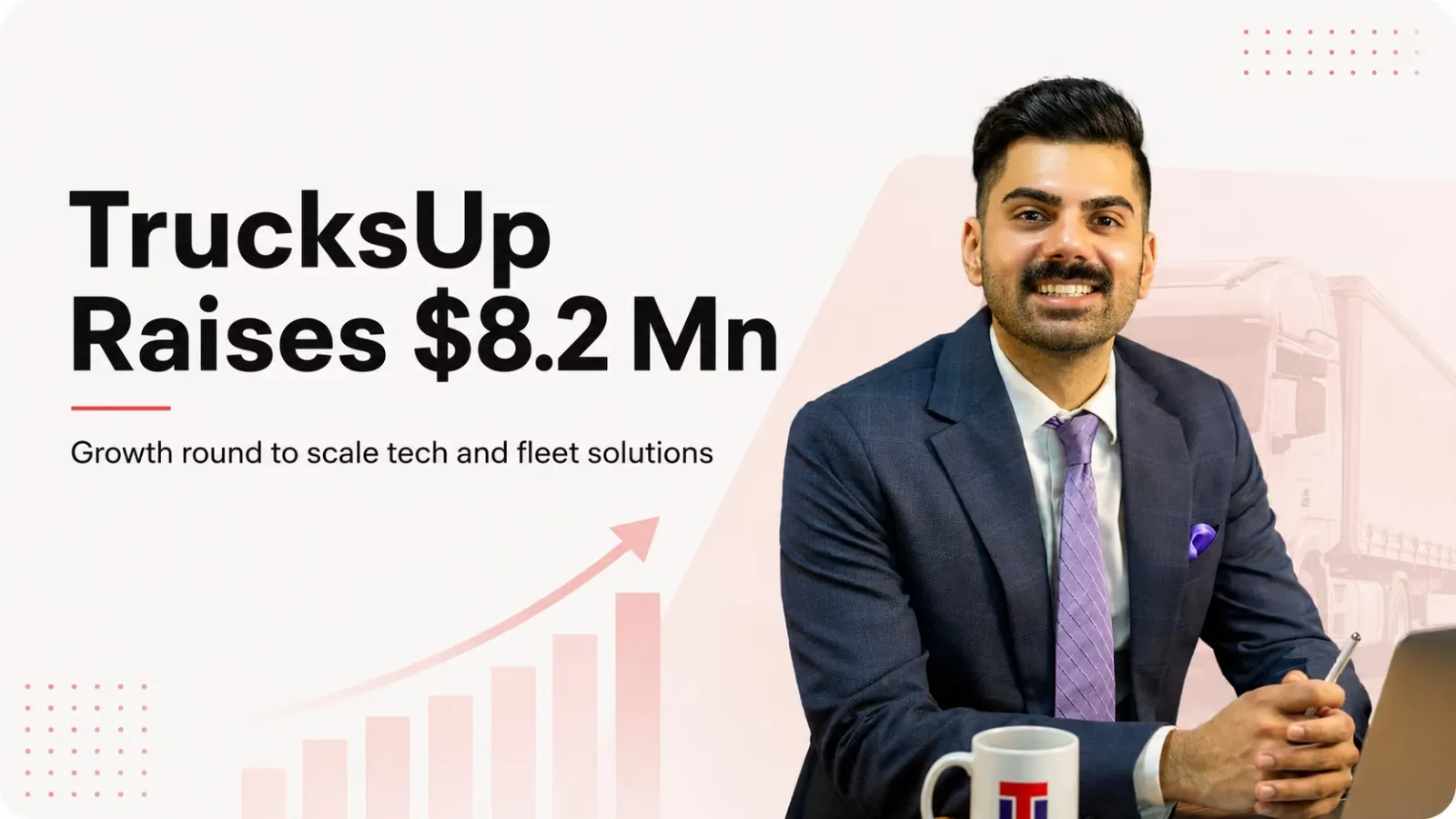
The founders' decision to increase their personal stakes during this funding round, rather than simply maintaining existing ownership percentages, is a detail that institutional investors typically weigh carefully when evaluating growth-stage companies. It signals founder confidence in the business's trajectory at a valuation the company itself is setting, a dynamic that can meaningfully influence how comfortable new investors feel about the round's pricing relative to founders potentially taking money off the table instead.
TrucksUp's FASTag integration addresses a specific pain point within India's trucking economy: the electronic toll collection system, while mandatory nationwide, has historically been poorly integrated with the broader financial and operational tools truck owners use daily, creating friction around balance top-ups, transaction reconciliation and dispute resolution. By embedding FASTag management directly into its core platform, TrucksUp positions itself as a daily-use utility for truck owners rather than solely a marketplace they visit only when seeking new loads.
Vehicle financing represents perhaps the highest-stakes component of TrucksUp's bundled offering, given the significant capital outlay required to purchase commercial trucks and the historically challenging underwriting environment for individual truck owners, many of whom lack the formal credit history that traditional lenders require. Success in this segment depends heavily on the company's ability to develop underwriting models that accurately price risk using alternative data sources — trip history, fuel consumption patterns, toll payment records — rather than conventional credit bureau data that may be sparse or unavailable for its target customer base.
As TrucksUp deploys its fresh growth capital, the company's ability to scale its financial services offerings profitably, while maintaining the trust of a customer base that has often been underserved or mistreated by formal financial institutions in the past, will likely prove as important to its long-term success as the underlying technology powering its freight-matching marketplace.
Looking ahead, TrucksUp's growth trajectory will likely be shaped by how effectively it can cross-sell its bundled financial products to its existing freight-matching user base, converting a logistics marketplace into a genuine financial-services relationship with India's trucking community. That conversion, if achieved at scale, would position the company to weather the periodic freight-rate volatility that has historically challenged pure marketplace models, by diversifying its revenue base beyond transaction commissions alone toward more durable, recurring financial-services income.
Competing freight-tech platforms in India have pursued broadly similar bundled strategies with varying degrees of commercial success, making execution quality — rather than the underlying business model concept itself — the more decisive factor in determining which players ultimately consolidate market share. TrucksUp's $42.3 million valuation places it among the mid-tier of India's freight-tech startups, leaving it room to grow into a larger valuation bracket should its bundled financial-services strategy prove out at scale over the coming fundraising cycles.
The company's Gurugram base places it within India's dense logistics-tech corridor along the National Capital Region, a geography that has produced several of the country's most prominent freight and supply-chain startups, benefiting from proximity to major logistics hubs, a deep pool of relevant engineering talent and easy access to the institutional investors who have historically clustered their India logistics coverage around Delhi-NCR.