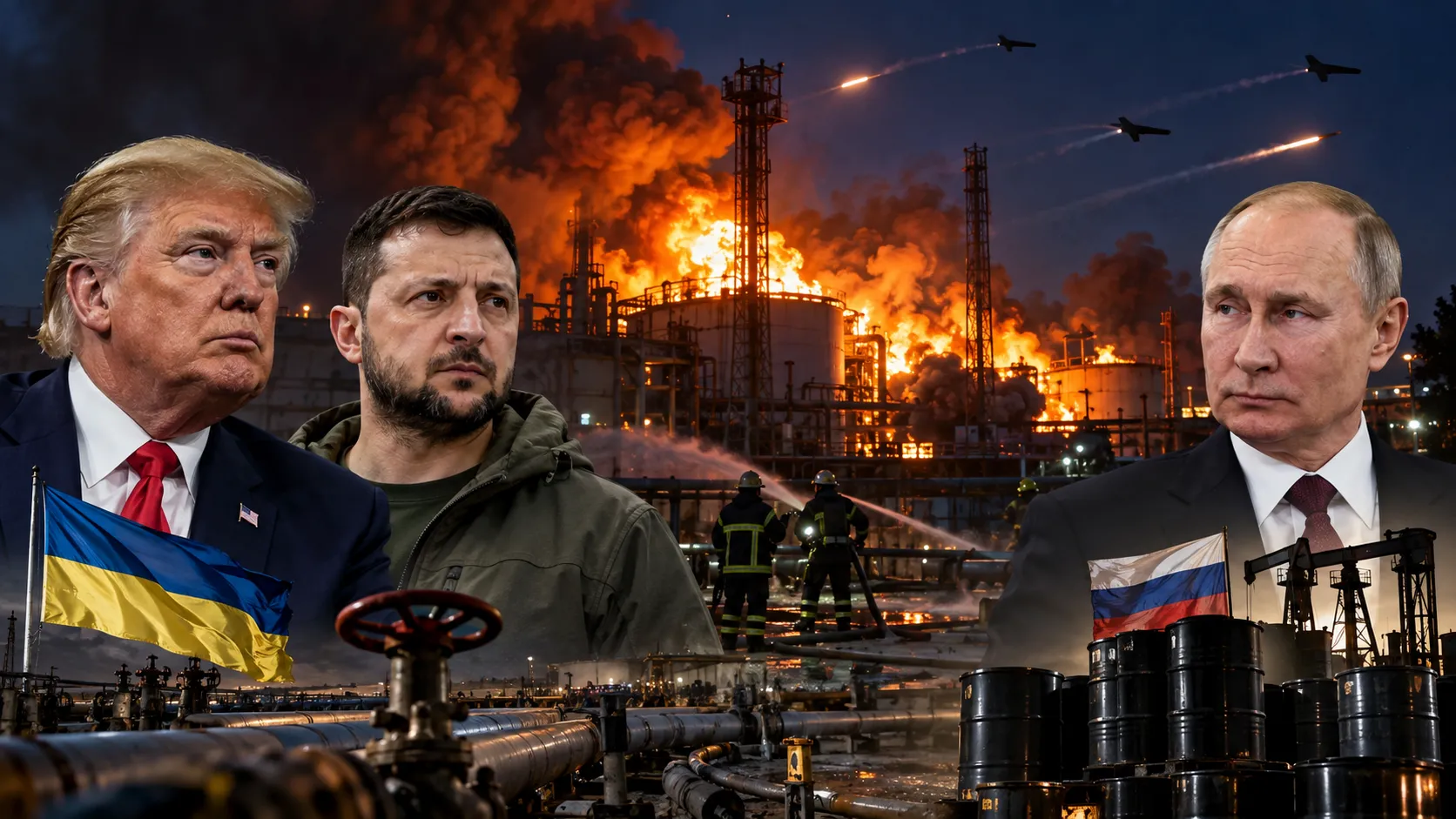
Russian missiles and drones struck Ukrainian gas facilities overnight, wounding 33 people, hours after President Donald Trump announced that Moscow and Kyiv had agreed to an “energy ceasefire” to spare each other’s energy infrastructure, according to Ukrainian officials cited by NPR.
Trump had announced the truce “effective immediately”, saying both parties had agreed. Ukrainian President Volodymyr Zelenskyy said the announcement was “news for me” but that Ukraine supported any step towards de-escalation and was ready to pause strikes if Russia reciprocated. He later said Russia had hit a power plant in Kharkiv after Trump’s statement.
The confusion comes at a delicate moment for global energy markets. The average US gasoline price stood at $4.35 a gallon, according to motoring group AAA, and benchmark Brent crude has hovered around $100 a barrel as conflict in the Middle East, including the US war with Iran, disrupts supplies.
The diesel deal
The ceasefire announcement was paired with a more controversial initiative: a deal with Russian President Vladimir Putin to import Russian diesel into the United States and global markets. Trump framed the effort as part of his “America First” strategy to bring down energy prices for American consumers.
In a statement, Trump defended the plan by pointing to Europe’s past purchases of Russian energy. “The European Union paid Russia $250 Billion Dollars for Energy, and the Fake News Media doesn’t want to get near that story,” he said.
Zelenskyy condemned the diesel arrangement as “not fair and not honest” and a gift to Putin. Many US allies, while supportive of an energy ceasefire in principle, have criticised the plan to buy Russian fuel. According to Axios, a US official said Trump decided to make the deal after Zelenskyy ignored repeated US requests to stop attacking Russian oil refineries.
The plan also faces domestic legal questions. Republican Senator Thom Tillis of North Carolina said the arrangement may violate a 2022 law passed by Congress that banned imports of Russian oil following the full-scale invasion of Ukraine, unless specific conditions are met.

Why energy infrastructure is a battlefield
Since the full-scale invasion in 2022, Russia has repeatedly targeted Ukraine’s power plants, gas facilities and electricity grid, particularly ahead of winter, aiming to weaken the economy and civilian morale. Ukraine, in turn, has used long-range drones to strike Russian oil refineries, export terminals and fuel depots, seeking to cut the revenues that fund Moscow’s war effort and to disrupt fuel supplies to the front.
Both campaigns have had global effects. Ukrainian strikes on Russian refineries have at times reduced Russia’s fuel exports, tightening global diesel markets. Russian attacks on Ukraine’s gas production and storage have increased the country’s need for imports, adding demand to European gas markets.
Markets on edge
For energy traders, the key question is whether the ceasefire will hold. A genuine truce that protects refineries and export terminals on both sides would ease pressure on fuel markets, particularly diesel, which has been tight globally. But reports of continued strikes suggest the arrangement may be fragile.
An energy truce that holds would ease pressure on fuel markets; one that exists only on paper risks adding a new layer of uncertainty.
The wider supply picture remains strained. The International Monetary Fund’s latest World Economic Outlook, released this week at its annual meetings in Bangkok, assumes the Strait of Hormuz will not reopen until March 2027, and warns that energy prices will stay above pre-war levels even after conditions normalise. Some emerging economies without adequate inventories, the Fund warned, could face shortages as countries compete for cargoes.
High fuel prices are also politically sensitive in the United States, where gasoline costs weigh heavily on household budgets. Importing Russian diesel could add supply and ease prices at the margin, but it would also undermine Western sanctions designed to cut Moscow’s energy revenues.
Allies uneasy
European governments have spent four years reducing their dependence on Russian energy, at great cost, and have imposed successive rounds of sanctions, including caps on the price of Russian oil and bans on refined product imports. A US move to buy Russian diesel would complicate that effort and could create tensions within the Western alliance.
For Ukraine, the episode underlines the uncertainty of relying on Washington’s diplomacy. Kyiv wants any ceasefire to be verifiable and reciprocal, and fears arrangements that ease pressure on Moscow without securing commitments to end attacks on Ukrainian cities and infrastructure.
The politics at home
Domestically, the energy ceasefire and diesel deal have become entangled in US political debates ahead of the midterm elections. Gasoline prices above $4 a gallon are a familiar political liability for any administration, and the White House has made lowering energy costs a central theme. Critics argue that easing pressure on Russia undermines Ukraine and Western unity, while supporters say American consumers should not bear the cost of sanctions while Europe bought Russian energy for years.
Tillis’s intervention is significant because it comes from within the president’s own party. If lawmakers conclude the diesel deal requires congressional approval or conflicts with existing sanctions law, the arrangement could face legal challenges or legislative pushback, adding to uncertainty for traders and refiners trying to plan supply.
Refiners and fuel distributors face practical questions too. Contracts for diesel cargoes are typically arranged weeks or months in advance, and buyers need clarity on whether purchases of Russian-origin fuel would expose them to sanctions penalties, banking restrictions or shipping and insurance complications. Until those questions are resolved, many market participants are likely to remain cautious, limiting the immediate effect of the deal on prices at the pump.
What it means for India
India has a significant stake in how this plays out. It is one of the world’s largest importers of crude oil and has become a major buyer of discounted Russian crude since 2022, refining much of it into diesel and other products, some of which it exports to Europe and elsewhere. Changes in US policy towards Russian fuel, and any shifts in sanctions enforcement, could affect the economics of those flows.
Higher global oil prices also feed directly into India’s import bill, inflation and fiscal position. The IMF this week raised its 2026 growth forecast for India to 7%, but cautioned that the country is not insulated from the energy shock.
The episode shows, once again, how tightly energy markets remain bound to geopolitics. Whether the energy ceasefire becomes a genuine step towards de-escalation or another short-lived announcement will matter for fuel prices from Houston to Mumbai in the months ahead.