Taiwan Semiconductor Manufacturing Company, the world's largest contract chipmaker and the main supplier of advanced processors for artificial intelligence, reported a record quarterly profit on 15 October as demand for AI hardware continued to outstrip supply.
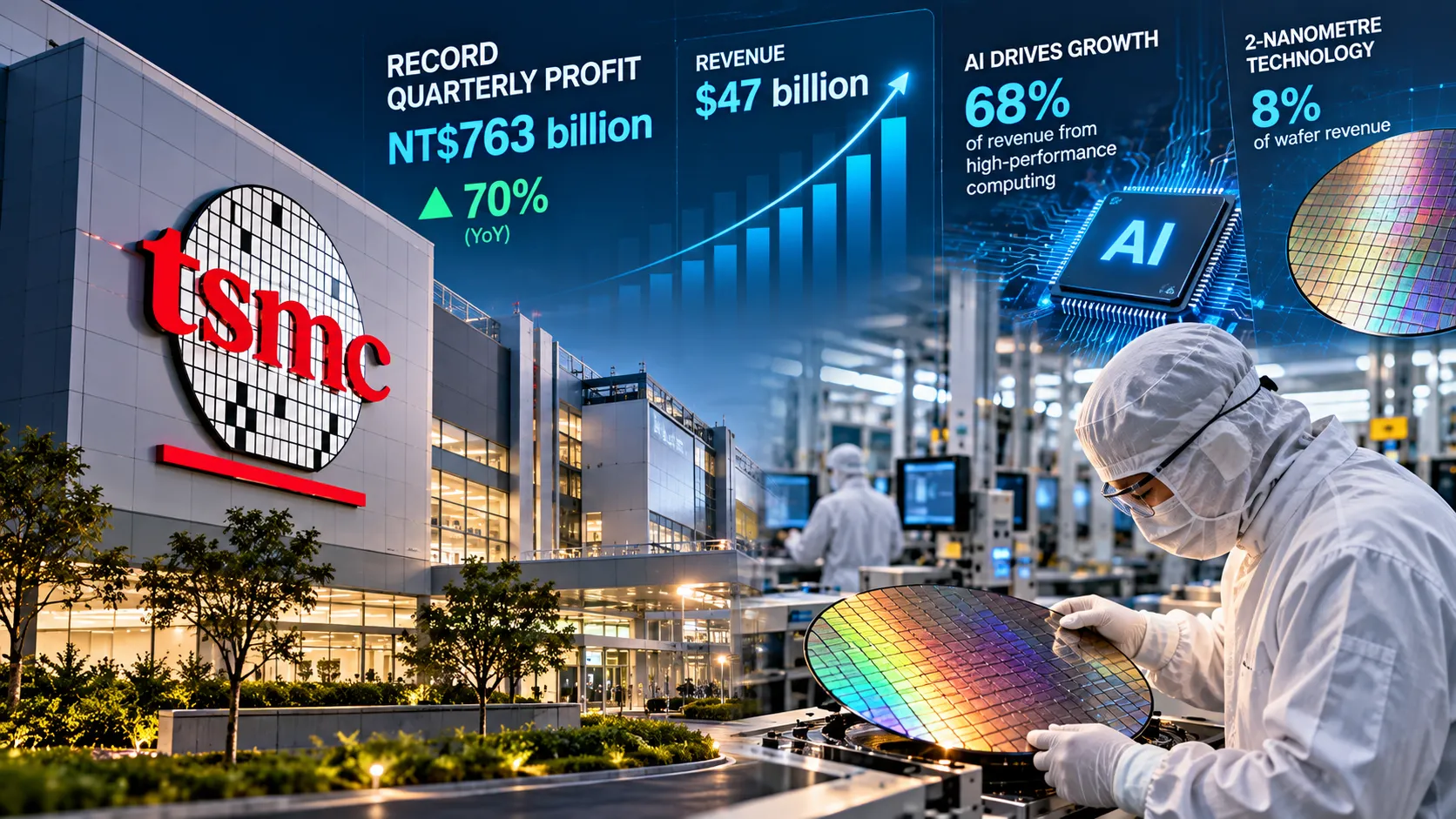
Net profit for the July–September quarter rose nearly 70 per cent from a year earlier to about NT$763 billion, slightly above analysts' estimates compiled by LSEG, according to reports by investingLive and Tech Startups. Revenue came in at about $47 billion, above the top of TSMC's own guidance range.
It was the company's sixth consecutive quarter of record profit, underlining how central TSMC has become to the AI boom.
AI Now Dominates the Business
High-performance computing, the segment that includes the AI accelerators designed by companies such as Nvidia, AMD and the large cloud providers, accounted for 68 per cent of revenue, up from 57 per cent a year earlier.
TSMC's most advanced manufacturing process, 2-nanometre technology, contributed 8 per cent of wafer revenue in the quarter, up from 3 per cent in the previous quarter, as production ramped up for the next generation of chips.
Chief executive C.C. Wei said AI demand "remained extremely robust" and would probably outpace the company's earlier long-term growth forecast. He added that supply still falls well short of demand, and that close to 20 new fabrication plants are being built, most of them in Taiwan.
Guidance Raised, Margins Softer
TSMC raised its full-year 2026 revenue growth forecast to about 44 per cent in US dollar terms, from slightly above 40 per cent in July. For the fourth quarter, it guided revenue of $52 billion to $54 billion, implying continued strong sequential growth.
But the margin picture was less rosy. The gross margin was about 66 per cent in the third quarter, well above a year earlier but lower than in the second quarter, a decline TSMC attributed mainly to the early costs of ramping up 2-nanometre production. Fourth-quarter gross margin guidance of 65 to 67 per cent has a midpoint slightly below the third quarter's level.
Heavy Spending Ahead
TSMC reaffirmed capital expenditure of $60 billion to $64 billion for 2026 and said investment over the next three years is expected to be significantly higher than in the previous three. The company has been expanding manufacturing outside Taiwan, including in Arizona and Japan, partly in response to customer and government pressure to diversify supply.
Overseas plants typically cost more to build and run than TSMC's facilities in Taiwan, which adds to pressure on margins.
Why Shares Slipped
Despite the strong results, TSMC's shares slipped as investors focused on the softer margin outlook, the costs of the 2-nanometre ramp and overseas expansion, and the implications of heavier capital spending for near-term free cash flow.
The reaction reflects the high expectations already built into the stock. As one of the most valuable companies in the world, TSMC is priced for sustained growth, and investors are scrutinising any sign that profitability could be squeezed by the costs of meeting AI demand.
The AI Spending Debate
TSMC's results land amid a broader debate about whether the extraordinary spending on AI infrastructure is sustainable. Technology companies are pouring hundreds of billions of dollars into data centres and chips, and some analysts have warned that not all of that investment will generate adequate returns.
For now, TSMC sits at the most secure point in the AI supply chain. Whoever wins the race to build the best AI models and services, most of them depend on TSMC to manufacture their chips. That position gives the company pricing power and visibility into demand that few other businesses enjoy.
What It Means for India
TSMC's performance is also relevant to India's semiconductor ambitions. India has launched an incentive programme to build a domestic chip industry, and Tata Electronics is building the country's first commercial fabrication plant in Dholera, Gujarat, in partnership with Taiwan's Powerchip Semiconductor Manufacturing Corporation.
TSMC's experience shows both the opportunity and the challenge. Demand for chips, particularly for AI, is strong and growing. But leading-edge manufacturing requires enormous capital, deep technical expertise and years of learning, which is why the industry remains concentrated in a handful of companies and places. India's initial focus on mature-node chips, packaging and testing reflects a pragmatic path into an industry where TSMC dominates the most advanced segment.
The Geopolitics of Chipmaking
TSMC's dominance also places it at the heart of geopolitical tensions. Taiwan's central role in advanced chip production has made the island's security a concern for governments and companies worldwide, and has driven efforts in the United States, Europe, Japan and India to build more domestic semiconductor capacity. TSMC's own expansion into Arizona and Japan is partly a response to that pressure.
Export controls on advanced chips and manufacturing equipment to China have added further complexity, shaping which customers TSMC can serve and how the global semiconductor supply chain is organised. For investors, these factors represent risks that sit alongside the company's extraordinary commercial strength. For governments, they underline why semiconductor manufacturing has become a matter of national strategy rather than simply industrial policy, and why countries such as India are investing heavily to secure a place in the industry's supply chain.
For Indian companies, the results also carry a more immediate message. India's large information technology services firms and its growing number of AI startups depend on access to advanced computing capacity, much of it built on chips manufactured by TSMC. Tight supply of the most advanced processors can affect the cost and availability of AI infrastructure for Indian businesses, which is one reason the government has invested in subsidised computing capacity through its national AI mission.
The Road Ahead
The fourth-quarter guidance suggests TSMC expects another record period. Investors will be watching whether margin pressure from the 2-nanometre ramp and overseas expansion eases as production matures, and whether customer demand remains as strong as Wei predicts.
For the global technology industry, TSMC's results offer the clearest signal yet that the AI hardware boom is far from over. The bigger question, which TSMC's numbers alone cannot answer, is whether the companies buying those chips will generate enough revenue to justify the investment.


