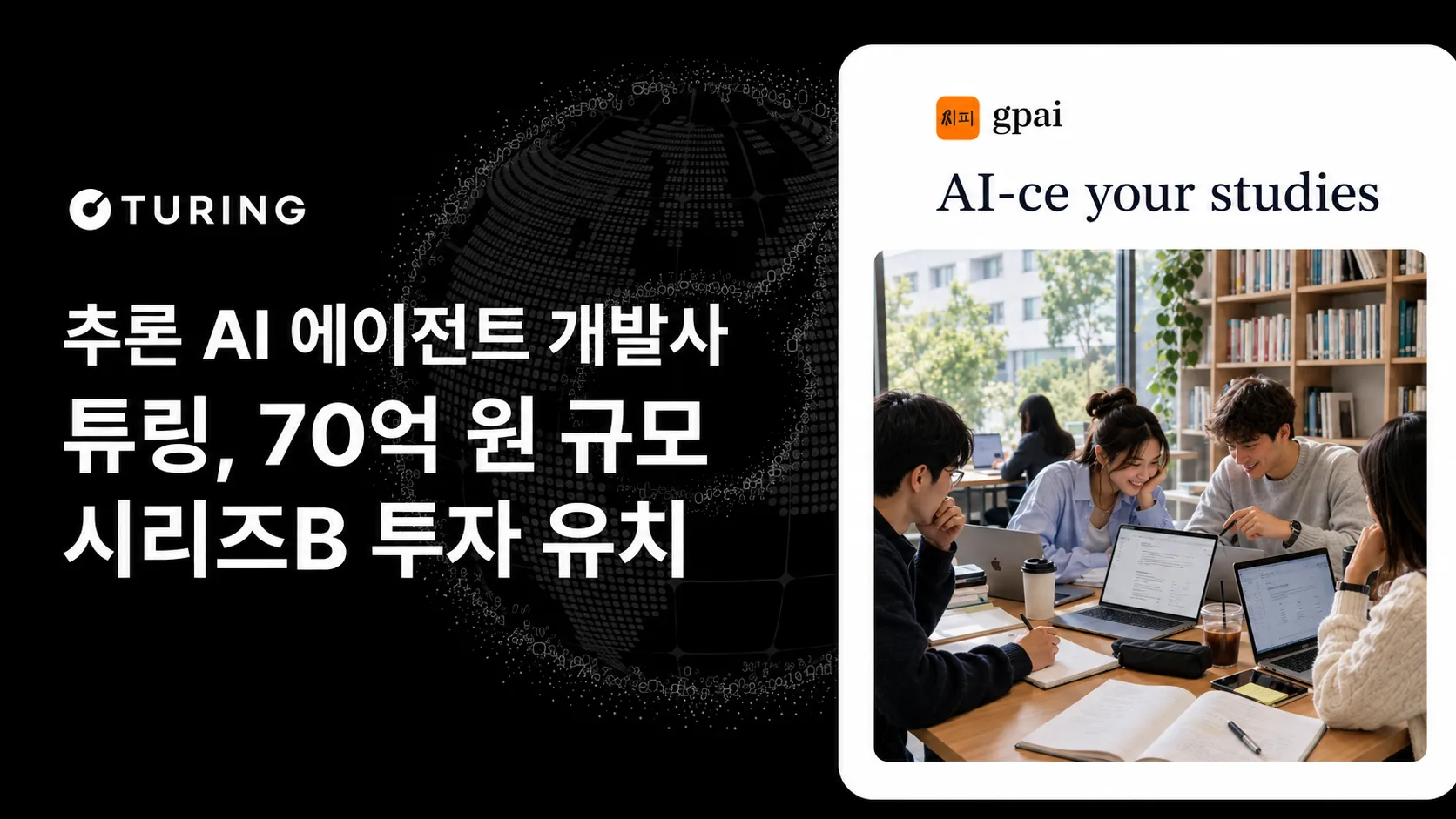
Turing, a South Korean AI start-up building an AI agent for university students, has raised ₩7 billion in Series B funding from investors including Korea Development Bank, Kingo Investment Partners and Company K Partners, with existing backer Kolon Investment also participating.
The company's core product, GPAI, is an AI agent built around university academic workflows — including studying, assignment completion, exam preparation and team-based projects — and has already surpassed 1.5 million sign-ups within a single year, according to the company, with growth concentrated in South Korea and the United States.
Having built its initial user base primarily among STEM students, Turing now intends to broaden GPAI's applicability across academic disciplines beyond science, technology, engineering and mathematics — a natural next step for a consumer AI product seeking to expand its addressable market beyond an early, technically inclined adopter base.
That existing traction gives Turing something increasingly valuable in a crowded consumer AI landscape: genuine distribution and habitual usage, rather than merely access to capable underlying models. As foundation models become more broadly accessible and commoditised, owning a specific, sticky user workflow has become an increasingly important differentiator for AI application companies competing for both users and investor capital.
Korea Development Bank's participation lends an institutional, quasi-governmental dimension to the round, reflecting South Korea's broader strategic interest in supporting domestic AI application companies capable of competing internationally, rather than ceding the category entirely to United States- and China-based platforms.
The funding also reflects growing global investor interest in education-focused AI agents more broadly, a category that has attracted significant capital worldwide as students increasingly turn to AI tools for studying and academic support — even as universities and educators continue to grapple with the implications for academic integrity and independent learning.
For Turing, expanding GPAI beyond its STEM roots represents both an opportunity and a test: broadening into humanities, social sciences and other non-technical disciplines will require the company to demonstrate that its AI agent can add genuine value across academic domains with far less standardised, rules-based problem structures than the STEM subjects on which the product initially built its user base.


