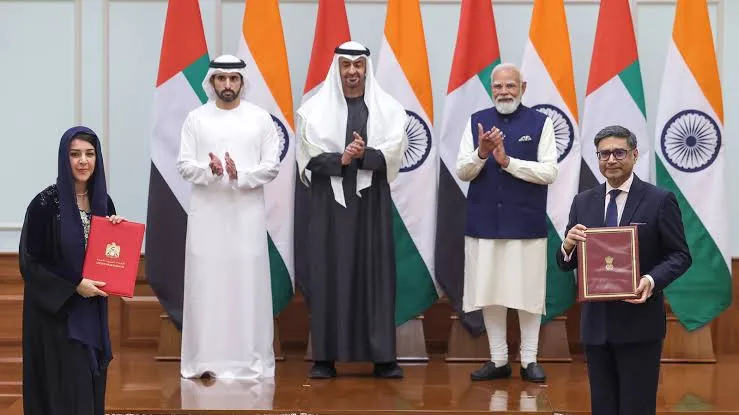
Bilateral trade between the United Arab Emirates and India reached US$101.25 billion in the 2025-26 financial year, marking the second consecutive year in which trade between the two countries has exceeded the $100 billion mark, according to figures reported on September 12. The two countries have set a target of raising bilateral trade to $200 billion by 2032, underscoring the scale of ambition behind what has become one of India's most consequential bilateral economic relationships in the Gulf region.
The UAE-India Comprehensive Economic Partnership Agreement, which entered into force in 2022, holds particular significance in this relationship as the first agreement of its kind concluded by the UAE with any trading partner. Since coming into effect, CEPA has contributed to increasing the flow of goods, services and investment between the two countries, while expanding opportunities for private-sector businesses on both sides of the partnership.
Beyond the headline trade figures, the partnership is increasingly moving from pure goods trade toward deeper structural integration. Officials pointed to a range of strategic initiatives now underway, including Bharat Mart — a large-scale trading and distribution hub concept — and the Virtual Trade Corridor, alongside cooperation under the India-Middle East-Europe Economic Corridor, a multi-country infrastructure and connectivity initiative intended to link South Asia, the Gulf and Europe through integrated shipping, rail and digital trade routes.
These initiatives are described as helping to strengthen supply-chain integration and create new routes for trade and investment flows between the UAE, India and global markets more broadly. For businesses on both sides, the shift from a trade relationship centred primarily on oil, gems and jewellery, and remittance-linked commerce toward one increasingly built around logistics infrastructure, digital trade corridors and diversified investment flows marks a meaningful evolution in how the two economies engage with one another.
For the UAE's large resident Indian community — among the biggest in the country by population — the deepening economic relationship carries direct relevance. Indian-origin businesses have historically played an outsized role in UAE trade, from the traditional gold, textile and general trading sectors concentrated in Dubai to a growing presence in technology, financial services and logistics. As bilateral trade infrastructure becomes more sophisticated, Indian entrepreneurs and professionals based in the UAE are increasingly positioned as intermediaries who understand both markets, a role that could grow in importance as corridor-based trade initiatives mature.
Financial and logistics analysts note that infrastructure-driven partnerships of this kind tend to have a longer gestation period than conventional trade agreements, since they require coordinated investment in ports, digital customs systems and cross-border regulatory alignment before the full benefits of integration are realised. The India-Middle East-Europe Economic Corridor, in particular, involves multiple national governments and remains at a comparatively early stage of implementation relative to the scale of its stated ambitions.
Still, the sustained growth in bilateral trade — crossing $100 billion for a second straight year even amid a challenging period for global trade more broadly, marked by elevated shipping costs and geopolitical uncertainty in the wider region — suggests the underlying economic relationship between the UAE and India has developed a degree of resilience. Whether the newer logistics and corridor-based initiatives can sustain that momentum toward the $200 billion target will depend on how quickly the infrastructure and regulatory groundwork now being laid translates into measurable increases in trade volume and investment flows over the coming years.


