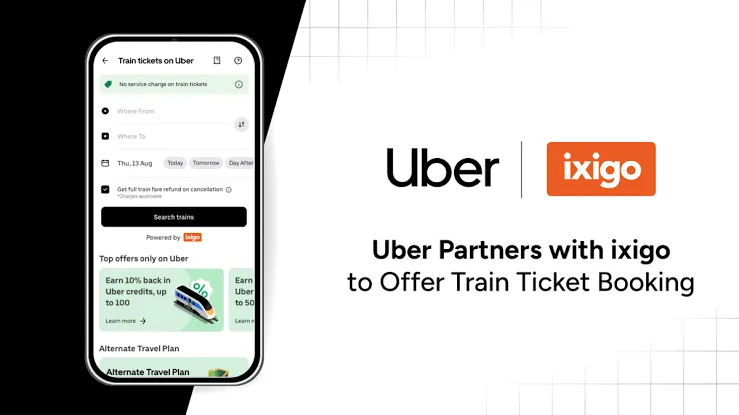
Uber has expanded its mobility footprint in India through a new partnership with travel-technology company ixigo, integrating train ticket booking directly into the Uber app. The tie-up allows Indian users to book train tickets, check PNR status and seamlessly connect their first- and last-mile journeys to broader intercity travel, without needing to switch between separate applications — a convenience that reflects intensifying competition among mobility platforms to become single-window travel super-apps for Indian consumers.
The tie-up is the latest example of India's ride-hailing platforms racing to close product gaps against increasingly well-integrated domestic competitors.
Under the partnership, ixigo provides the underlying booking technology and post-booking customer services, while Uber contributes its mobility network to connect travellers to and from railway stations. The integration extends Uber's existing India mobility portfolio, which already spans ride-hailing categories including moto, auto and car rides, along with metro connectivity and intercity car and bus services. Train travel remains the dominant mode of long-distance transport for hundreds of millions of Indians, making it a strategically significant addition to Uber's domestic offering.
The Uber-ixigo tie-up also reflects the growing importance Indian mobility platforms place on frequency of use as a retention metric, given that ride-hailing alone often generates relatively sporadic engagement compared to the potential frequency achievable by capturing a broader share of users' total travel activity, including recurring intercity train journeys. By embedding train booking within its existing app, Uber gains additional touchpoints with its user base between individual ride-hailing trips, a dynamic that platform strategists increasingly view as critical to sustaining engagement in mature, competitive mobility markets.
For ixigo, the partnership provides expanded distribution through one of India's most widely used mobility applications, potentially exposing its train-booking infrastructure to a large base of Uber users who may not have previously used ixigo directly. The listed travel-technology company has increasingly positioned itself as an infrastructure and technology partner to other consumer platforms, rather than competing purely as a standalone consumer app — a strategy that mirrors moves by several Indian fintech and travel companies to monetise technology infrastructure through B2B partnerships alongside direct consumer offerings.
The partnership also reflects growing commercial sophistication among Indian travel-technology companies more broadly, several of which have shifted strategic focus toward becoming embedded infrastructure providers for larger consumer platforms, rather than competing head-on as standalone destination apps. This B2B-oriented strategy allows companies like ixigo to monetise their booking technology and customer-service infrastructure across multiple distribution channels simultaneously, diversifying revenue beyond direct consumer acquisition, which has become an increasingly expensive and competitive undertaking across India's crowded travel-booking app landscape.
Industry data on multimodal travel apps in other markets suggests that successful integrations of this kind typically take twelve to eighteen months to meaningfully shift user booking behaviour, a timeline that will test both companies' patience as they invest in deeper technical and marketing integration well beyond the initial feature launch.
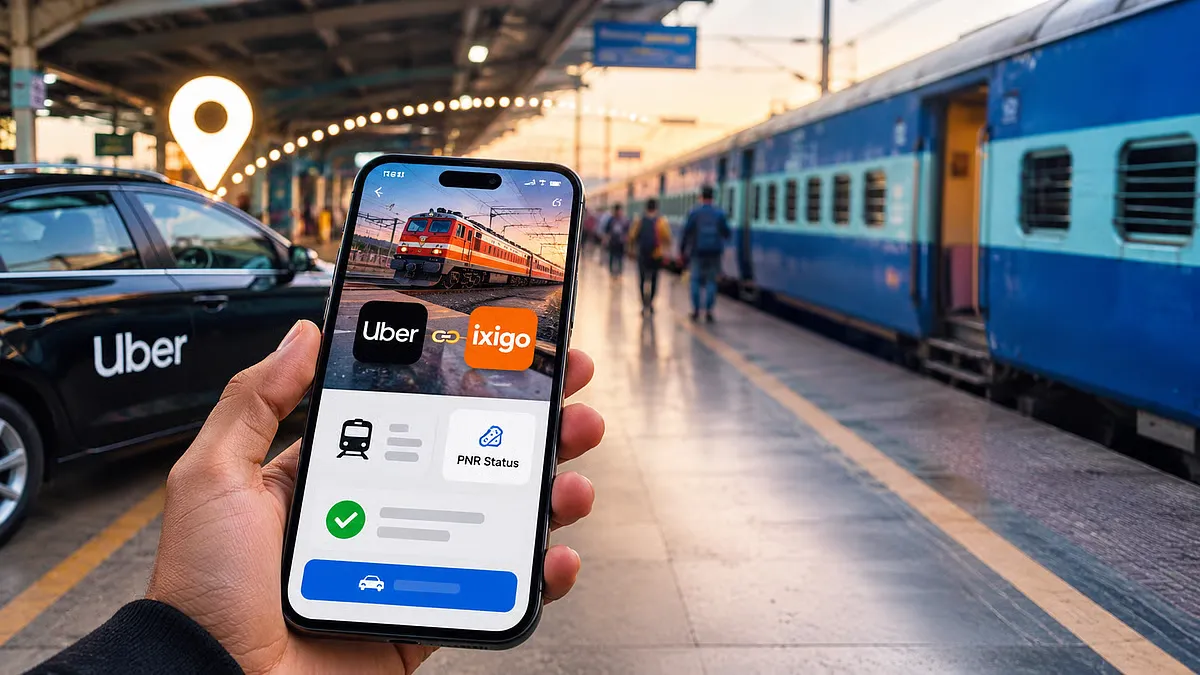
Analysts tracking India's mobility sector note that the integration reflects a broader shift toward multimodal super-apps, as ride-hailing platforms globally seek to capture a larger share of the end-to-end travel journey rather than competing solely on point-to-point urban rides. In India specifically, where railways remain the backbone of intercity movement, mobility platforms that can seamlessly bridge first-mile, intercity and last-mile travel are positioned to capture significantly greater share of wallet from frequent travellers, particularly in a market where convenience and reliability continue to drive platform loyalty more than price alone.
Beyond the immediate convenience for consumers, the Uber-ixigo integration highlights a broader competitive dynamic playing out across India's travel and mobility sector, where platforms increasingly compete not just on price or coverage but on how comprehensively they can bundle the end-to-end travel experience. Rival platforms, including domestic ride-hailing and travel-booking companies, have pursued similar bundling strategies in recent years, reflecting a shared belief that reducing the number of separate applications a traveller must use meaningfully increases platform stickiness and repeat usage. For ixigo, embedding its booking technology within Uber's significantly larger user base offers a distribution advantage that would be costly to replicate through direct marketing alone, while for Uber, the addition of train bookings closes a notable gap in its India product relative to domestic competitors that have already moved toward multimodal travel integration.
From a market-structure perspective, the Uber-ixigo integration also reflects growing convergence between India's travel-booking and mobility sectors more broadly, following several years in which the two categories operated largely as distinct, separately monetised markets. As bundled, multimodal travel experiences become more common across major platforms, smaller standalone travel-booking apps may find it increasingly difficult to compete purely on individual booking features, pushing further consolidation or partnership activity across the sector. For ixigo shareholders and Uber's India leadership alike, the partnership's performance over its first several months will offer an early signal of whether bundled multimodal travel genuinely drives incremental platform engagement, or whether users continue to treat train and ride-hailing bookings as largely separate decisions regardless of application-level integration.
The Uber-ixigo partnership adds to a string of recent consolidation and integration moves across India's travel and mobility ecosystem, as platforms race to reduce friction across the full travel journey. For consumers, the tie-up promises a more seamless booking experience; for both companies, it represents a strategic bet that deeper platform integration — rather than expansion into new standalone products — will be the more efficient path to growth in an increasingly saturated Indian mobility market.
As both companies work to integrate their systems more deeply, the partnership's ultimate success will likely be measured by whether it meaningfully shifts user behaviour toward using Uber for a larger share of their total travel journey, rather than simply adding a convenience feature used occasionally. For India's broader mobility sector, the tie-up adds further evidence that the next phase of competitive differentiation will be defined less by individual product categories and more by how comprehensively platforms can bundle the full spectrum of a traveller's journey within a single application.
Both companies say they will monitor adoption data closely over the coming quarters before deciding whether to extend the integration into deeper fare-bundling or loyalty-programme features across their combined user base.


