TechFuture Tech5 MIN READ

Uber and China's Pony.ai to Test Robotaxis in London as Global Driverless Race Heats Up

Pony.ai's seventh-generation robotaxis will begin testing on London roads in the coming weeks, as Uber pursues autonomous rides in up to 15 cities by the end of 2026 through more than 30 partners.

By Shaym Kumar · Author9 October 2026New
Uber and China's Pony.ai to Test Robotaxis in London as Global Driverless Race Heats Up

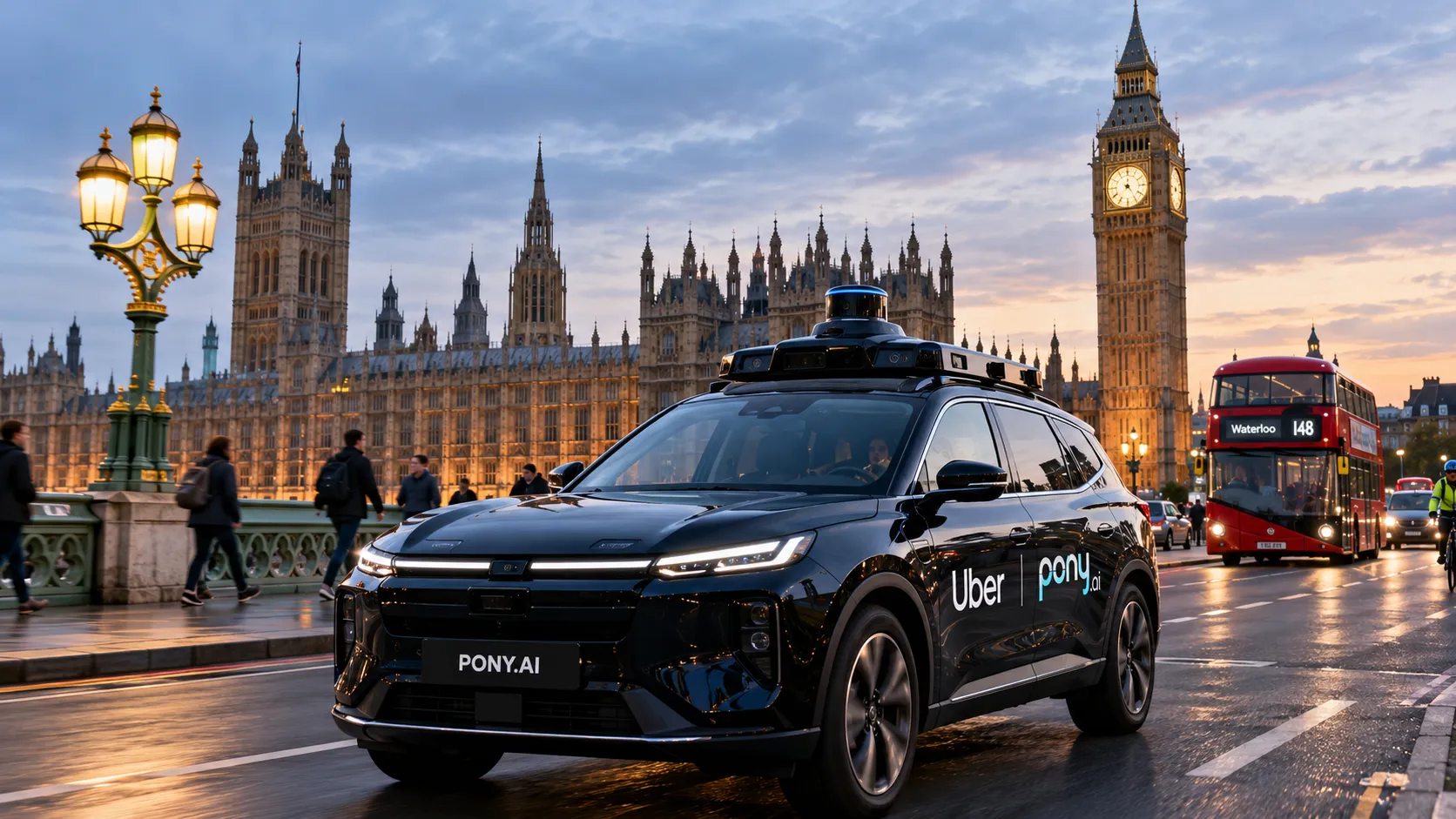
LONDON, Oct 8 — Uber and Chinese autonomous driving company Pony.ai plan to begin testing robotaxis on the streets of London in the coming weeks, extending their partnership into one of the world's most complex urban driving environments.

The trials will use Pony.ai's seventh-generation robotaxi system. They mark another step in Uber's strategy of building a global network of autonomous vehicle partners rather than developing self-driving technology in-house.

Uber now works with more than 30 autonomous vehicle partners and expects to offer autonomous trips in up to 15 cities by the end of 2026. London, with its narrow streets, dense traffic, cyclists and complex junctions, would be among the most demanding of them.

Key facts at a glance

• Partners: Uber and Pony.ai

• Plan: test Pony.ai's seventh-generation robotaxis in London in the coming weeks

• Uber's network: more than 30 autonomous vehicle partners; autonomous trips in up to 15 cities targeted by end-2026

• Partnership history: Middle East deployment agreed in May 2025; Zagreb launch with Verne in August 2026 using the Arcfox Alpha T5

• Pony.ai footprint: four Chinese cities and Qatar

• London rivals: Wayve (raised $1.2 billion in February 2026, plus $300 million contingent from Uber) and Waymo (testing)

A partnership that has spread quickly

Uber and Pony.ai first teamed up in May 2025 to deploy robotaxis in the Middle East. The partnership has since expanded to Europe, where the companies have set out plans for a substantial robotaxi fleet. In August 2026, Uber launched autonomous rides in Zagreb, Croatia, working with Croatian robotaxi company Verne and using the Arcfox Alpha T5 vehicle.

The London tests build on that progress. Pony.ai already operates robotaxi services in four major Chinese cities and in Qatar, giving it substantial operational experience. Its Gen-7 system is designed to lower the cost of autonomous hardware, a key factor in making robotaxi services commercially viable at scale.

Uber's platform strategy

Uber abandoned its own self-driving programme in 2020, selling the unit to Aurora. Since then, it has pursued a different approach: partnering with a wide range of autonomous vehicle developers and offering their vehicles on its ride-hailing and delivery network.

The logic is straightforward. Uber has the customers, the demand data, the payment systems and the operational know-how to run a mobility marketplace. Autonomous developers have the technology but often lack the consumer reach. By combining the two, Uber aims to become the default platform through which riders access driverless vehicles, regardless of who makes them.

The approach also reduces Uber's exposure to the risks of any single technology. If one developer stumbles, others can fill the gap. With more than 30 partners across different regions, Uber is effectively hedging its bets across the autonomous industry.
a9224270-ebc7-47bf-a47f-7c0095028d67.png

London's growing robotaxi scene

London is becoming a key battleground for autonomous driving in Europe. British company Wayve, which develops AI-based driving software, raised $1.2 billion in February 2026, with a further $300 million in contingent funding from Uber, and has been working with Uber on plans for robotaxi services in the city. Waymo is also testing in London as it prepares for international expansion.


“Uber is building the marketplace for autonomy, not the cars. London will test whether that strategy can work in one of the world's most demanding cities.”
— The Impactful Global Indian

The UK has positioned itself as an early mover on regulation. The Automated Vehicles Act, passed in 2024, set out a legal framework for self-driving vehicles, including how responsibility is assigned when a vehicle is operating autonomously. The government has encouraged pilot services as part of its strategy to attract investment in advanced transport technology.

For London's transport system, robotaxis raise important questions. Supporters argue they could improve safety, reduce congestion and provide convenient transport at lower cost. Critics worry about the impact on licensed taxi and private-hire drivers, about safety in complex urban settings and about how autonomous vehicles fit with the city's goals to reduce car use.

The China question

Pony.ai's involvement adds a geopolitical dimension. Chinese autonomous driving companies have made rapid progress at home, where they have tested and operated large fleets, and they are increasingly looking abroad for growth. Partnerships with Western platforms such as Uber give them access to new markets.

At the same time, governments in the United States and Europe have become more cautious about Chinese technology in connected vehicles, citing concerns about data security. How UK regulators approach data handling and oversight for Pony.ai's London operations will be watched closely by policymakers elsewhere.

For Pony.ai, a Nasdaq-listed company, international partnerships also matter for investors, who have been looking for evidence that Chinese autonomous driving technology can win business outside its home market despite rising regulatory scrutiny of connected vehicles.

What makes London hard

Most robotaxi services to date have launched in cities with wide roads, grid layouts and predictable weather, such as Phoenix and parts of the American Sun Belt. London is very different. Its road network is centuries old, with narrow streets, irregular junctions, frequent roadworks and large numbers of pedestrians, cyclists, buses and delivery vehicles sharing limited space. Drivers drive on the left, and weather conditions — rain, low winter sun and occasional fog — test sensors and software.

Success in such an environment would be a powerful demonstration of a system's maturity. That is part of why London has become a proving ground for companies hoping to show that autonomous driving can work in older, denser cities around the world, including fast-growing urban centres in Asia.

What to watch

The London tests are an early step. Moving from testing to commercial service will require regulatory approval, demonstrated safety performance and public acceptance. Weather, road layouts and traffic patterns in London differ markedly from those in Chinese and Middle Eastern cities where Pony.ai has operated.

For Uber, success in London would strengthen its claim to be the leading global platform for autonomous mobility. For Pony.ai, it would be a significant validation of its technology in a demanding Western market.

For business leaders and investors, the broader trend is clear. Autonomous driving is moving from a handful of US cities to a genuinely global industry, with partnerships spanning the United States, China, the Middle East and Europe. The next few years will determine which companies — and which business models — emerge as the winners.

TagsUberPony.aiRobotaxiAutonomous VehiclesLondonUnited KingdomSelf-Driving CarsWayveWaymoChina TechMobilityRide-HailingZagrebVerneDriverless CarsFuture TechTransport PolicyAIEuropeSmart Cities

Reader reviews

Sign in to rate and review this article.
Loading reviews…