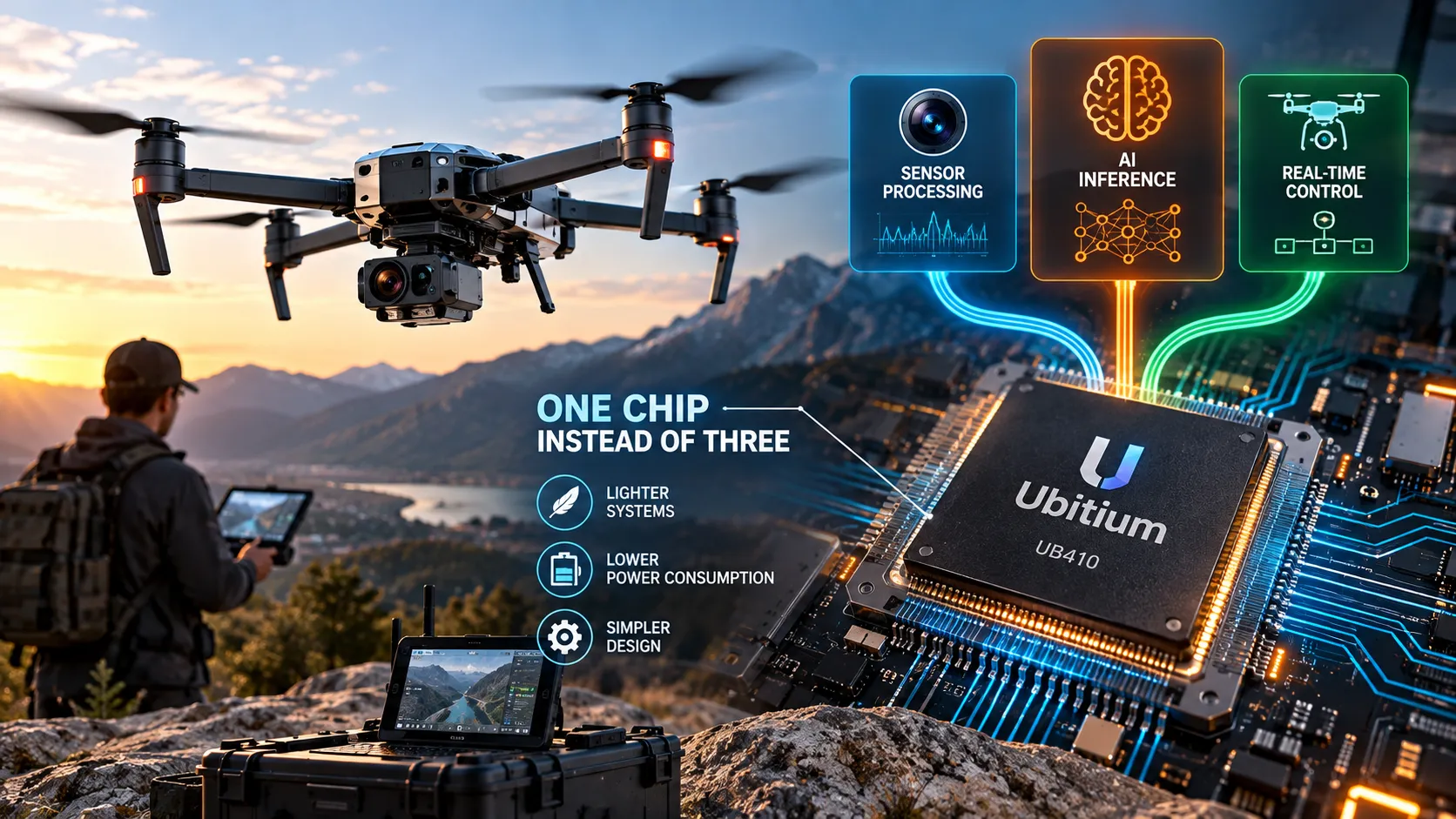
A modern drone is, in computing terms, a crowded machine. One chip processes signals from its sensors, another runs the artificial intelligence that interprets what it sees, and a third handles the real-time control that keeps it in the air. Each adds weight, consumes power and complicates engineering. Ubitium, a young German semiconductor company, believes all three jobs can be done by a single processor, and it has raised fresh capital to prove it at commercial scale.
The Düsseldorf-based startup has raised $14 million in new seed funding, announced on October 13. Ibex Investors led the round, with participation from OpenOcean and existing investors KBC Focus Fund, Runa Capital and Inflection. Florian Seibel, co-founder and co-chief executive of German defence technology company Quantum Systems, invested personally. The round brings Ubitium's total seed funding to $18 million since it was founded in 2024.
The money will advance the company's next processor, the UB410, towards commercialisation.
One chip instead of three
Ubitium is building what it calls a universal processor for physical AI, the industry term for artificial intelligence that operates in the physical world, in robots, drones, vehicles and industrial equipment. Unlike chatbots or cloud AI models, these systems have to sense their surroundings, interpret them and act, often within milliseconds and without relying on a network connection.
Today, that work is typically split across several types of chip: digital signal processors for sensor data, neural processing units for AI inference, and central processors or microcontrollers for control. Ubitium's architecture replaces them with a single, reconfigurable array of programmable processing elements that can be allocated dynamically depending on the workload. A unified memory design reduces costly data transfers between chips, and native support for RISC-V software tools is meant to make it easier for manufacturers to program.
"Physical AI machines bring a whole new set of computing challenges, and the inference isn't the hardest one," said Hyun Shin Cho, Ubitium's co-founder and chief executive. "Sensing the real world and controlling the machine in it are just as hard."
Proof in silicon
What distinguishes Ubitium from many hardware startups is that it already has a working chip. Its first device, the UB108, was manufactured on Samsung's 8-nanometre process and contains 256 processing elements. According to the company, it has demonstrated signal processing, AI inference and real-time control running on the same array.
"We built one Physical AI processor that does all three, proved it in silicon in a year," Cho said.
The next commercial chip, the UB410, will scale the design up to 4,096 processing elements. Tape-out and delivery of evaluation units to customers are planned for 2027. Initial applications will focus on high-resolution radar and audio systems, which demand complex signal processing alongside onboard AI. Autonomous systems, including drones, are the longer-term target for the full architecture.
The technology rests on long foundations. Co-founder and chief technology officer Martin Vorbach is a pioneer of reconfigurable computing with roughly three decades in the field, while chief architect Peter Weber adapted those concepts for production silicon. The team cites 17 issued core patents, more than 250 combined patents, more than 350 peer-reviewed papers and over 15 years of continuous development work, with alumni from Intel, Nvidia, Apple and Texas Instruments.


