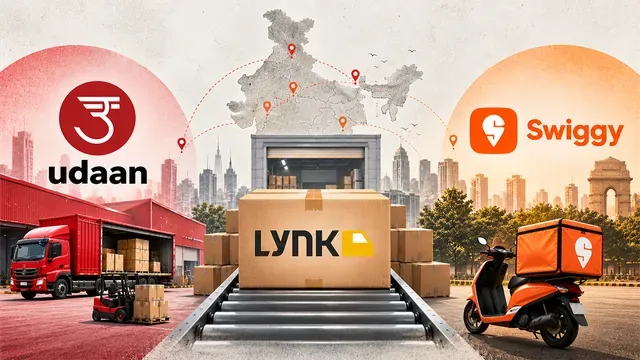
Udaan, the Bengaluru-headquartered business-to-business commerce platform that connects manufacturers, wholesalers and kirana retailers across India, has acquired LYNK, the last-mile logistics business previously owned by food-delivery major Swiggy, in a share-swap transaction valued at approximately Rs 500 crore. The deal, announced on September 8, 2026, marks one of the more notable consolidation moves in India's fragmented B2B logistics landscape this year and gives Udaan direct control over a delivery network built to serve dense urban markets.
LYNK was originally developed within Swiggy's stable of adjacent businesses as a hyperlocal and intra-city logistics offering, aimed at helping merchants move goods quickly across metro clusters. Over the past two years, as Swiggy sharpened its focus on its core food-delivery and quick-commerce operations ahead of continued public-market scrutiny, several of its non-core bets were quietly reassessed. LYNK's absorption into Udaan represents a natural handoff: a logistics capability built for speed and density moving to a platform whose core customer base — small and mid-sized retailers — depends precisely on that kind of reliable, fast fulfilment.
For Udaan, the acquisition addresses a persistent bottleneck in India's B2B commerce chain: the last mile. While the company has spent years building out warehousing, credit and catalogue infrastructure for wholesale trade, delivery to the doorstep of a neighbourhood store has often relied on third-party logistics partners with inconsistent service levels. Bringing LYNK's fleet, technology stack and city-level operating knowledge in-house is expected to shorten delivery windows, tighten cost control and give Udaan a proprietary logistics layer that competitors relying purely on outsourced networks will find harder to replicate quickly.
The transaction structure — an all-stock exchange rather than a cash payout — is itself instructive. It suggests both companies see more value in continued alignment through equity than in a clean financial exit, and it reflects the broader capital discipline that has characterised Indian startup M&A through 2026, where all-stock and stock-plus-earnout deals have become more common as founders and investors try to conserve cash while still consolidating market position. For Swiggy, offloading a logistics unit in exchange for equity in a well-capitalised B2B platform allows it to maintain indirect exposure to a large addressable market without carrying the operational weight of running the business itself.
The move also fits a broader pattern reshaping India's e-commerce and B2B ecosystem in 2026: platforms increasingly prefer to acquire narrow, working logistics capability rather than build it from scratch, given how capital-intensive and operationally complex last-mile delivery has proven to be even for well-funded players. Udaan, which has weathered a difficult funding environment in prior years and refocused on unit economics and profitability, is signalling with this deal that it intends to compete more aggressively on delivery speed and reliability — long considered a differentiator that larger e-commerce marketplaces have used against traditional wholesale trade.
Industry analysts tracking India's business-to-business commerce sector say the LYNK acquisition could prompt similar consolidation elsewhere, as logistics-heavy startups that have struggled to reach standalone profitability look for strategic buyers with complementary retail or wholesale networks. For India's estimated 13 million kirana stores, faster and more predictable B2B deliveries could translate into lower working-capital strain and fresher inventory cycles — a small but meaningful shift in the economics of neighbourhood retail. Udaan has not disclosed integration timelines for LYNK's operations, but the company is expected to retain much of the acquired workforce as it folds the delivery network into its existing logistics stack over the coming quarters.