Udaan, the Bengaluru-based business-to-business e-commerce platform that once ranked among India's most valuable startups, returned to revenue growth in the year to March 2026 while narrowing its losses for a fourth consecutive year, as it works towards a long-awaited stock market listing.
Gross revenue rose 12.6 per cent to ₹5,134 crore in fiscal 2026 from ₹4,561 crore a year earlier, according to consolidated financial statements filed by its Singapore-based group company, Trustroot Internet, and reported by Entrackr. The growth follows a roughly 20 per cent decline in fiscal 2025.
The net loss narrowed 19.2 per cent to ₹852 crore from ₹1,055 crore. It is the fourth straight year of narrower losses for the company, which lost ₹2,075 crore in fiscal 2023 and ₹1,674.1 crore in fiscal 2024.
From Hypergrowth to Focus
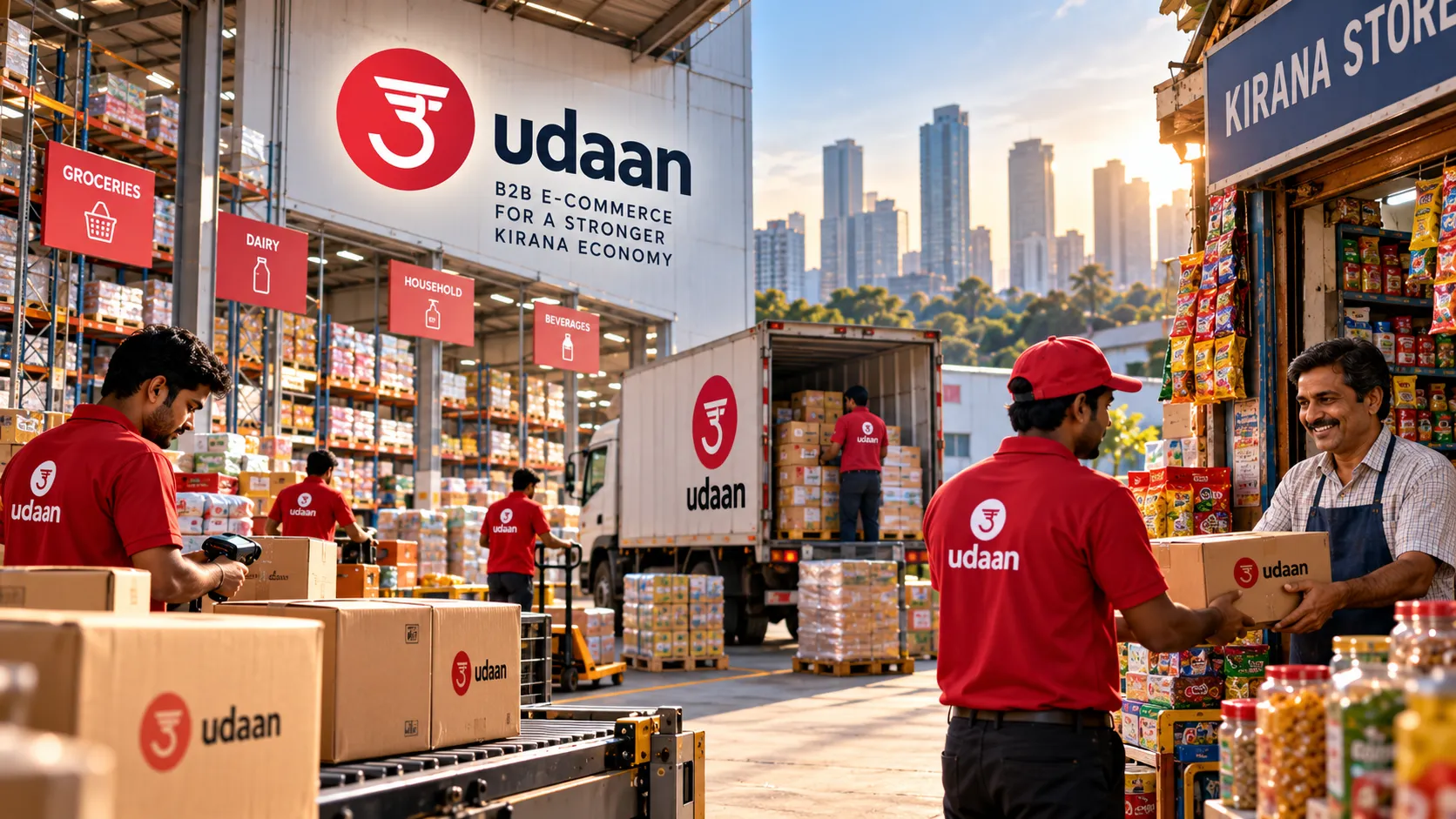
Udaan was founded in 2016 by former Flipkart executives Vaibhav Gupta, Sujeet Kumar and Amod Malviya. Its platform connects brands, manufacturers and wholesalers with the millions of small retailers, kirana stores and restaurants that dominate Indian commerce.
During the funding boom of 2020 and 2021, Udaan expanded aggressively across categories and became one of India's most highly valued startups. Its gross merchandise value reached roughly ₹10,000 crore in fiscal 2022. But as funding tightened, the company refocused on its core business of groceries and essential goods, exiting lower-margin and slower-moving categories such as lifestyle and general merchandise.
That retreat explains the steep decline in revenue in recent years. The fiscal 2026 numbers suggest the company has now stabilised its core business and is growing again from a smaller, more focused base.
A Leaner Cost Structure
The most visible sign of discipline is in staff costs. Employee benefit expenses fell to ₹347.5 crore from ₹500 crore, while share-based compensation was halved to ₹140 crore from ₹280 crore.
Material costs, the largest expense, rose 11.3 per cent to ₹4,859 crore, broadly in line with revenue growth. Logistics expenses increased 16.7 per cent to ₹182 crore. Finance costs climbed 33.5 per cent to ₹247 crore, reflecting the company's greater reliance on debt financing in recent years.
Udaan earns revenue from the sale of goods, logistics services, platform fees, credit services and advertising. Its lending business, which offers working capital to small retailers, is strategically important because credit is one of the main reasons small shopkeepers choose a particular supplier.
Dealmaking to Build Scale
Udaan has also turned to acquisitions to strengthen its distribution network. In September 2026, it agreed to buy Lynk Logistics, Swiggy's retail distribution business, for ₹500 crore. As part of the deal, Swiggy will receive about a 2.8 per cent stake through preference shares and will invest another ₹75 crore for a further 0.4 per cent.
Earlier, in March 2026, Udaan's parent Trustroot acquired Info Edge's 26.14 per cent stake in ShopKirana, an Indore-based B2B platform, for $32.97 million. Info Edge received preference shares in Trustroot as part of the transaction.
The company has also announced structured financing of about $160 million to strengthen its balance sheet and simplify its capital structure.
The IPO Question
Udaan is preparing for a public listing and is reportedly aiming to reach profitability by late 2027 or the first quarter of 2028, ahead of a planned IPO.
That timeline faces uncertainties. Entrackr noted that a shift towards rising interest rates could complicate the company's plans, particularly given its rising finance costs. The Reserve Bank of India raised its policy rate earlier this month for the first time since 2023, and higher borrowing costs weigh on companies that depend on debt to fund inventory and lending.
The broader IPO market is also crowded. A series of large listings, including Jio Platforms, is drawing investor attention, and the appetite for loss-making companies will depend on how recent listings perform.
The B2B Opportunity
Despite the challenges, the market Udaan serves remains vast. India has an estimated 1.2 crore or more kirana stores, most of which buy from fragmented networks of distributors and wholesalers. Digitising that supply chain promises lower costs, better selection and access to credit for small retailers, as well as data and distribution reach for brands.
Udaan competes with Reliance's B2B arm, Jumbotail, and a range of regional players, as well as with brands building direct distribution to retailers. Quick commerce companies are also influencing urban consumer purchasing patterns, which in turn affects kirana stores and their suppliers.
The Kirana Economy
Udaan's fortunes are tied closely to the health of India's small retailers. Kirana stores remain the dominant channel for grocery and household purchases in most of the country, particularly outside the largest cities, even as modern retail and e-commerce have grown. These shops typically operate on thin margins, buy frequently in small quantities and depend on credit from distributors to manage cash flow.
That makes reliable supply, competitive pricing and access to working capital the main battlegrounds for B2B platforms. Udaan's integration of logistics, wholesale supply and lending is designed to address all three. The challenge has always been doing so profitably at scale, because the average order value from a single small shop is modest and delivery across dense urban neighbourhoods and dispersed rural areas is costly. The company's narrower focus on groceries and essentials, where purchase frequency is high and demand is steady, reflects a bet that density and repeat orders can eventually make the economics work.
Competition in the segment has also intensified as fast-moving consumer goods companies strengthen their own distribution and digital ordering tools for retailers. Large brands increasingly offer apps that allow shopkeepers to order directly, bypassing intermediaries. For Udaan, the response has been to emphasise breadth of assortment across many brands, reliable delivery and bundled credit, services that individual manufacturers find harder to replicate on their own. Whether that proposition is strong enough to keep retailers loyal as alternatives multiply will be one of the key questions investors ask when the company eventually seeks a listing.
What Comes Next
Udaan's fiscal 2026 results show a company that has moved decisively from growth at any cost to growth with discipline. Losses are still substantial, but they have fallen by more than half from their fiscal 2023 peak, and revenue is rising again.
The next phase will test whether Udaan can integrate its acquisitions, keep costs under control and grow faster than the market while managing higher financing costs. If it can, it may yet deliver on the promise that made it one of India's most celebrated startups, this time with a business built to withstand public market scrutiny.