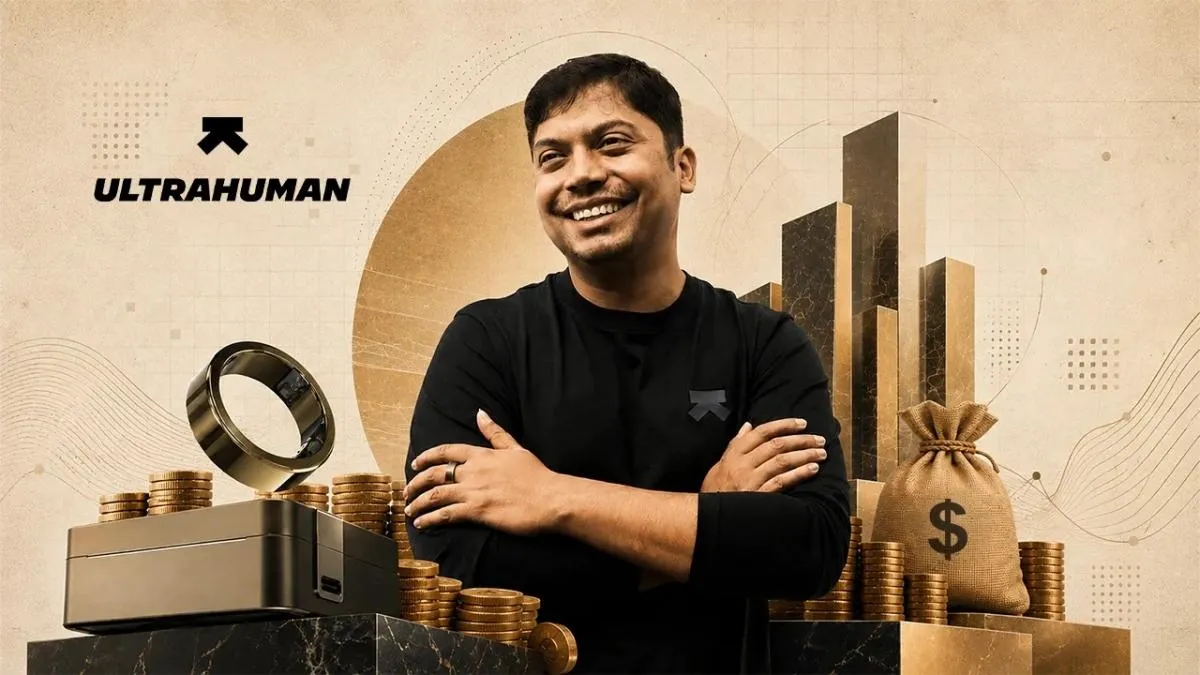
Ultrahuman, the Bengaluru-based wearable health technology company best known for its smart ring, has raised $70 million in a fresh funding round led by Qualcomm Ventures, with participation from Labcorp, Alpha Wave, Blume Ventures, Nexus Venture Partners and Alteria Capital. The round, structured as $65 million in primary equity alongside $5 million in venture debt, values the company at approximately $365 million, nearly three times the valuation it commanded in 2023.
The fresh capital arrives at a moment when consumer appetite for continuous, data-driven health monitoring is accelerating well beyond fitness tracking and into clinical-adjacent territory. Ultrahuman has positioned itself at that intersection, building a product line that blends consumer hardware with increasingly sophisticated biological sensing, and investors appear to be betting that the category still has considerable room to mature.
The size of the round also stands out against the backdrop of a broader Indian venture funding environment that has grown considerably more selective over the past two years, with investors increasingly concentrating capital into fewer, larger rounds for companies that have already demonstrated durable product-market fit rather than spreading smaller cheques across a wider field of early-stage bets. Ultrahuman's ability to secure a round of this size, anchored by a strategic investor of Qualcomm Ventures' standing, suggests the company has cleared that higher bar convincingly.
According to the company, the new funds will be directed toward four areas: advanced sensing hardware, artificial intelligence-driven health algorithms, miniaturised electronics, and expanded clinical research to validate the accuracy of its measurements against medical-grade benchmarks. That last point matters increasingly to regulators and healthcare partners alike, as wearable makers face growing scrutiny over whether consumer-grade sensors can be trusted for anything beyond casual wellness tracking.
The involvement of Labcorp, a major diagnostics and clinical-testing company, is notable in this context. Pairing a consumer hardware business with a clinical laboratory partner signals an ambition to bridge the gap between everyday biometric tracking and formal diagnostic pathways, a combination that has attracted growing investor interest across the global digital health sector as insurers and employers look for scalable, preventive-care tools.
India's preventive healthcare and wellness technology market has expanded rapidly over the past several years, driven by rising disposable incomes, growing health awareness following the pandemic, and a broader cultural shift toward proactive rather than purely reactive healthcare. Wearable devices sit at the centre of that shift, since continuous data collection allows both individuals and, increasingly, healthcare providers to identify early warning signs well before conditions become acute enough to require clinical intervention, a value proposition that has proven especially compelling to India's growing urban middle class.

Founded in 2019 by Mohit Kumar and Vatsal Singhal, Ultrahuman has built its reputation around the Ultrahuman Ring, a finger-worn device that tracks sleep, recovery and activity, and has since layered in additional capabilities including continuous glucose monitoring and environmental sensing. The company has increasingly framed its ambitions beyond simple fitness tracking, describing its long-term goal as building what it calls a human-computer interface anchored around the body's own biological signals.
Including the latest round, Ultrahuman has now raised more than $173 million since inception, a trajectory that places it among the more heavily capitalised consumer health hardware companies to emerge from India. The company competes in a global category that includes established international players in smart-ring and wearable health technology, a market where differentiation increasingly hinges on sensor accuracy, software intelligence and the depth of biomarker coverage rather than device design alone.
Globally, the smart ring category in particular has become one of the more closely watched segments within consumer wearables, prized for its combination of unobtrusive form factor and increasingly sophisticated sensor capability. Ultrahuman's decision to expand from a single flagship device into a broader platform spanning glucose monitoring and environmental sensing reflects a common strategic pattern among wearable hardware companies: using an initial hardware success to build a wider ecosystem of complementary data streams that deepen customer engagement and create higher switching costs over time.
For global Indian diaspora investors tracking the country's technology sector from abroad, Ultrahuman represents a particularly legible investment story: a hardware-and-software company competing directly against internationally recognised wearable brands while remaining headquartered and substantially engineered within India, a positioning that has increasingly appealed to overseas capital looking for exposure to India's technology growth beyond the more familiar software services and e-commerce categories.
For India's broader healthtech ecosystem, the round is a reminder that global capital continues to flow toward companies that can demonstrate both consumer traction and a credible path toward clinical validation. Wearable health devices sit at a particularly interesting juncture in India, where preventive healthcare spending is rising alongside smartphone-linked digital literacy, giving domestically built hardware brands a chance to compete directly with international incumbents.
Whether Ultrahuman can convert its expanded capital base into the kind of clinical partnerships that unlock insurance reimbursement or physician-level trust remains the central question for the company's next phase. What is clear is that investors are treating the wearable health category not as a fitness niche but as an emerging layer of the broader healthcare stack, one where sensing hardware, software intelligence and clinical credibility increasingly need to be built together rather than bolted on later.
Industry analysts tracking India's digital health sector have repeatedly noted that the companies most likely to succeed over the next decade will be those that can credibly bridge consumer wearables with formal clinical pathways, rather than remaining confined to the wellness and lifestyle category alone. Ultrahuman's partnership with a diagnostics major in Labcorp, paired with its stated ambition to build what it calls a human-computer interface, positions the company to make exactly that argument to future investors, insurers and healthcare partners as it moves into its next phase of growth.
Business leaders and policymakers watching India's digital health sector will likely view this round as further evidence that the country's wearable technology companies are capable of attracting serious global institutional capital on the strength of genuine product differentiation rather than domestic market size alone, a distinction that matters considerably as India seeks to position its technology sector as a genuine innovation exporter rather than purely a large addressable consumer market for foreign products.