Ultrahuman, the Bengaluru-based startup best known for its health-tracking smart rings, has raised $70 million in a new funding round backed by Qualcomm's venture arm, valuing the company at $365 million — roughly three times its $120 million valuation in 2023 — as it looks to expand well beyond sleep and health tracking into a broader on-device computing platform.
The round, which closed on September 3, 2026, comprises $65 million in primary equity and $5 million in debt, according to founder and CEO Mohit Kumar, who disclosed the financing in an interview with TechCrunch. Qualcomm Ventures was joined by U.S. diagnostics giant Labcorp, Alpha Wave, Blume Ventures, Nexus Venture Partners and Alteria Capital.
Rather than simply raising capital, Ultrahuman is using the round to underpin a significant strategic shift: moving its rings from passive health trackers, dependent on smartphone and cloud processing, toward devices capable of running software and algorithms directly on the ring itself — an ambition the company is positioning as building a "human-computer interface" rather than a conventional wearable.
"Today, all rings are essentially trackers: users put on the device, and it measures their heart rate, movement, and sleep," the company said of its current generation of hardware. "We want to turn the ring into a computer, with apps and algorithms running directly on the device." To that end, Ultrahuman is developing a new ring model built around Qualcomm silicon, replacing its current reliance on Nordic Semiconductor chips and cloud-based processing. Ahead of that hardware launch, the company plans to roll out a software update to its existing Ring Air and Ring Pro devices by the end of September 2026, unlocking game-controller input, AI application interactions and a third-party developer platform — an early signal of its ambient-computing ambitions.
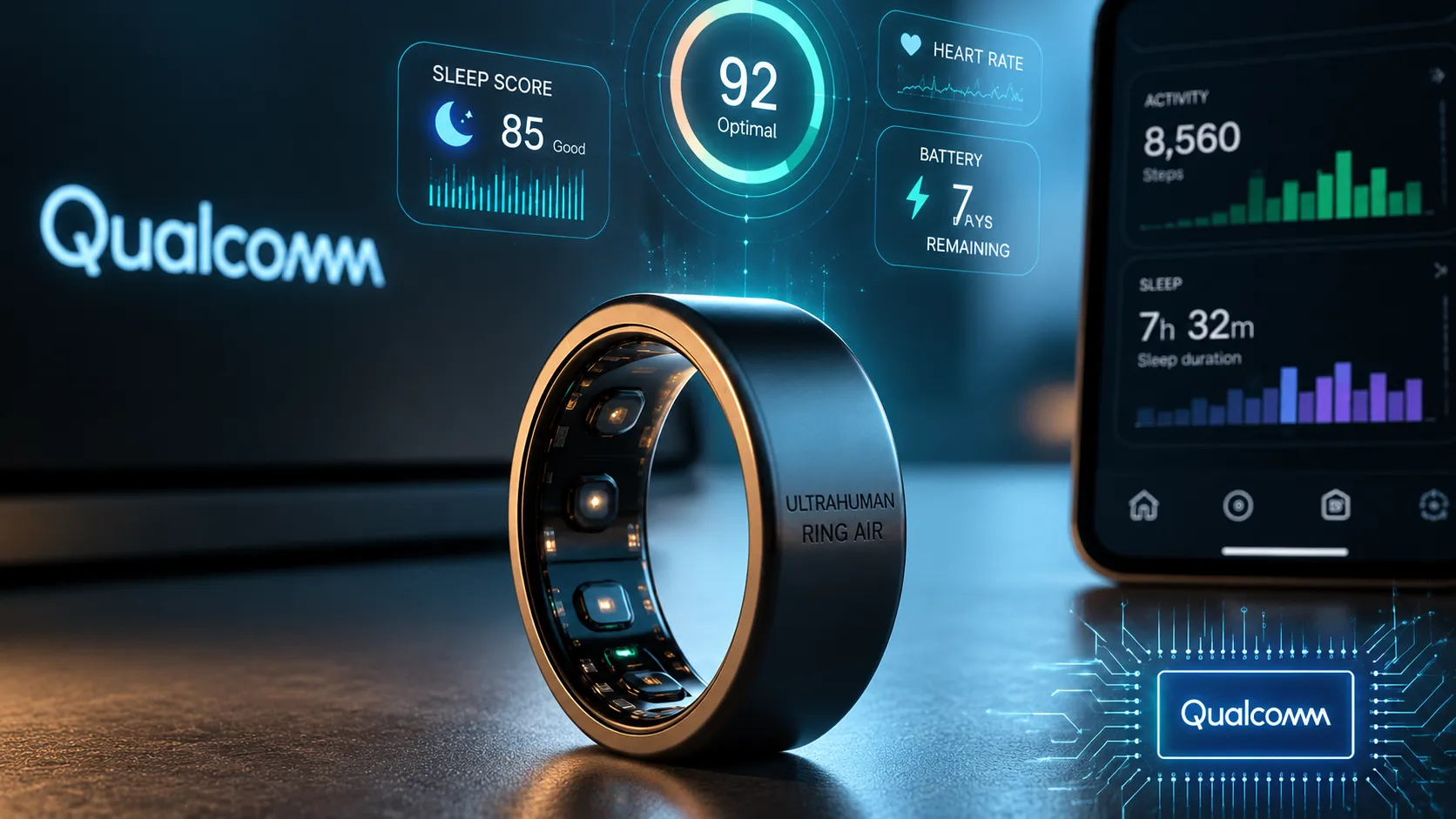
The raise comes at a financially strong moment for Ultrahuman: the company reports an annual revenue run rate of $140 million, up 45 percent year-over-year, with a target of reaching $200 million by January 2027. For the fiscal year ended March 2025, Ultrahuman posted operating revenue of $64 million alongside a net profit of $8.2 million, giving the $365 million valuation a relatively modest 2.6x revenue multiple by hardware-sector standards. The company is also exploring a collaboration with Labcorp to combine long-term circulation data collected by its rings with blood test results, aiming to help assess risks related to cardiovascular health, fertility and aging.
Ultrahuman's raise arrives at a pivotal moment for the smart ring category more broadly. Category leader Oura, valued at $11 billion following an $875 million funding round, filed for an initial public offering on September 3, 2026, reporting $1.21 billion in revenue for the nine months ending June 30, 2026, and targeting a valuation above $16 billion — a scale roughly 44 times Ultrahuman's current valuation, underscoring both the size of the opportunity in wearable health computing and how much room Ultrahuman has left to grow if its strategy succeeds.
Founders Mohit Kumar and Vatsal Singhal, who previously built and sold food-delivery venture Runnr to Zomato, have steadily expanded Ultrahuman's hardware roadmap since the company's early focus on continuous glucose monitoring, positioning the ring as the anchor device for a broader personal health and computing platform rather than a single-purpose fitness tracker.
Notably, the company still faces market headwinds: Ultrahuman lost its entire US distribution for much of the past year due to an International Trade Commission import ban, even though the United States remains its largest market — a reminder that regulatory and trade risk remains a live challenge even for well-funded Indian hardware exporters.
Ultrahuman has said it does not plan to pursue an initial public offering before 2028 at the earliest, wanting to first demonstrate approximately eight consecutive quarters of profitable operations. In the meantime, the company plans to use the new capital to accelerate research and development across sensing, AI, miniaturized electronics and health algorithms, while expanding its Blood Vision and metabolic health offerings and deepening investment in clinical science.