
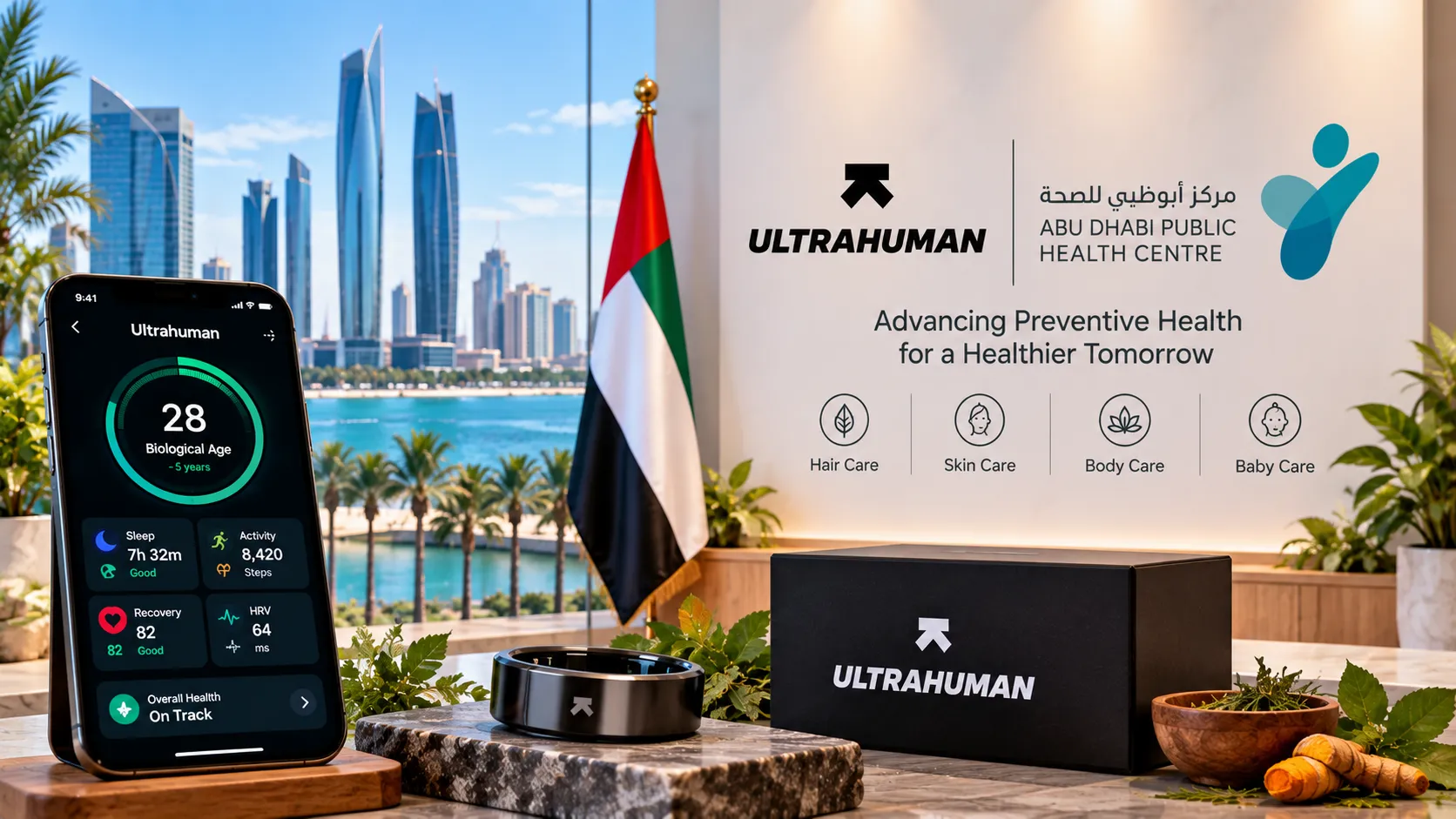
Ultrahuman, the Bengaluru-founded maker of the Ultrahuman Ring, has signed a two-year memorandum of understanding with the Abu Dhabi Public Health Center (ADPHC) to develop and validate a biological-age model designed to work with data from any wearable device, not just its own.
The partnership gives Ultrahuman a government health authority as a research and distribution partner in one of its most valuable markets. Residents will be able to access the biological-age tool through the emirate’s TAMM government services platform and the Sahatna health app, according to details reported by TechCrunch.
Ultrahuman’s co-founder and chief executive Mohit Kumar said the United Arab Emirates is already among the company’s top ten markets, accounting for about 4% to 5% of revenue. The company has operated in the UAE for nearly five years, and customers there show roughly 25% higher retention than in its other markets. Ultrahuman describes the partnership as its first step towards deploying a health algorithm at national scale, with a phased rollout to follow two years of research and clinical validation.
What a biological-age model does
Biological age is an estimate of how old a person’s body appears to be, based on physiological markers, as opposed to their chronological age. Researchers use measures such as resting heart rate, heart-rate variability, sleep quality, physical activity and recovery, all of which modern wearables can track continuously, to estimate whether a person is ageing faster or slower than average.
The concept has become a centrepiece of the longevity movement and a powerful engagement tool for wearable companies. A single, intuitive number that rises or falls with lifestyle changes can motivate users far more effectively than a dashboard of raw metrics.
The scientific challenge is validation. Biological-age estimates vary widely depending on the data and methods used, and few have been rigorously tested against health outcomes in large populations. Partnering with a public health authority gives Ultrahuman a path to clinical credibility that consumer companies rarely achieve on their own.
Wearable-agnostic by design
The most strategically significant feature of the agreement is that the model will be wearable-agnostic. Instead of locking the tool to Ultrahuman’s ring, the company and ADPHC aim to build a model that can ingest data from a range of devices, including smartwatches and other rings.
Kumar told TechCrunch that data from rings, wrist-worn devices, straps and patches could feed into the system alongside clinical biomarkers. “If you look at Ultrahuman as a company, we obviously have the Ultrahuman Ring, which is a way to acquire data from the human body,” he said. “But truly, what we care about is not just the form factor, the ring, but what do we do with this data?”
For a public health agency, that design is essential. A government cannot reasonably promote a health metric available only to owners of a single brand. For Ultrahuman, it is a bet that the long-term value in wearables lies as much in software, models and health-system integration as in hardware.
Privacy has been built into the structure of the deal. According to TechCrunch, the model will not be trained on UAE residents’ data, and Ultrahuman will not receive personally identifiable information through the partnership. That approach is likely to reassure regulators in a region that has tightened data-protection rules, particularly around health data.


