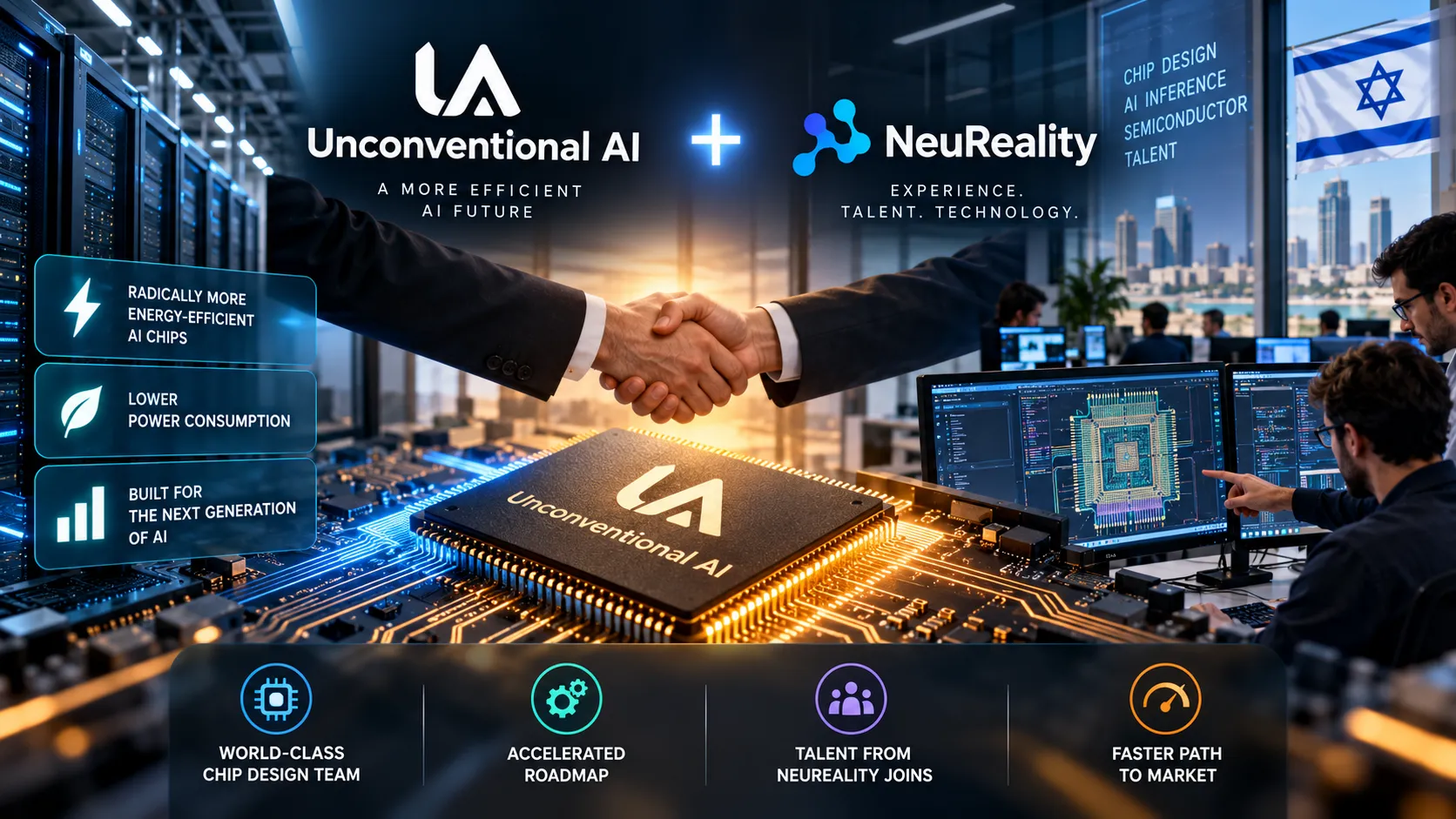
Unconventional AI, a US hardware startup that has set out to challenge Nvidia with radically more energy-efficient chips, has agreed to acquire Israeli semiconductor company NeuReality, gaining an experienced chip design team as it races to bring its technology to market.
The deal was announced on 26 October. No official price was disclosed, but Israeli business daily Globes reported market estimates of $150 million to $200 million in cash and shares. Neither company commented on the terms.
"The hardest thing in this industry is assembling a team that can build real silicon," said Naveen Rao, Unconventional AI's chief executive, adding that the acquisition "accelerates our roadmap significantly".
A Startup With a Bold Ambition
Unconventional AI is led by Rao, a serial entrepreneur who has sold two companies: Nervana Systems, an AI chip startup acquired by Intel, and MosaicML, an AI model training company acquired by Databricks. Within two months of its founding, Unconventional AI raised $475 million at a valuation of $4.5 billion, one of the largest seed rounds ever recorded.
Its investors include Jeff Bezos, Sequoia Capital, Andreessen Horowitz, Lightspeed Venture Partners and Lux Capital.
The company aims to develop an AI chip based on analog circuits, a fundamentally different approach from the digital processors that dominate computing today. Unconventional AI claims its technology could deliver 1,000 times the energy efficiency of Nvidia's chips, though analog AI chips have yet to be deployed commercially at scale.
Why Analog
Digital chips represent data as discrete ones and zeros and perform calculations through billions of transistors switching on and off. Analog computing instead uses continuous physical quantities, such as electrical currents or voltages, to represent and process information, which can be far more energy-efficient for certain operations central to AI, such as the matrix multiplications at the heart of neural networks.
The approach has long attracted researchers, but analog systems face challenges with precision, noise and manufacturing variability. Several startups have pursued analog or in-memory computing for AI, with mixed results. Unconventional AI's large funding round reflects investor willingness to bet on a breakthrough as the energy consumption of AI becomes a major concern.
NeuReality's Journey
NeuReality was founded in 2019 by Moshe Tanach, Zvika Shmueli and Yossi Kasus, veterans of Intel, Marvell, Mellanox and Habana Labs. The company developed technology aimed at making AI inference, the process of running trained AI models, more efficient and less costly by reducing the system-level overheads around AI accelerators.
The company raised about $105 million in total. A $37 million round in July 2023, led by Cardumen Capital, XT and Varana Capital, valued it at about $220 million, according to PitchBook data cited by Globes. Its investors include Varana Capital, its first investor and largest shareholder, as well as OurCrowd, Samsung Ventures, Arm and Rao himself.
NeuReality employs about 40 people in Caesarea and Tel Aviv. Tanach, most of the management team and research and development staff will join Unconventional AI, while some sales, marketing and finance employees will be laid off. The Israeli team will join a similar number of employees in California.
Tanach has said "the economics of AI inference were fundamentally broken", a problem that NeuReality and now Unconventional AI aim to address.
The Talent Rationale
The deal is primarily about people. Building custom silicon requires teams with deep expertise in chip architecture, design, verification and working with manufacturing partners, skills that are scarce and in high demand. Acquiring an existing team can save years compared with hiring individuals one by one.
Israel has long been one of the world's leading centres for semiconductor design. Intel, Nvidia, Apple, Qualcomm and other chip companies operate major research centres in the country, and Israeli startups such as Mellanox, acquired by Nvidia, and Habana Labs, acquired by Intel, have produced influential technologies.
The Investor Outcome
For NeuReality's investors, the deal offers a reasonable return, though short of their original ambitions, according to Globes. The transaction gives employees and investors shares in Unconventional AI, which could deliver further gains if the acquirer succeeds.
The acquisition reflects a broader consolidation trend among AI chip startups. Many companies that raised funding to challenge Nvidia have found it difficult to compete against its dominant position and its CUDA software ecosystem, leading to acquisitions, pivots or closures.
The Energy Imperative
The energy consumption of AI has become a pressing global issue. Data centres running AI workloads require enormous amounts of electricity, and utilities in the United States, Europe and Asia are struggling to keep up with demand. Technology companies are signing deals for nuclear, gas and renewable power to meet their needs.
Chips that dramatically reduce the energy required for AI computation could ease these pressures, lowering costs and environmental impact. That potential explains the intense interest in novel computing approaches, from analog and photonic chips to neuromorphic designs.
Implications for India
India's semiconductor ambitions focus largely on manufacturing, assembly and testing, supported by the India Semiconductor Mission. But chip design is an area where India already has significant strength, with large design centres operated by global companies and a growing number of design startups.
Deals like Unconventional AI's acquisition of NeuReality underscore the value of experienced design teams. India's large pool of chip design engineers could position it to support the next generation of AI hardware companies.
The Challenge of Competing With Nvidia
Nvidia's dominance in AI chips rests not only on hardware but on its software ecosystem. Its CUDA platform, developed over nearly two decades, is deeply embedded in AI research and development, and most AI frameworks and tools are optimised for Nvidia hardware. Any challenger must offer not only superior hardware but also software that allows developers to move workloads with minimal effort.
That challenge is even greater for a radically different architecture such as analog computing, which may require new approaches to programming and model design. Unconventional AI's success will depend on whether it can make its technology accessible to developers and compatible with existing AI workflows. The NeuReality team's experience in building system-level software and hardware for AI inference could help address that challenge, providing expertise in integrating novel chips into practical data centre deployments.
What Comes Next
Unconventional AI will now integrate NeuReality's team and work to bring its analog chip to market. The company faces significant technical challenges and formidable competition, but with substantial funding, experienced leadership and now an expanded silicon team, it is among the most closely watched startups in AI hardware.