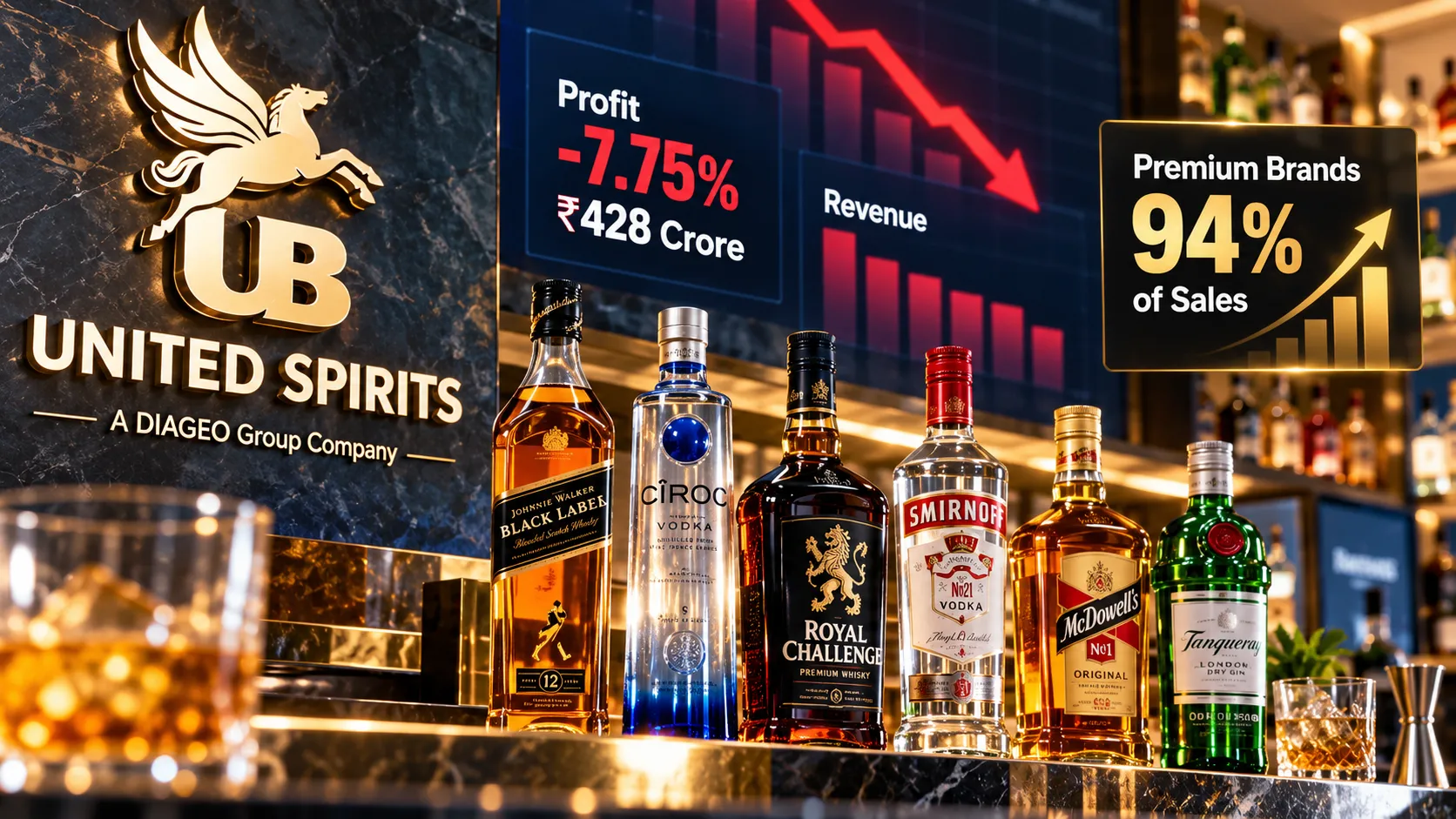
India's largest spirits company has reported a dip in quarterly profit, but its results show the industry's steady shift towards premium brands, a trend that is reshaping the country's alcoholic beverage market.
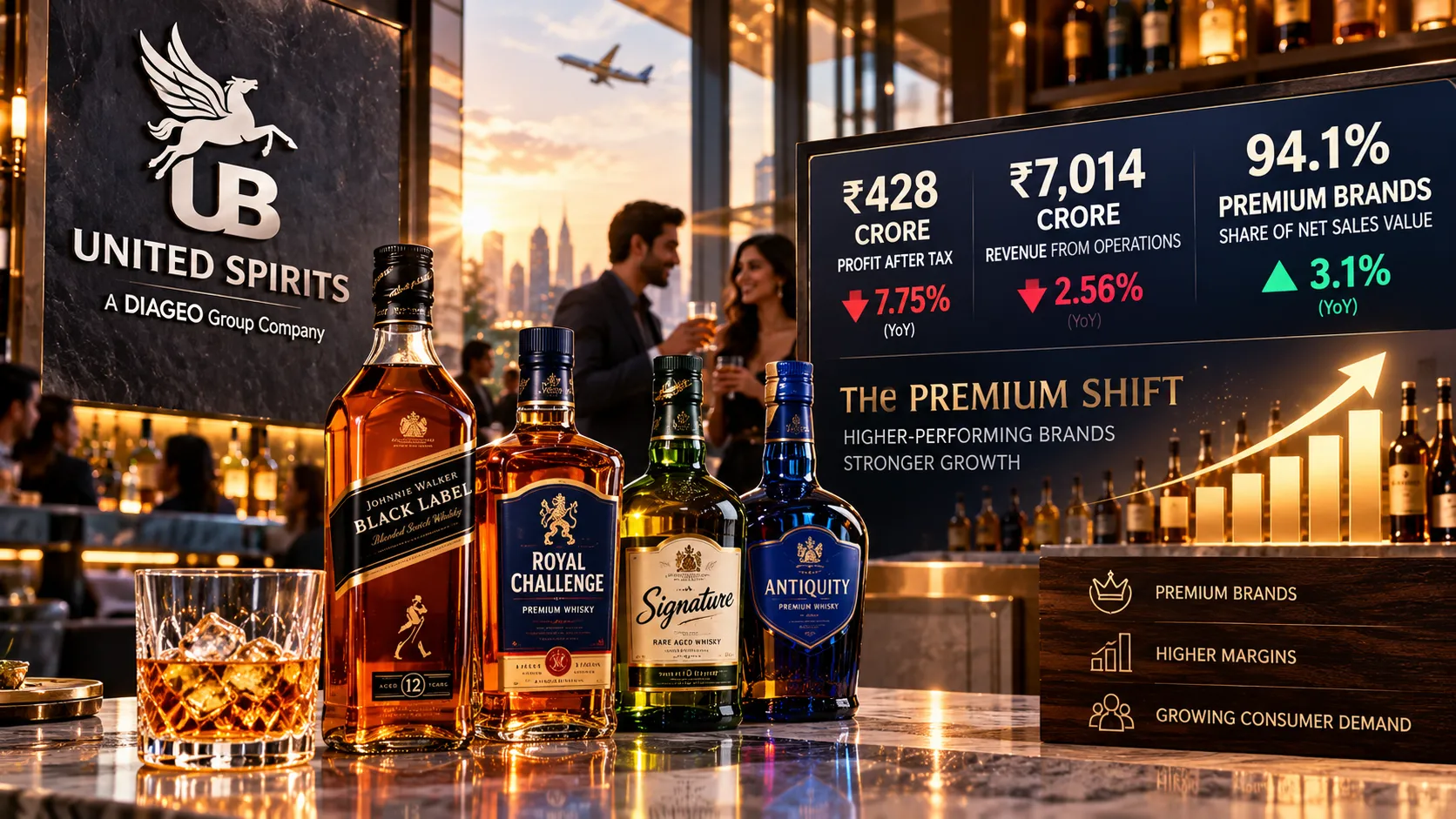
United Spirits reported consolidated net profit of ₹428 crore for the July-September quarter, down 7.75% from ₹464 crore a year earlier, according to Upstox on Thursday, October 29. Revenue from operations fell 2.56% to ₹7,014 crore from ₹7,199 crore. Total expenses fell 2.22% to ₹6,471 crore.
The premium shift
The most significant figure was the share of premium brands. United Spirits' Prestige & Above segment, which includes its higher-priced whiskies, rose to 94.1% of net sales value, up 3.1 percentage points from a year earlier. Net sales value in the segment grew 6.3%.
That means the company is selling a larger proportion of more expensive brands, even as overall revenue declined. Premiumisation, the trend of consumers trading up to higher-priced products, has been a defining theme in India's consumer markets, from cars and smartphones to food and beverages.
For spirits companies, premium brands typically carry higher margins, which can support profitability even when volumes are flat or falling.
The Diageo connection
United Spirits is controlled by Diageo, the British drinks giant that owns brands such as Johnnie Walker, Smirnoff and Guinness. Diageo acquired control of United Spirits from Vijay Mallya's UB Group more than a decade ago and has since reshaped the business, selling or franchising many of its lower-priced brands to focus on premium segments.
The company's portfolio includes Indian whisky brands such as McDowell's No. 1, Royal Challenge, Signature and Antiquity, as well as Diageo's international brands sold in India.
Why revenue fell
The revenue decline likely reflects the company's deliberate exit from lower-priced segments, along with state-level factors that affect the alcohol industry. In India, alcohol is regulated and taxed by individual states, which set excise duties, retail pricing and distribution rules. Changes in state policies can significantly affect sales in individual markets.
Weak demand in the lower end of the market, where consumers are more sensitive to price increases, may also have played a role. Higher inflation in fuel and food can squeeze the budgets of consumers who buy mass-market brands.
The India-UK trade deal
The trade agreement between India and the United Kingdom, which reduces tariffs on Scotch whisky, could have significant implications for United Spirits and the industry. Lower tariffs could make imported Scotch more affordable, boosting demand for premium international brands, including those sold by Diageo.
At the same time, cheaper imported whisky could increase competition for Indian premium brands, potentially affecting their market share.
Competition
United Spirits competes with Pernod Ricard India, which owns brands such as Royal Stag, Blenders Pride and Chivas Regal, as well as domestic companies such as Radico Khaitan, Allied Blenders and Distillers, and Tilaknagar Industries. Indian single malt brands, such as Amrut and Paul John, have also gained recognition and market share in the premium segment.
The rise of Indian craft spirits, including gins and single malts, has added competition at the top end of the market.
The Indian spirits market
India is one of the world's largest markets for whisky by volume, and its alcoholic beverages market is growing as incomes rise and social attitudes change. Young, urban consumers are increasingly willing to spend on premium drinks, and women are a growing segment of drinkers in cities.
However, the industry faces significant regulatory complexity, high taxes and restrictions on advertising, which make it challenging to build brands. Several states have prohibition or partial restrictions on alcohol sales.
What it means for investors
For investors, United Spirits' results reflect a business in transition towards premium segments, which should support margins over time even if volumes are subdued. The company's strong balance sheet and the backing of Diageo provide stability.
Investors will watch the impact of the India-UK trade deal, state-level policy changes and the pace of premiumisation in coming quarters.
The premiumisation strategy
United Spirits has focused on moving its portfolio towards premium brands, which carry higher prices and margins. Its Prestige & Above segment, which includes brands such as Johnnie Walker, Black Dog, Antiquity and Royal Challenge, accounts for 94.1% of net sales value. The company has deliberately exited or reduced exposure to lower-priced brands in its popular segment, sacrificing volume for profitability.
Premiumisation reflects rising incomes and changing consumer preferences in India, where a growing middle class is trading up to better-quality spirits. Scotch whisky imports into India have grown significantly, and Indian single malt brands have gained international recognition.
State regulation
India's alcohol market is heavily regulated at the state level. Each state sets its own taxes, pricing rules and distribution systems, and policy changes in large states can have a significant impact on sales. Some states have state-controlled distribution, while others allow private retail. Changes in excise duties, licensing and retail policies can cause sudden shifts in demand, and companies like United Spirits must navigate a complex patchwork of rules.
Input costs
The cost of extra neutral alcohol, glass bottles and packaging materials affects margins for spirits makers. Glass prices are linked to energy costs, and higher fuel prices increase transport costs. Grain prices also affect the cost of producing alcohol. These pressures can squeeze margins when companies are unable to raise prices quickly due to state regulations on pricing.
What comes next
The December quarter, which includes the festive and wedding season, is typically strong for alcohol sales in India. United Spirits' performance during this period will indicate whether demand for premium brands continues to grow and whether the company can return to revenue growth.
The road ahead for premium spirits
The long-term trend towards premium spirits in India remains strong, supported by rising incomes, urbanisation and changing social attitudes towards drinking. The India-UK trade agreement, which reduces tariffs on Scotch whisky, could make imported premium whisky more affordable over time, which may benefit Diageo's portfolio in India. However, Indian brands have also grown in popularity, and competition for premium consumers is intensifying. United Spirits' ability to keep growing its premium portfolio while managing costs will be key to restoring profit growth.
Investors will look closely at the company's commentary on state-level policy changes, raw material costs and the pace of premiumisation in its next results, which will indicate whether the profit decline is a temporary setback or a sign of more persistent pressures on the business.