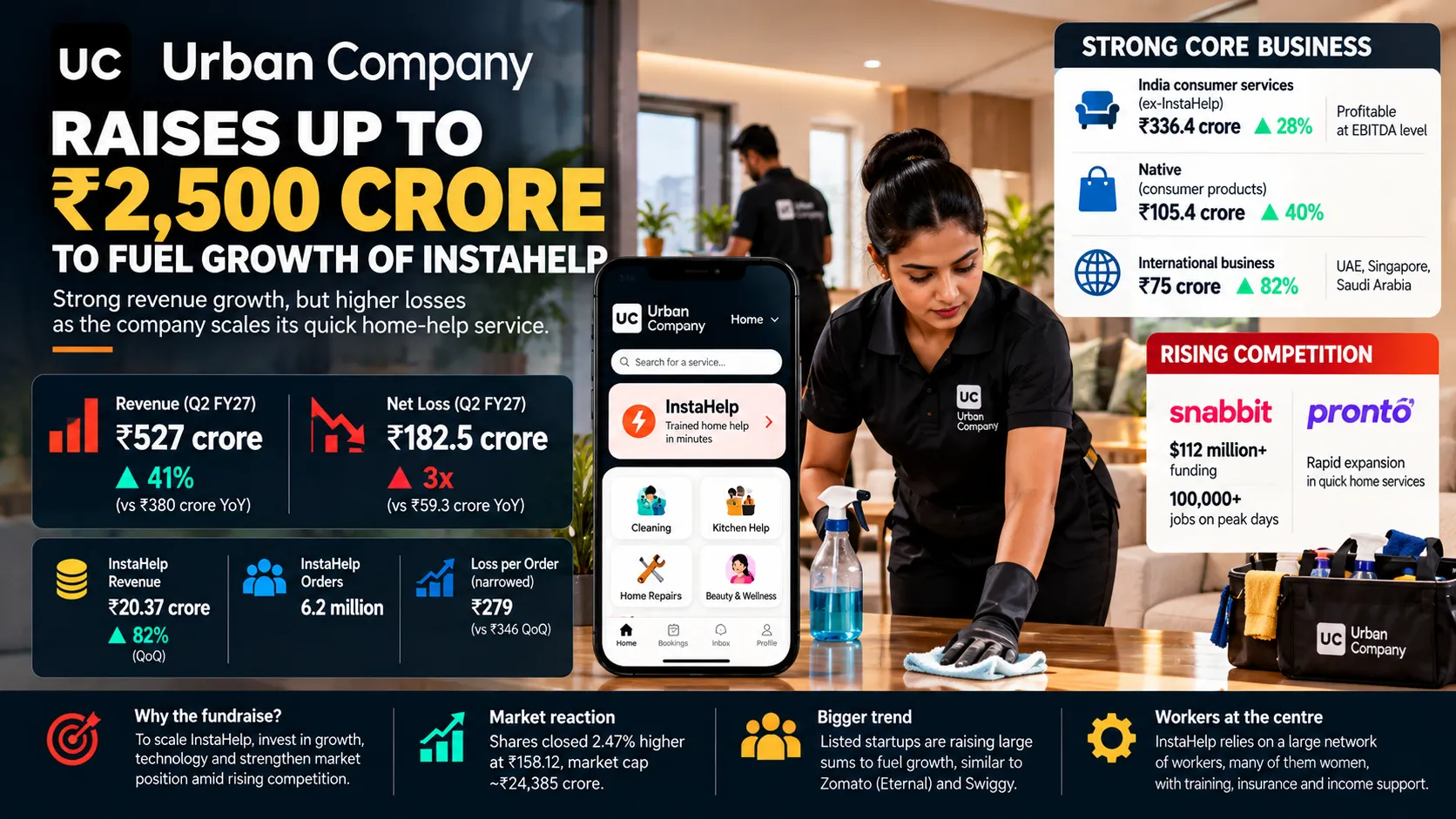
Urban Company, the listed home-services platform, has approved plans to raise up to ₹2,500 crore in fresh capital, as heavy spending on its fast-growing InstaHelp quick home-help service pushed its second-quarter loss sharply higher.
The company's board on 16 October cleared the fundraise, which may be carried out through a qualified institutional placement, a preferential allotment, a private placement or a combination of these routes, in one or more tranches. The proposal is subject to shareholder and regulatory approvals.
The capital raise was announced alongside results for the September quarter, the second of the 2027 financial year, which showed a business growing rapidly at the top line but absorbing significant losses as it builds a new, capital-intensive service category.
Revenue Up 41%, Losses Triple
Urban Company reported consolidated revenue from operations of ₹527 crore for the quarter ended 30 September, up 41 per cent from ₹380 crore a year earlier.
Net loss, however, widened to ₹182.5 crore from ₹59.3 crore in the same quarter last year, roughly a threefold increase. For the first half of the financial year, revenue stood at ₹1,065.6 crore, while the net loss for the six months reached ₹274.6 crore.
The numbers underline the trade-off the company has made. Its established businesses are growing and, in the case of its core Indian consumer services, generating operating profits. But management has chosen to invest heavily in InstaHelp, a service that dispatches trained household help such as cleaners and kitchen assistants to customers within minutes, and that investment is now the dominant driver of the company's losses.
Inside the InstaHelp Bet
InstaHelp generated revenue of ₹20.37 crore in the quarter, up 82 per cent from the previous quarter, according to the company's disclosures. It handled 6.2 million orders during the period.
The segment reported an adjusted EBITDA loss of ₹174 crore, which accounts for almost all of the company's quarterly loss. There were signs of improving efficiency: the loss per order narrowed to ₹279 from ₹346 in the previous quarter. But the net order value, the average value of each booking, also fell to ₹114 from ₹138, suggesting the company is still pricing aggressively to build habit among customers.
The economics of InstaHelp differ markedly from Urban Company's original model, under which independent professionals such as beauticians, electricians and plumbers are booked through the app for scheduled appointments. Quick home help requires a dense network of workers positioned close to customers so that they can arrive within minutes, which means paying for idle time, training, local hubs and incentives before order volumes are high enough to cover those costs.
The Core Business Remains Profitable
Outside InstaHelp, the picture is more encouraging. Revenue from India consumer services, excluding InstaHelp, rose 28 per cent to ₹336.4 crore and the segment was profitable at the adjusted EBITDA level.
Native, the company's consumer products business, which sells water purifiers and smart locks, grew revenue 40 per cent to ₹105.4 crore. The international business, which includes operations in the United Arab Emirates, Singapore and Saudi Arabia, reported revenue of ₹75 crore, up 82 per cent.
Those numbers show that the company's legacy platform has matured into a business capable of funding part of its own growth. The question for investors is whether InstaHelp can follow a similar path, and how much capital it will consume before it does.
Why Raise Now
The ₹2,500 crore fundraise gives Urban Company a substantial war chest at a time when competition in quick home services has intensified sharply.