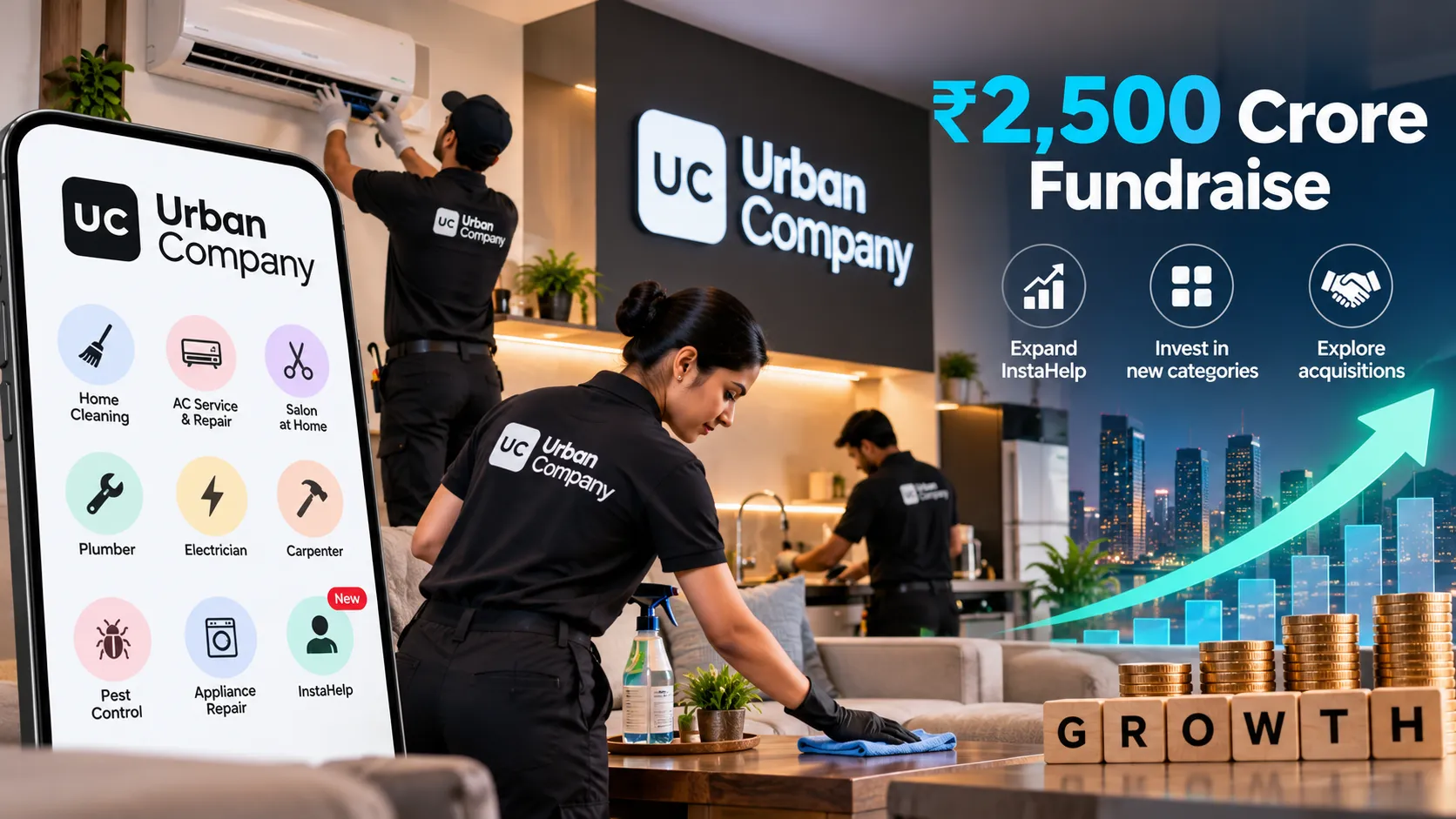
Urban Company, India's largest home services platform, is preparing to raise up to ₹2,500 crore in fresh capital, a little over a year after its stock market debut, as it doubles down on its loss-making quick home help business and looks to expand into new categories.
The company's board approved the proposal on Friday, October 16, alongside its results for the July-September quarter. The money will be raised through the issue of equity shares and/or convertible securities by way of a preferential allotment or private placement, according to Inc42. The timing, pricing and investors have not been disclosed.
Urban Company said the funds would be used to strengthen the market leadership of InstaHelp, its on-demand household help service, to invest across its three businesses, and to pursue potential acquisitions.
A sharp rise in losses
The fundraise was announced as Urban Company reported a sharp rise in losses. Consolidated net loss for the second quarter of fiscal 2027 more than tripled to ₹182.5 crore from ₹59.3 crore a year earlier, and nearly doubled from ₹92.1 crore in the previous quarter.
Revenue from operations rose 41% to ₹537.3 crore from ₹380 crore a year earlier, but total expenses grew faster, climbing 61.5% to ₹745.7 crore. The main driver was InstaHelp, in which the company invested ₹174 crore during the quarter, an expense it described as "deliberate."
Including InstaHelp, the company reported an adjusted EBITDA loss of ₹144 crore. Excluding it, adjusted EBITDA was a profit of ₹30 crore, showing that the core business remains profitable on an operating basis.
InstaHelp: the costly growth engine
InstaHelp, launched in 2025, offers household help such as cleaning, dishwashing and kitchen assistance at short notice, often within minutes. It is Urban Company's answer to a new wave of "quick service" startups, including Snabbit and Pronto, that have attracted significant venture capital.
The business is growing rapidly. Fulfilled orders rose 63% from the previous quarter to 6.2 million, and operating revenue reached ₹20.5 crore, up from ₹1.4 crore a year earlier. InstaHelp accounts for about 45% of new users in the micro-markets where it operates, making it an important customer acquisition channel for the wider platform.
But the economics remain challenging. The adjusted EBITDA loss for InstaHelp widened to ₹174 crore from ₹132 crore in the previous quarter, although loss per order fell 19% to ₹279 from ₹346, suggesting improving efficiency as volumes grow.
Competition is intense. Snabbit founder Aayush Agarwal claimed his company served 6.45 million orders in the same period, slightly more than InstaHelp, according to Inc42, underlining the race for leadership in the segment.
Where the money will go
Co-founder and chief executive Abhiraj Singh Bhal signalled broader ambitions. "Our ambition is to go beyond being just a home services company," he said, according to Inc42.
He indicated that any acquisitions would be aimed at adding new categories. "If at all we do an M&A, it would be to add on categories that we don't operate in today," Bhal said, adding that acquiring an InstaHelp competitor was "highly unlikely." No acquisition deals have been finalised.
The board also gave in-principle approval to explore residential air conditioners under Native, Urban Company's in-house appliances brand, which currently sells water purifiers and smart locks. The company said it would launch only if the product is materially better than existing options. "We've now operated in the segment of air conditioning servicing and repair for close to 11-12 years," Bhal said, pointing to the company's large AC service customer base as a potential sales channel.
Bhal described the company's approach to capital allocation as "calibrated and measured."
Strength in the core business
Beyond InstaHelp, Urban Company's established businesses continued to grow. In India consumer services, excluding InstaHelp, net transaction value rose 26.3% to ₹963 crore, and net revenue grew 28% to ₹336 crore.
The international business, which operates in the United Arab Emirates and Singapore, is profitable, with net transaction value up 66% to ₹267 crore.
Native's net transaction value rose 35% to ₹132 crore and operating revenue grew 40% to ₹105 crore. Its adjusted EBITDA loss was ₹9 crore, with the loss margin narrowing to 6.8% of net transaction value from 9% a year earlier. The company expects combined net transaction value growth of 50% to 55% across the second and third quarters, as festive demand and e-commerce sales shift into the October-December period.
Market reaction
Investors reacted negatively to the widening losses and the prospect of equity dilution. On Monday, October 19, the first trading session after the announcement, Urban Company shares fell as much as 9.5% to ₹143.30 on the BSE and closed 9.92% lower at ₹142.6, according to Inc42. At midday, the company's market capitalisation was about ₹22,323 crore, or roughly $2.7 billion.
Not all analysts were deterred. Emkay Global Financial Services maintained its "Buy" rating and raised its target price to ₹200 from ₹190, citing growth opportunities across segments and the strength of the core business.
Profitability targets
Management reiterated its guidance of reaching adjusted EBITDA breakeven at the consolidated level by the third quarter of fiscal 2028 and generating ₹1,000 crore of adjusted EBITDA by fiscal 2031. It said these targets were achievable even without the new capital, though Bhal acknowledged that InstaHelp's losses have limited the company's financial flexibility.
The fundraise therefore appears designed to give Urban Company room to invest aggressively in InstaHelp and new categories without jeopardising its path to profitability.
The new-age stock dilemma
Urban Company's situation reflects a broader challenge for India's listed internet companies. Investors have rewarded companies that show a clear path to profitability, but many of these businesses are also expected to keep investing in new growth areas to stay ahead of well-funded rivals. Quick commerce companies such as Eternal's Blinkit and Swiggy's Instamart have faced similar scrutiny as heavy investments have weighed on earnings.
Raising capital through a preferential allotment or private placement can be faster than a public offering, and the involvement of large institutional investors could signal confidence. However, it dilutes existing shareholders, which explains part of the market's negative reaction.
What it means for the gig economy
InstaHelp's growth is also notable for India's gig economy. Quick household help services create flexible work opportunities, particularly for women in urban areas, while giving households on-demand access to services traditionally arranged informally. As the segment grows, questions around worker earnings, safety and social security are likely to draw more attention, especially as new labour codes bring gig and platform workers under a social security framework.
What comes next
Investors will watch for details of the fundraise, including the investors, pricing and timing, as well as any acquisitions Urban Company pursues. The performance of InstaHelp, particularly progress in reducing losses per order, and the possible launch of air conditioners under Native, will be key indicators of whether the company's expansion strategy pays off.
For now, Urban Company is betting that investing heavily in quick home help will cement its leadership in a market it helped create, even if that means short-term pain for profits and its share price.