
FundingVenture Capital5 MIN READ

US Series A Funding Hits $42 Billion, Up 60%, But the Number of Deals Has Barely Moved as AI Inflates Round Sizes

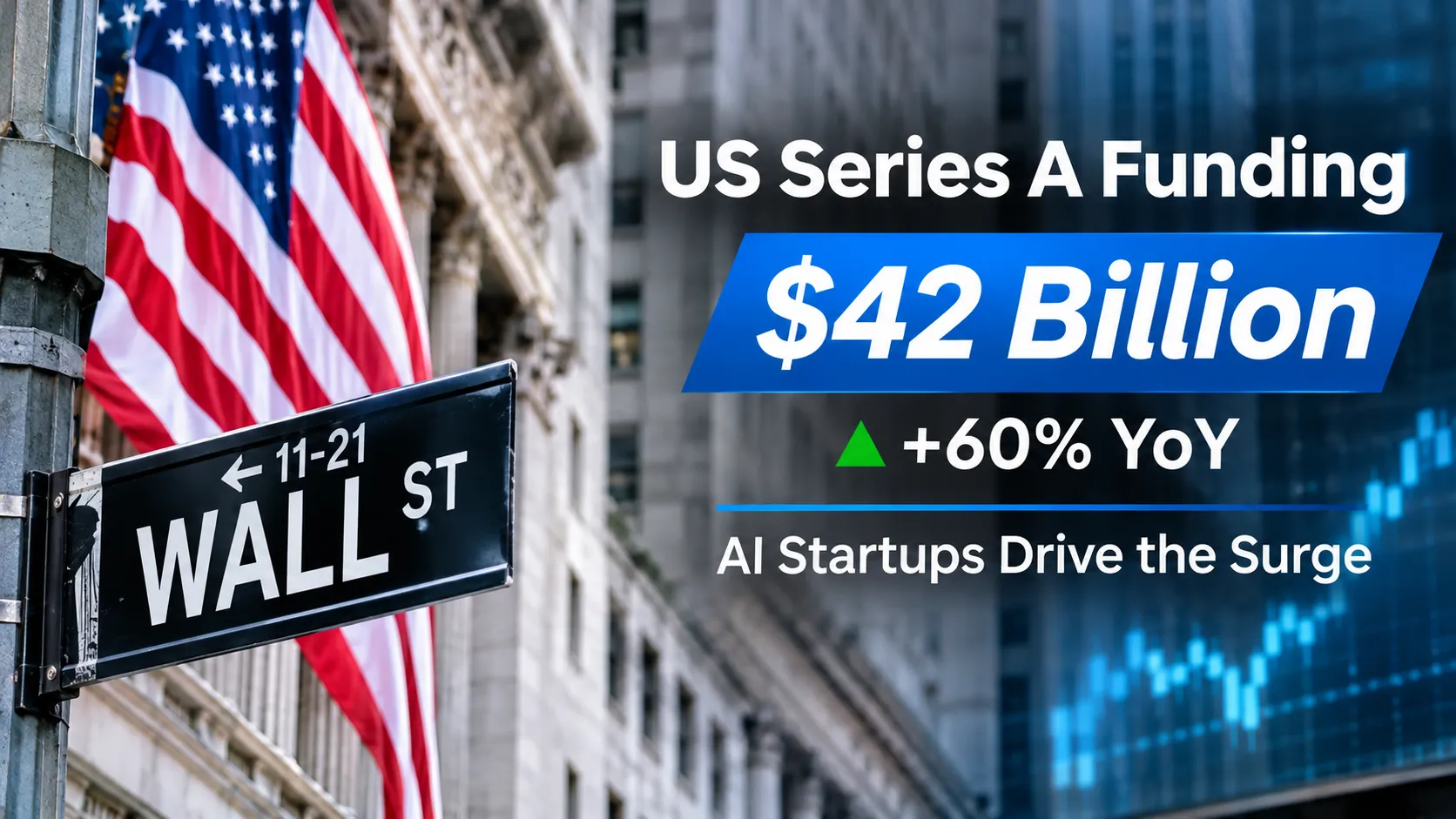
US startups raised about $42 billion in Series A rounds through October 2026, up about 60% from a year earlier and nearly double 2023 levels, Fortune reported on November 19, citing Crunchbase data. But the number of Series A deals of $1 million or more has stayed roughly flat at about 1,200 a year, as giant AI rounds such as Mirendil's $1 billion inflate the totals.

By Nisha Omkumar · Author20 November 2026New
US Series A Funding Hits $42 Billion, Up 60%, But the Number of Deals Has Barely Moved as AI Inflates Round Sizes

On paper, it has never been a better time to raise a Series A in the US. In practice, the boom is concentrated in a narrow slice of companies.

US startups raised about $42 billion in Series A funding through October 2026, up about 60% from the same period a year earlier and nearly double the total in 2023, Fortune reported on Thursday, November 19, citing data from Crunchbase.

However, the number of Series A deals has barely changed. The count of rounds of $1 million or more has held roughly steady at about 1,200 a year, according to Fortune, meaning the increase in total funding has been driven by much larger round sizes rather than more companies raising money.

The AI effect

The surge in Series A funding is largely the result of artificial intelligence. AI startups have raised unusually large early-stage rounds, as investors compete to back companies they believe could become dominant players in the next wave of technology.

Fortune highlighted examples including Mirendil, which raised a $1 billion Series A, and TypeSafe AI, which raised $870 million. Rounds of this size were once reserved for late-stage companies preparing for an IPO.

AI companies often need large amounts of capital early, to pay for computing power, hire scarce research talent and train models. Investors are willing to provide it because of the potential size of AI markets and the fear of missing out on the next major winner.

A changing Series A

Roseanne Wincek, co-founder and managing partner of Renegade Partners, commented on the shift in the Series A market in Fortune's report, describing how round sizes and valuations have changed as AI has reshaped early-stage investing.

Traditionally, a Series A round was the first significant institutional funding for a startup that had shown early signs of product-market fit, typically ranging from a few million to perhaps $20 million. Today, the term covers a much wider range, from modest rounds for traditional software startups to mega-rounds for AI companies.

The rising cost of computing

Part of the reason AI startups need more capital is the rising cost of computing infrastructure. Fortune noted that memory chip prices have roughly doubled, citing Gartner, as demand from AI data centres has outstripped supply. Memory is a crucial component of AI servers, and higher prices increase the cost of building and running AI systems.

The shortage of advanced chips and memory has also benefited semiconductor companies such as SK Hynix, Samsung and Micron, which have reported strong profits.

Winners and losers

The concentration of funding in large AI rounds means that many startups, particularly those outside AI, face a more difficult fundraising environment. Investors are being more selective, and companies without a clear AI angle may struggle to raise capital at attractive valuations.

The flat deal count suggests that the overall number of startups reaching the Series A stage has not grown, even as total investment has surged. For founders, this means competition for Series A funding remains intense.

The risks of mega-rounds

Large early-stage rounds carry risks for both investors and startups. High valuations can create pressure to grow quickly and make it difficult to raise future rounds at higher prices. If AI markets do not develop as expected, or if competition compresses margins, some heavily funded startups could struggle.

Some investors have warned that the AI funding boom shows signs of excess, drawing comparisons with the dot-com era. Others argue that AI is a genuinely transformative technology and that large investments are justified by its potential.

“More money is flowing into Series A rounds than ever, but it is going to fewer, bigger bets.”
— TIGI Funding Desk

The broader market

The Series A boom comes amid a broader surge in AI investment, including record funding rounds for AI model developers and the successful public listing of Anthropic this week, which valued the company at more than $1 trillion. The success of high-profile IPOs could encourage more investment in early-stage AI companies, as investors see potential paths to large returns.

What it means for Indian founders

Many Indian founders and Indian-origin entrepreneurs in the US are building AI startups, and the US funding environment affects them directly. The concentration of capital in AI rounds also influences venture investment in India, where investors are increasingly backing AI startups and Indian founders are building companies for global markets.

In India, Series A funding has been more modest, but AI startups have also attracted growing investor interest, and global investors are paying closer attention to Indian AI talent.

834d2ed2-3842-41ba-b802-2825240e6a47.png

The seed stage picture

The trends seen at the Series A stage are also visible at the seed stage, where AI startups have raised unusually large initial rounds. Some seed rounds now exceed $20 million or even $50 million, particularly for companies founded by well-known researchers or experienced entrepreneurs.

These large early rounds mean that some startups skip traditional stages of funding altogether, raising enough capital to reach significant scale before a formal Series A.

Where the money is going

Much of the AI Series A funding has gone to companies building AI models, infrastructure and tools, as well as applications in areas such as coding, healthcare, legal services and finance. Investors are particularly interested in companies that can demonstrate rapid revenue growth, as AI products have in some cases reached millions of dollars in revenue within months of launch.

Fast revenue growth has become a key justification for the high valuations attached to AI startups.

Lessons from past cycles

Venture capital has gone through several boom-and-bust cycles, including the dot-com bubble of the late 1990s and the funding surge of 2021, which was followed by a sharp correction in 2022. In each case, a period of abundant capital and high valuations was followed by a pullback that left many startups struggling to raise further funding.

Experienced investors say the companies most likely to survive a downturn are those with strong fundamentals, disciplined spending and real customer demand.

The investor's dilemma

For venture capital firms, the current environment presents a difficult choice. Investing in large AI rounds at high valuations carries the risk of overpaying, but missing out on a company that becomes a dominant AI platform could be even more costly. Many firms have raised larger funds to compete for the biggest deals.

Smaller funds and individual angel investors, meanwhile, are finding it harder to participate in the most sought-after AI rounds, which are often led by large firms with deep pockets. Some are focusing on niches outside AI or on very early stage companies where valuations are still more modest and the potential for outsized returns remains.

What comes next

Investors will watch whether the Series A boom continues into 2027 or cools if AI valuations come under pressure. The direction of interest rates, the performance of AI stocks and the success of recent IPOs will all influence how much capital flows into early-stage startups.

TagsSeries Aventure capitalstartup fundingCrunchbaseFortuneAI startupsRenegade PartnersRoseanne WincekMirendilTypeSafe AImega-roundsearly-stage fundingmemory pricesGartnerUS startupsVC trendsseed fundingAI valuationsIndian foundersinvestors

Reader reviews

Sign in to rate and review this article.
Loading reviews…

