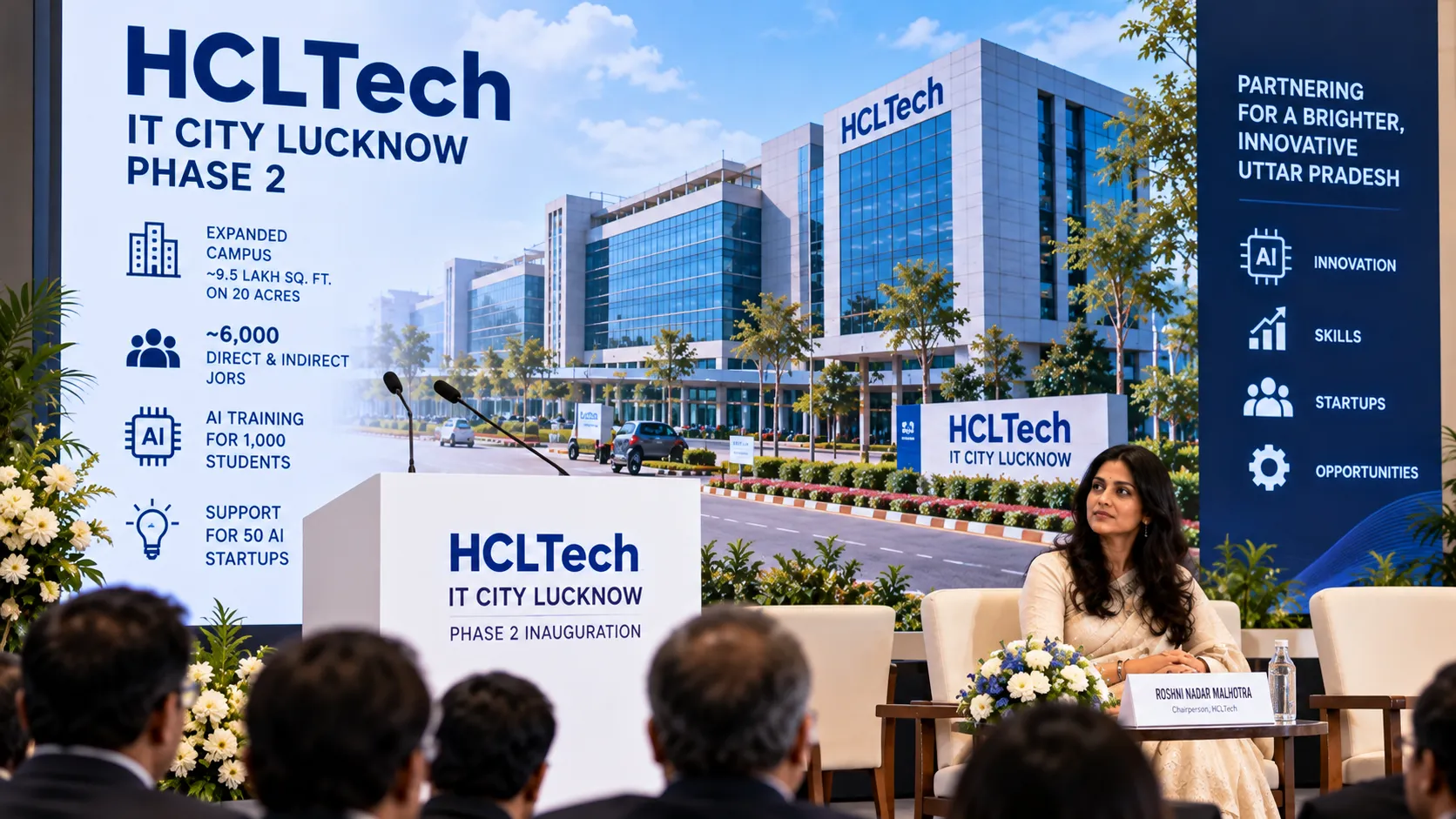
Uttar Pradesh will support at least 50 artificial intelligence start-ups in Lucknow over the next five years, Chief Minister Yogi Adityanath said on 6 October, as he launched a ₹500 crore second phase of HCLTech's IT City campus in the state capital.
The announcement came at an event marking ten years of HCLTech's Lucknow campus, attended by HCLTech chairperson Roshni Nadar Malhotra. The expansion adds about 9.5 lakh square feet of space on 20 acres and is expected to create around 6,000 direct and indirect jobs, according to the Free Press Journal and Dataquest.
HCLTech will also run an AI training programme for 1,000 students from local colleges. The chief minister used the occasion to urge the company to partner with the state on its AI plans, arguing that Lucknow should grow beyond IT services into AI, semiconductors, cybersecurity and deep technology.
Phase 2 of HCL IT City
The second phase includes a new IT building with about 5,000 seats, a multilevel car park and a cafeteria, the Free Press Journal reported. Dataquest, citing the company, said the expansion raises capacity by 4,500 technology professionals. The two figures were reported separately, and no detailed breakdown was published.
HCLTech also launched the HCL-GUVI Emerging Technology Centre at the Lucknow campus, which will train students and young professionals in AI, data analytics and advanced computing, Dataquest reported. The training of 1,000 local students announced by the chief minister forms part of the company's skilling push in the city.
The investment decision for HCL IT City in Lucknow was taken in 2016, and the campus has now operated for about a decade. HCL's founder Shiv Nadar began the group's journey in Uttar Pradesh around five decades ago, a point both the chief minister and Nadar Malhotra stressed at the event.
“Our continued expansion in Lucknow reflects our unwavering faith in the talent, potential, and ecosystem of the state,” Nadar Malhotra said, according to Dataquest. She also said the HCL Foundation, the group's social development arm, has reached about 50 lakh people in Uttar Pradesh.
Adityanath summed up the relationship in a single line, according to the Free Press Journal: “HCL chose Lucknow and Lucknow embraced HCL.” He described the company's employees as brand ambassadors for the state.
At the event, the HCL Foundation also handed out equipment, grants and certificates to beneficiaries of its rural programmes, including farm machinery for a woman farmer and a machine for making handicrafts from water hyacinth, a reminder that the group's footprint in the state extends well beyond its office campus. The chief minister said HCL's programmes had reached more than 50 lakh people and over 3,000 villages over the past decade or so, and that the group runs residential campuses and schools in Sitapur and Bulandshahr.
Senior officials at the event included Shikhar Malhotra, chairman of the Shiv Nadar Foundation; Manoj Kumar Singh, chief executive of the Uttar Pradesh Transformation Commission and the state's outgoing chief secretary; and Alok Kumar, principal secretary for IT and electronics.
The AI ambition
The 50-startup target is the most notable policy signal from the event. “The Uttar Pradesh government's resolve is to establish Lucknow among India's leading AI innovation cities,” Adityanath said, as reported by the Free Press Journal. He said the government would extend full support to establish at least 50 world-class AI start-ups in Lucknow and build an innovation ecosystem around them over five years.
The state has been working on this idea for some time. In December 2023, Uttar Pradesh began developing an AI City on a 40-acre parcel in the Nadarganj area of Lucknow, inviting real estate developers to design, build and operate the infrastructure, with incentives of up to ₹100 crore for IT parks and the AI City, Outlook reported at the time. Adityanath said on 6 October that work on what he called India's first AI City was progressing.
Under the state's new start-up policy, Noida and Lucknow are being developed as deep-tech hubs, the chief minister said. He did not set out how the 50 AI start-ups would be selected or funded, and no budget for the programme was announced.
That leaves open questions. Building 50 globally competitive AI companies requires founders, capital, computing resources and customers, and most of India's AI start-up activity remains concentrated in Bengaluru, Delhi-NCR, Mumbai and Hyderabad. Lucknow's advantage lies in lower costs, a large pool of graduates and a state government keen to attract technology investment, but it has a smaller base of experienced founders and investors.
A state making its case on technology
Adityanath used the event to set out a broader economic argument. He said about 55 per cent of India's mobile phones and about 60 per cent of its electronic components are now manufactured in Uttar Pradesh, much of it in the Noida region. He said the state's IT and IT-enabled services exports have risen from about ₹12,000 to ₹15,000 crore to more than ₹1 lakh crore, with a target of ₹2.5 lakh crore within four years, and that electronics exports have grown from about ₹3,800 crore to ₹45,000 crore.
These figures were presented by the chief minister and were not independently broken down at the event. The state runs IT parks in Lucknow, Kanpur, Prayagraj, Meerut and Agra, seven Software Technology Parks, and 12 IT and ITES special economic zones in Gautam Buddha Nagar, with new IT parks planned in Varanasi, Bareilly, Kanpur and Gorakhpur, he said. He also pointed to road links as part of the pitch, saying a journey of about 1,200 km from Ballia to Bijnor that once took several days can now be completed in about 10 hours.
He also addressed migration, a sensitive issue in a state that has long exported workers to other parts of India. “The youth of UP is choosing Lucknow for their careers, and youth from across the world are coming to UP,” he said, recalling that a decade ago young people had to look to Delhi, Mumbai, Bengaluru and Hyderabad for jobs.
For HCLTech, the expansion fits a wider pattern among Indian IT services companies, which have been adding capacity in Tier 2 cities where talent is plentiful and costs are lower. For Uttar Pradesh, an anchor employer that keeps growing gives credibility to its pitch for AI investment. Whether that pitch turns into 50 start-ups, and how many of them grow into substantial companies, is what investors and job seekers in the state will be watching over the next five years.