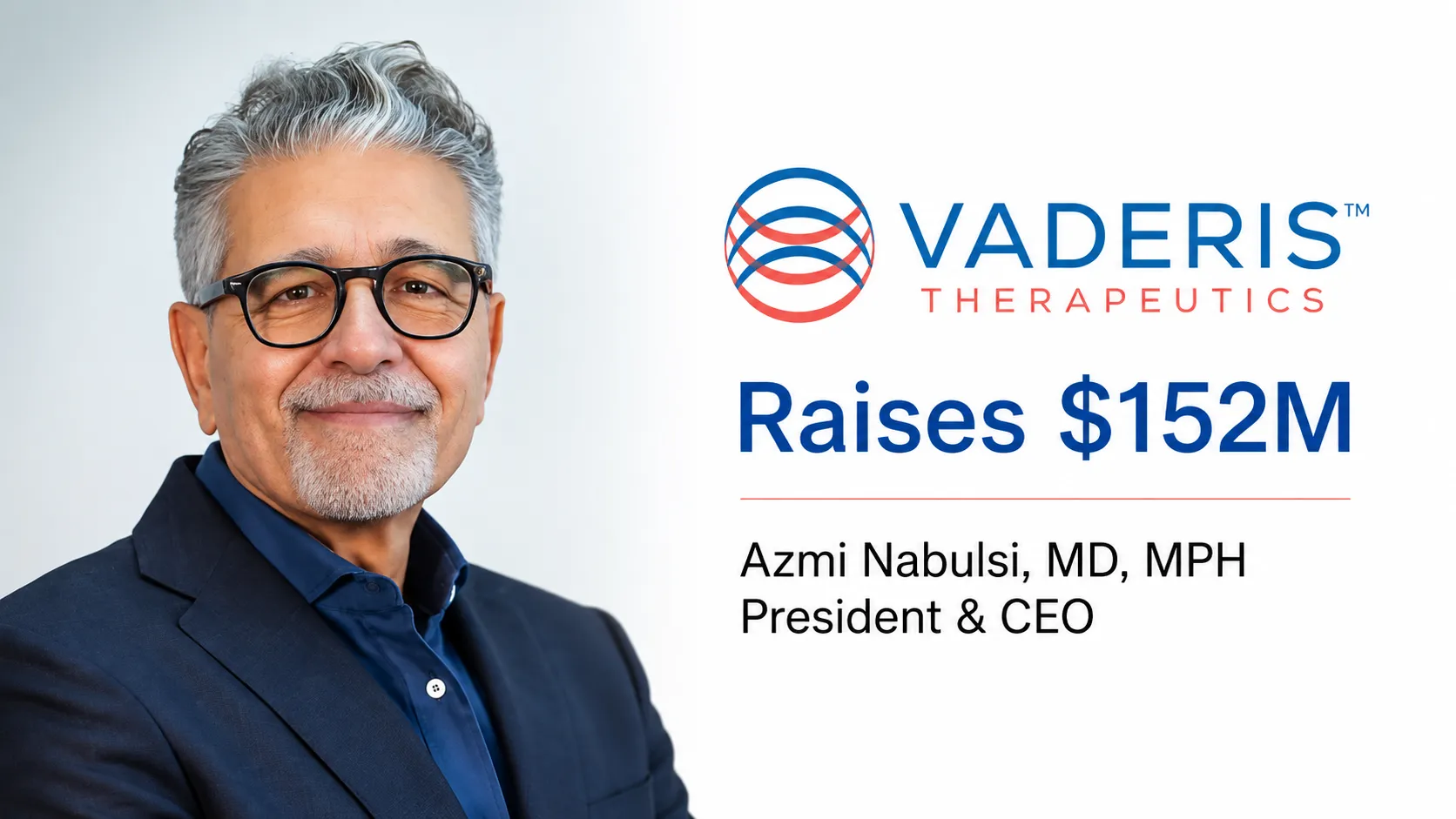
Vaderis Therapeutics AG, a Swiss biotechnology company developing targeted therapies for rare vascular diseases, has raised $152 million in a Series B funding round. The round was backed by Droia Oncology Ventures and Perceptive Advisors, alongside participation from EQT, Medicxi, Omega Funds and Goldman Sachs — a syndicate that combines specialist biotech investors with major institutional capital, reflecting continued investor appetite for well-capitalised, science-driven biotech companies even as broader venture markets have grown more selective through 2026.
The financing adds to a broader pattern of institutional capital moving into rare-disease biotech at the Series B stage, a segment that has historically relied more heavily on specialist life-sciences investors alone.
Rare vascular diseases represent a category of conditions that, despite affecting relatively small patient populations individually, collectively impose substantial clinical and economic burden, and have historically attracted less pharmaceutical research investment than more common disease categories due to smaller addressable markets. Vaderis Therapeutics' focus on this underserved therapeutic area positions the company within a broader biotech investment trend favouring rare-disease and orphan-drug development, where regulatory pathways in several major markets offer incentives such as expedited review and extended market exclusivity for successful therapies.
Clinical development for rare vascular disease therapies also benefits from increasingly sophisticated genetic and biomarker-based patient identification tools, which have made it more feasible in recent years to design efficient clinical trials for conditions affecting smaller, geographically dispersed patient populations than was possible a decade ago. Vaderis Therapeutics' approach reportedly incorporates such precision-medicine techniques into its clinical development strategy, an approach increasingly common among well-funded rare-disease biotech companies seeking to manage the elevated per-patient trial costs characteristic of this therapeutic category.
The involvement of Goldman Sachs alongside specialist life-sciences investors such as Droia Oncology Ventures and Medicxi reflects a pattern increasingly visible across biotech financing in 2026, in which major financial institutions have deepened direct participation in late-stage private biotech rounds, rather than limiting their involvement to public-market activity such as IPOs. This trend has provided well-positioned biotech companies with access to larger financing rounds earlier in their development lifecycle, potentially reducing the funding gap that has historically constrained smaller biotech companies working on complex, capital-intensive therapeutic programmes.
The rare-disease biotech funding environment has also benefited from growing pharmaceutical industry interest in licensing or acquiring promising clinical-stage assets from smaller, well-funded biotech companies, providing an additional potential exit pathway beyond traditional public listings. This dynamic has made well-capitalised, scientifically credible rare-disease companies like Vaderis Therapeutics increasingly attractive acquisition targets for larger pharmaceutical companies seeking to expand their own rare-disease portfolios, a consideration that likely factored into the investment thesis of institutional backers such as Goldman Sachs participating in this round alongside more specialised life-sciences investors.
Clinical researchers specialising in vascular disease have noted that increased biotech investment in the category could accelerate progress on conditions that have historically received disproportionately limited pharmaceutical research attention relative to their clinical burden, a gap that well-capitalised companies like Vaderis Therapeutics are now positioned to help address.
The Series B also reflects growing investor recognition that European biotech hubs, including Switzerland's life-sciences ecosystem, continue to produce scientifically credible rare-disease companies capable of attracting global institutional capital, reinforcing the region's standing as a significant contributor to the broader rare-disease drug-development pipeline alongside more traditionally dominant U.S. biotech clusters.
Company leadership indicates the fresh capital will be directed toward advancing its pipeline of targeted therapies through continued clinical development, a process that for rare vascular disease treatments typically requires navigating smaller and more geographically dispersed patient populations for clinical trials compared to more common disease areas. This operational complexity often extends development timelines and increases per-patient trial costs, making sustained, well-capitalised financing rounds such as this Series B particularly consequential for companies operating in the rare-disease therapeutic space.
Rare-disease drug development has historically faced a persistent structural funding challenge: while regulatory incentives such as orphan-drug designations can accelerate approval timelines and extend market exclusivity, the smaller patient populations involved mean that eventual commercial returns, while often substantial on a per-patient basis, arrive later and with greater uncertainty than in larger disease categories. This dynamic has made rare-disease biotech companies particularly dependent on sustained access to well-capitalised private funding rounds to bridge the gap between early clinical proof-of-concept and eventual commercialisation. Vaderis Therapeutics' ability to secure $152 million at the Series B stage, with participation from a major institutional investor such as Goldman Sachs, suggests growing investor confidence that rare vascular disease represents a therapeutic area capable of delivering commercially meaningful outcomes despite its smaller addressable patient population, a signal that could encourage further investment into similarly underserved rare-disease categories.
From an industry-structure perspective, Vaderis Therapeutics' progress also reflects a broader maturation of Europe's rare-disease biotech ecosystem, which has increasingly attracted global institutional capital rather than relying primarily on regional specialist investors, as was more typical in earlier funding cycles. This growing internationalisation of rare-disease biotech capital could meaningfully expand the pool of underserved conditions able to attract well-capitalised development programmes in the years ahead.

As Vaderis Therapeutics advances its clinical programmes, the company's progress will be closely watched within the broader rare-disease biotech investment community as an indicator of both scientific advancement and the continued viability of well-capitalised financing models for smaller therapeutic-area companies. With significant institutional capital now committed, the company enters its next development phase with substantially strengthened financial resources to pursue its targeted vascular disease pipeline.
As Vaderis Therapeutics advances toward later-stage clinical trials, its progress will offer a useful signal for the broader rare-disease biotech investment community regarding the continued viability of well-capitalised private financing as a pathway for developing therapies in smaller, underserved patient populations. Success at this stage could encourage further institutional capital into similarly overlooked rare-disease categories, reinforcing a broader shift already visible across biotech investment in 2026 toward previously underfunded therapeutic areas.
Vaderis Therapeutics has indicated further details of its clinical development timeline will be disclosed as its pipeline programmes advance through subsequent regulatory milestones over the coming year.
Perceptive Advisors and Omega Funds, both specialist healthcare investors participating in the round, have separately noted growing conviction that rare vascular conditions represent a therapeutic category where scientific understanding has advanced meaningfully in recent years, creating a more favourable environment for translating research progress into viable clinical-stage drug candidates than existed even five years ago.