
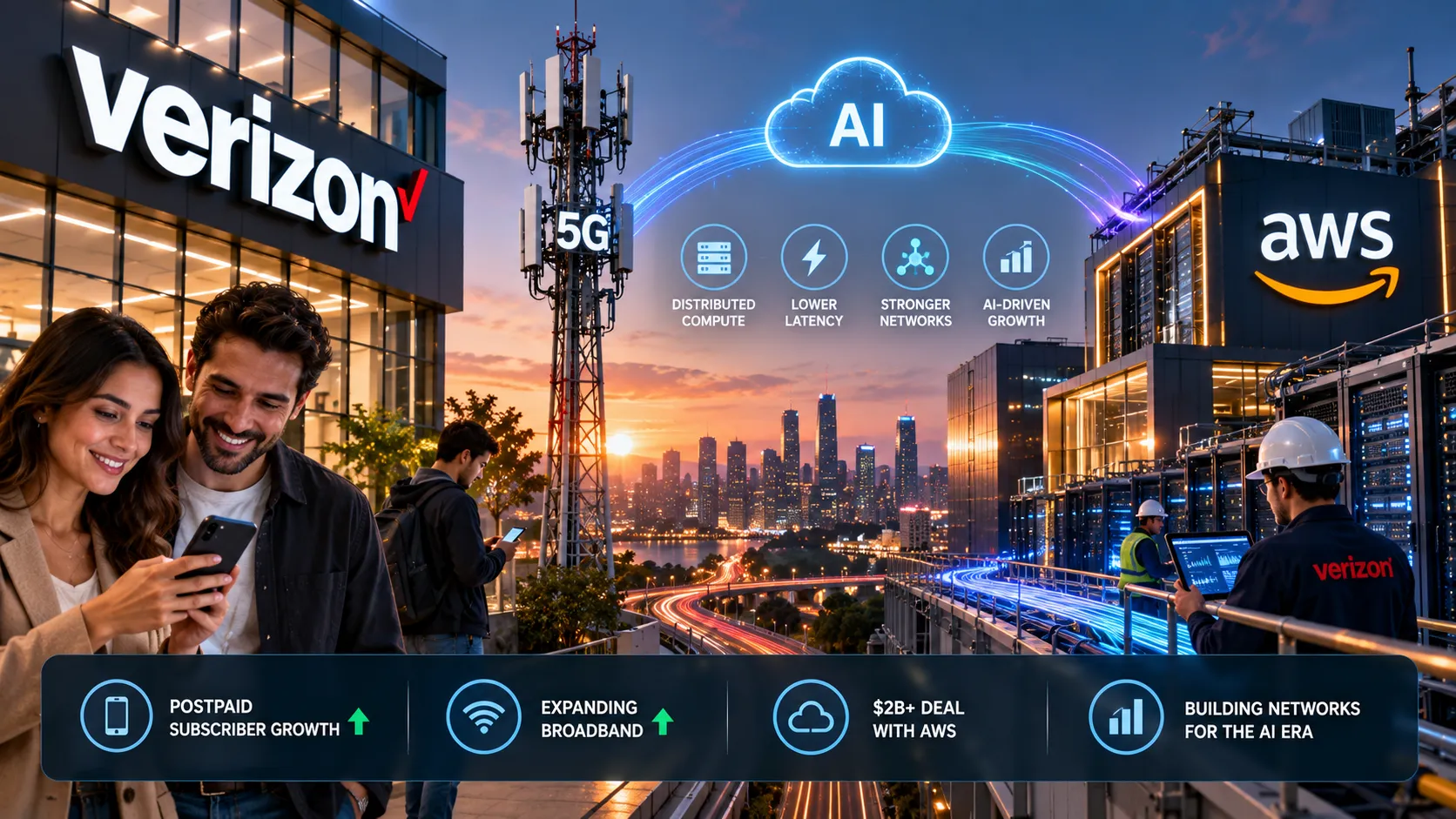
Verizon Communications reported its strongest third quarter for postpaid phone subscriber growth in five years and announced a deal worth more than $2 billion with Amazon Web Services, as the US telecom giant seeks to position its network as infrastructure for the artificial intelligence era.
The company added 406,000 net postpaid phone subscribers in the quarter ended 30 September, according to results released on 26 October, more than nine times the figure from a year earlier. Postpaid phone churn, the rate at which customers leave, improved by 4 basis points to 0.94 per cent.
Total operating revenue rose 1.5 per cent to $34.3 billion. Earnings per share were $1.25, up 6.8 per cent, while adjusted earnings per share, which exclude special items, rose 8.3 per cent to $1.31.
"Verizon delivered another record-breaking quarter," said chief executive Dan Schulman.
Guidance Raised Again
Verizon raised its full-year 2026 outlook for the third consecutive quarter. It now expects postpaid phone net additions of 1.1 million to 1.2 million for the year, adjusted earnings per share of $5.04 to $5.06, and free cash flow growth approaching 12 per cent.
Free cash flow in the third quarter reached $7.8 billion, up 12.1 per cent from a year earlier, giving the company resources to invest in its network, pay down debt and support its dividend, a key attraction for many Verizon shareholders.
The AWS Deal
The agreement with Amazon Web Services, valued at more than $2 billion, is aimed at scaling distributed compute for AI workloads. While full details were not disclosed, the deal reflects growing collaboration between telecom operators and cloud providers to bring computing power closer to where data is generated and used.
As AI applications proliferate, some workloads benefit from being processed near users rather than in distant data centres, reducing latency and network traffic. Telecom networks, with their extensive physical infrastructure, fibre networks and facilities across the country, are well placed to support such distributed, or edge, computing.
The deal follows other agreements between Verizon and major technology companies. Earlier this year, Verizon reached a deal with Google for dark fibre connectivity between data centres, part of a broader push to monetise its network assets as AI drives demand for high-capacity connectivity.
Broadband Growth
Verizon also added 314,000 broadband subscribers in the quarter, including 155,000 fibre customers and 159,000 fixed wireless access customers. Fixed wireless access, which delivers home internet over 5G networks, has become one of the fastest-growing segments of the US broadband market, allowing wireless carriers to compete with cable companies.
Fibre remains a strategic priority. Verizon has expanded its fibre footprint, including through its acquisition of Frontier Communications, a deal designed to significantly increase the number of homes and businesses it can reach with fibre broadband.
A Turnaround Under New Leadership
The results come during a period of change at Verizon under Schulman, the former PayPal chief executive who took over leadership of the company. Verizon had struggled with subscriber losses and intense competition from T-Mobile and AT&T in recent years, and new management has focused on improving customer experience, reducing churn and finding new growth avenues.
The strong subscriber numbers suggest those efforts are gaining traction. The improvement in churn is particularly notable in a mature market where carriers compete aggressively for customers through promotions and device deals.
The Telecom AI Opportunity
Telecom companies around the world are seeking ways to benefit from the AI boom. While cloud providers and chipmakers have captured most of the value so far, operators see opportunities in providing connectivity between data centres, hosting edge computing infrastructure and using AI to improve their own operations.
The demand for high-capacity, low-latency connectivity created by AI could help reverse years of slow growth in the telecom industry, where revenue has been constrained by saturated markets and price competition.
The India Parallel
The trend is visible in India too, where telecom and infrastructure companies are investing to capture AI-driven demand. Tata Communications this week announced plans to invest up to $450 million in a 10,000-km fibre network linking data centres, while Reliance Jio and Bharti Airtel have expanded into data centres and enterprise cloud services.
Indian IT services companies also play a role in telecom transformation globally, providing software, network engineering and AI services to operators, including in the United States.
Investor View
Verizon's results are likely to reassure investors who value the company's stable cash flows and dividend. The combination of subscriber growth, raised guidance and new AI-related revenue opportunities offers a more optimistic narrative than in recent years.
However, the telecom industry remains highly competitive, and Verizon carries substantial debt from past spectrum purchases and acquisitions. Maintaining subscriber momentum while investing in networks and managing its balance sheet will be key challenges.
Dividend and Debt
Verizon is one of the most widely held income stocks in the United States, valued by investors for its dividend, which it has raised for many consecutive years. Strong free cash flow is essential to sustaining that dividend while funding network investment and reducing debt. The company's 12 per cent growth in free cash flow in the quarter therefore matters as much to many shareholders as subscriber growth.
The company carries a significant debt load, built up through purchases of wireless spectrum, including large investments in the C-band spectrum used for 5G, and through acquisitions. Reducing leverage has been a priority, and improved cash generation gives management more flexibility to balance shareholder returns, investment and debt repayment. The AWS agreement and other AI-related deals could add new revenue streams that help support these goals over time, though their scale relative to Verizon's overall revenue remains modest for now.
What Comes Next
Verizon enters the fourth quarter, traditionally a busy period for promotions and device sales, with momentum. The integration of its fibre assets, execution on the AWS partnership and continued subscriber growth will determine whether the company can sustain its improved performance.
For the broader telecom sector, Verizon's deal with AWS is another sign that networks built for voice and data are being repurposed as critical infrastructure for the AI economy.


