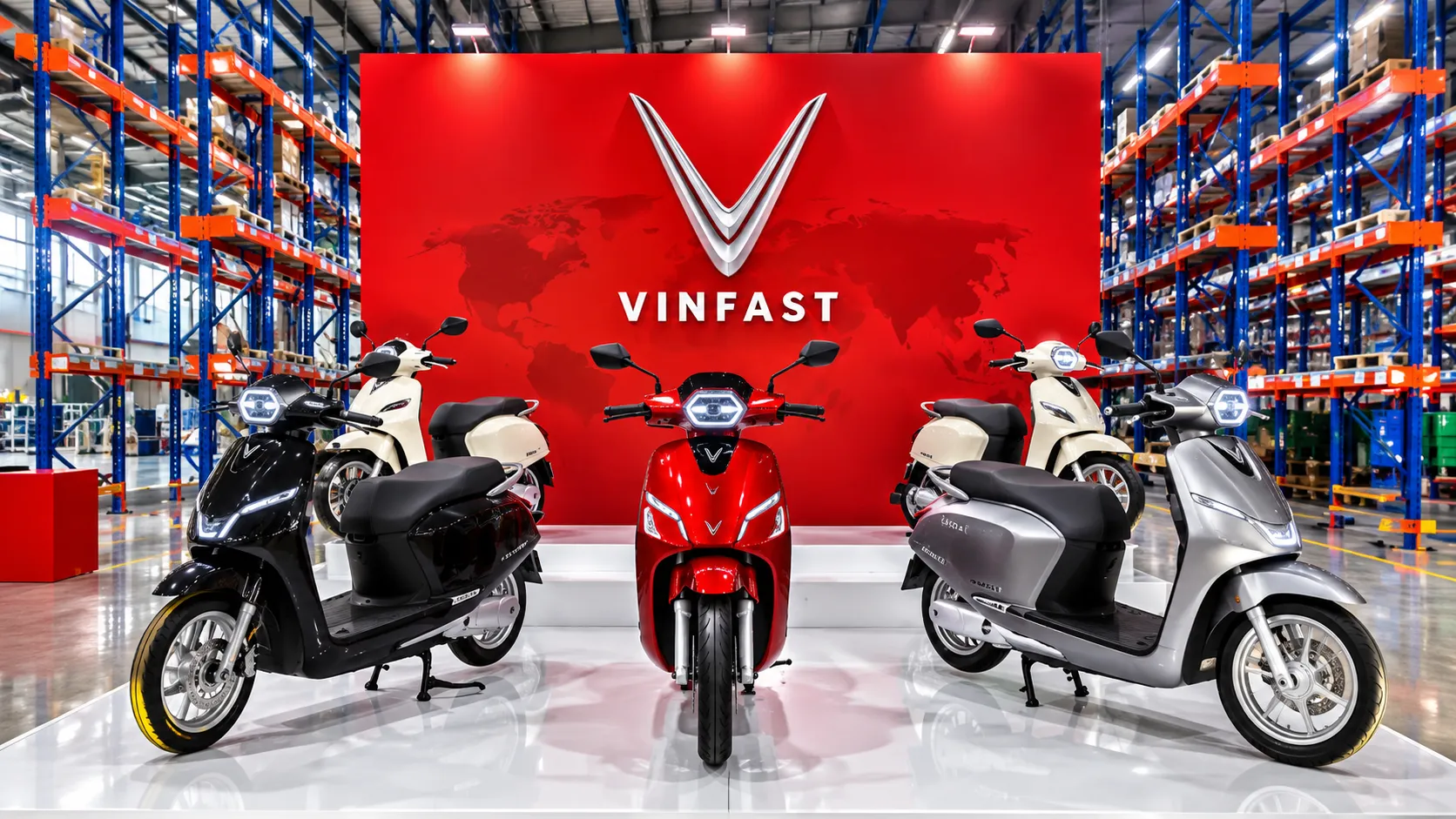
VinFast, the Vietnamese electric vehicle maker, is building a dedicated production line for electric scooters at its manufacturing facility in Tamil Nadu. The move signals a major push into India's electric two-wheeler market, the largest market for two-wheelers in the world.
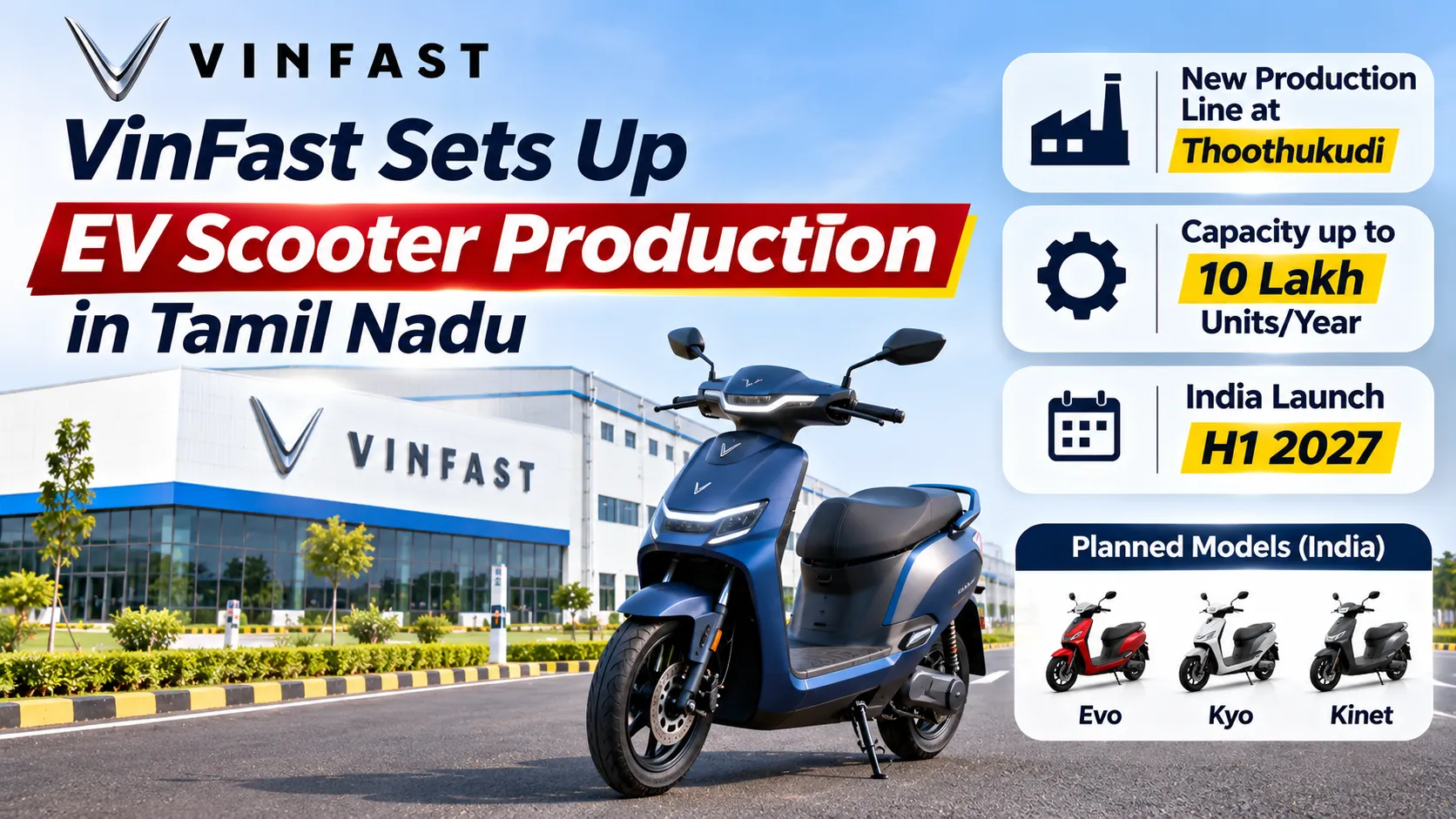
The company plans to enter India's electric two-wheeler segment in the first half of 2027, according to reports on November 22. The new line at its Thoothukudi facility will be able to scale up to 10 lakh (one million) units a year at maximum capacity.
Anurag Saxena, who leads VinFast's two-wheeler business in India, told PTI and Inc42 that the scooters would be adapted for Indian road and climate conditions and could offer battery swapping.
Which models are coming
VinFast has indicated it will launch battery-powered scooter models in India. Reports have referred to models including the Evo, Kyo and Kinet from VinFast's existing range. The final line-up, pricing and specifications for India have not yet been announced.
VinFast already sells electric scooters in Vietnam, where two-wheelers dominate personal transport. The company has built a range of models aimed at urban commuters, and its experience in a two-wheeler-heavy market gives it relevant expertise for India.
The Thoothukudi bet
VinFast's investment in Tamil Nadu has been one of the higher-profile foreign manufacturing commitments in India's EV sector. The company set up its plant in Thoothukudi, in the south of the state, initially focused on electric cars. Adding a dedicated two-wheeler line expands the facility's role significantly.
Tamil Nadu has become one of India's most important hubs for automobile manufacturing, including electric vehicles. The state is home to manufacturing plants for major carmakers and two-wheeler companies, as well as a large supplier ecosystem. Ola Electric's large scooter factory is located in the state, and companies including Ather Energy and TVS Motor also have significant operations there.
For VinFast, manufacturing locally offers several advantages. It helps the company avoid high import duties, qualify for government incentives tied to local production, and price its products competitively. Local production also allows faster delivery and easier adaptation to Indian conditions.
A crowded and competitive market
India's electric two-wheeler market has grown rapidly in recent years, but it is also intensely competitive. Established two-wheeler makers such as TVS Motor, Bajaj Auto and Hero MotoCorp have built strong electric scooter businesses, leveraging their brands, distribution networks and service centres.
Newer EV-focused companies, including Ather Energy and Ola Electric, have also captured significant market share, although Ola has faced challenges with service quality and market share in recent periods. Many smaller brands compete in lower-priced segments.
VinFast will need to differentiate itself to win customers. Battery swapping, if offered, could be one point of difference. Swapping allows riders to exchange a depleted battery for a charged one at a station in minutes, rather than waiting for a charge. It can be particularly attractive for commercial users such as delivery riders, who need to maximise time on the road.
Pricing will be critical. Indian two-wheeler buyers are highly price-sensitive, and electric scooters still often cost more upfront than petrol models, even if running costs are lower. Government subsidies and incentives have played an important role in supporting demand, and changes to these schemes can significantly affect sales.
Why two-wheelers matter for India's EV transition
Two-wheelers account for the large majority of vehicles sold in India. They are the main form of personal transport for hundreds of millions of people, especially in smaller cities and towns. Electrifying two-wheelers is therefore one of the most effective ways to reduce India's transport emissions, cut urban air pollution and lower the country's oil import bill.
The economics are increasingly favourable for riders. An electric scooter's running cost per kilometre is typically a fraction of a petrol scooter's, and maintenance is simpler because electric drivetrains have far fewer moving parts. For commuters who ride long distances every day, those savings can offset a higher purchase price within a few years.
Electric two-wheelers have also proven more commercially viable than electric cars in India so far. Their smaller batteries make them cheaper to produce, and charging is easier because batteries can often be removed and charged at home.
VinFast's global ambitions
VinFast is part of Vingroup, Vietnam's largest private conglomerate, founded by billionaire Pham Nhat Vuong. The company has pursued aggressive international expansion, including in the United States, Europe and Asia, and listed its shares in the US.
Its international journey has had mixed results. The company has faced questions about sales volumes, losses and product quality in some markets. India represents a large opportunity, but success will depend on careful execution, pricing and after-sales service.
Choosing India for a major two-wheeler manufacturing commitment suggests VinFast sees the country as a priority market. The scale of the planned capacity, up to one million units a year, also points to export ambitions. India-made scooters could potentially be shipped to other markets in South and Southeast Asia, Africa and the Middle East.
Implications for jobs and suppliers
A large scooter production line would create manufacturing jobs in Tamil Nadu and support local suppliers of components such as batteries, motors, electronics and plastics. Thoothukudi, a port city, is well placed for exports.
State and central governments have been keen to attract EV manufacturing investment, offering incentives through production-linked schemes and state industrial policies. VinFast's expansion will likely be welcomed as evidence that these policies are attracting foreign capital.
What to watch
The key milestones ahead include the official unveiling of VinFast's India scooter range, pricing announcements, the build-out of sales and service networks, and any battery swapping partnerships. Investors and competitors will also watch how quickly the Thoothukudi line ramps up production.
For The Impactful Global Indian's readers, VinFast's move underlines India's growing importance as a manufacturing base and consumer market for electric mobility. It also reflects deepening economic ties between India and Vietnam, two fast-growing Asian economies.
Whether VinFast can carve out a meaningful share of India's competitive electric two-wheeler market remains to be seen. But its investment adds another major player to a sector that is central to India's clean transport ambitions.


