Consumers around the world kept spending, and Visa kept collecting. The world's largest payments network has reported record annual revenue, driven by resilient consumer spending and strong growth in cross-border transactions.
Visa reported net revenue of $12.1 billion for its fiscal fourth quarter, ended September 30, up 13% from a year earlier, according to its earnings release on Tuesday, October 27. GAAP earnings per share rose 22% to $3.19, and non-GAAP earnings per share rose 17% to $3.48.
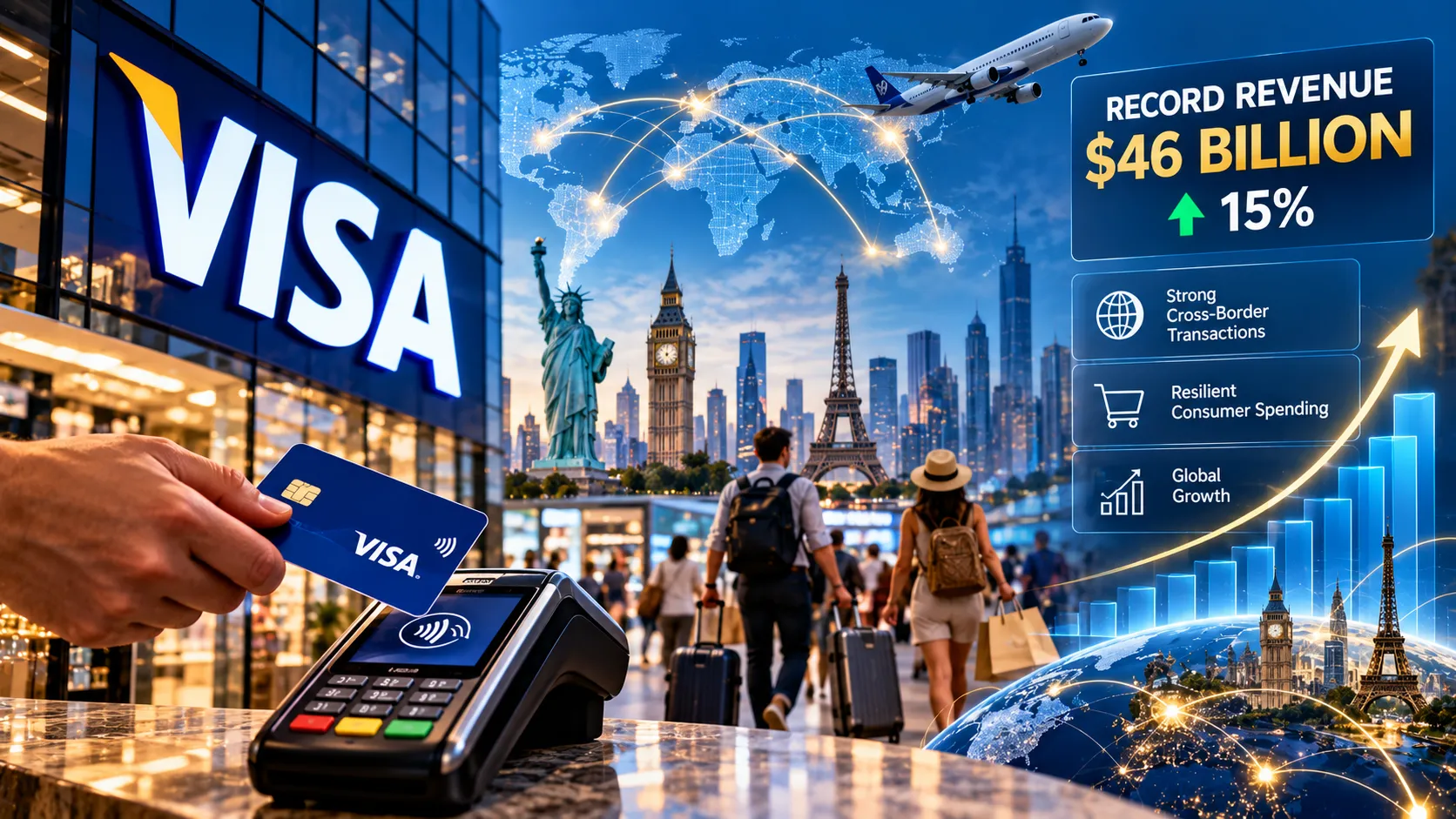
"Visa delivered a milestone year," said chief executive Ryan McInerney, noting that the company achieved record net revenue of $46 billion, up 15%.
A record year
For the full fiscal year, Visa's net revenue reached $45.9 billion, up 15%, or 14% in constant dollars. GAAP earnings per share rose 21% to $12.32, and non-GAAP earnings per share increased 16% to $13.27.
Payments volume grew 9% in constant dollars for both the quarter and the year. Processed transactions reached 74.2 billion in the quarter, up 10%, and 281.3 billion for the year, up 9%.
Cross-border strength
Cross-border volume, excluding transactions within Europe, rose 14% in the quarter and 12% for the year. Cross-border payments are among Visa's most profitable, since they carry higher fees, and they are closely linked to international travel and e-commerce.
Strong cross-border growth suggests that international travel has remained robust despite high fuel prices and geopolitical tensions, and that consumers continue to shop online from overseas merchants.
Returning cash to shareholders
Visa returned $5.2 billion to shareholders in the quarter through buybacks and dividends, including the repurchase of about 11 million Class A shares for $4 billion. For the full year, it returned $25.6 billion, including about 61 million shares bought back for $20.5 billion.
The board raised the quarterly dividend by 16% to 78 cents a share.
How Visa makes money
Visa does not issue cards or lend money. Instead, it operates the network that connects banks, merchants and consumers, earning fees on the volume of payments and the number of transactions processed. That model allows it to benefit from growth in consumer spending without taking on credit risk.
The company has been expanding into new areas, including value-added services such as fraud prevention, data analytics and consulting, as well as new payment flows such as business-to-business payments, cross-border money transfers and payouts to gig workers.
The new frontiers
Visa has been investing in emerging technologies, including stablecoins, which are digital tokens pegged to currencies such as the US dollar, and "agentic commerce," in which AI agents make purchases on behalf of consumers. The company has said it wants to ensure that its network remains central as payments evolve.
Competition is intensifying from real-time payment systems, digital wallets and fintech companies. In many countries, government-backed instant payment systems offer low-cost alternatives to card networks.
The India challenge
India illustrates both the opportunity and the challenge for Visa. The country is one of the world's fastest-growing digital payments markets, but much of that growth has come through the Unified Payments Interface (UPI), a government-backed real-time payment system that allows instant bank-to-bank transfers at little or no cost to users.
UPI processes billions of transactions every month and has become the dominant form of digital payment for everyday purchases in India. Visa competes with the domestic card network RuPay, which is linked to UPI and supported by government policy.
Visa continues to grow in India through credit cards, which are gaining popularity among affluent and middle-class consumers, and through cross-border payments, including spending by Indian travellers abroad and payments to Indian merchants from overseas.
Consumer resilience
Visa's results provide a window into consumer spending worldwide. Payments volume growth of 9% suggests that consumers, particularly in the United States, have continued to spend despite high interest rates and elevated energy prices. US consumer confidence improved in October, according to recent data.
The card versus account-to-account debate
Payment networks such as Visa and Mastercard face a long-term question about the growth of account-to-account payment systems, which move money directly between bank accounts without using card networks. Systems such as India's UPI, Brazil's Pix and the European Union's instant payment initiatives have shown that these systems can achieve rapid adoption, particularly when supported by governments.
Visa has responded by expanding into new payment flows and offering services that work alongside account-to-account systems, such as fraud prevention and tokenisation. It argues that card networks offer protections, rewards and global acceptance that are difficult to replicate.
Travel and e-commerce
Cross-border volume growth of 14% in the quarter highlights the importance of travel and international e-commerce for Visa. When consumers travel abroad or shop from foreign websites, card networks earn higher fees, making cross-border transactions among the most profitable for the company. The resilience of international travel despite high fuel prices and geopolitical tensions has been a significant support for Visa's earnings this year.
Shareholder returns
Visa's capital return programme, which delivered $25.6 billion to shareholders in the fiscal year, reflects the company's strong cash generation. Payment networks require relatively modest capital investment compared with their revenue, allowing them to return a large share of profits through buybacks and dividends. The 16% dividend increase signals management's confidence in continued earnings growth.
Fraud and security
As digital payments grow, so does fraud. Visa has invested heavily in AI-based fraud detection, tokenisation, which replaces card numbers with secure tokens, and authentication technologies. These services also generate revenue as value-added offerings to banks and merchants.
What comes next
Visa will provide its outlook for the new fiscal year on its earnings call. Investors will watch for signs of how consumer spending is holding up, the trajectory of cross-border travel and the progress of new growth areas such as value-added services and stablecoin-related payments.
The company also faces regulatory scrutiny in the United States over fees charged to merchants and competition in debit payments, which could affect its business in its largest market. Regulators in several countries are also examining card network fees and competition in digital payments, and the outcome of those reviews could shape Visa's growth in key markets. India's rapidly evolving payments landscape will remain an important test of how card networks adapt to government-backed alternatives. Consumer spending trends will remain the key driver.