Wakefit, the direct-to-consumer brand that built a business selling mattresses online before expanding into furniture and physical stores, delivered record sales in the September quarter. But rising raw material costs kept its profit from growing.
The Bengaluru-based company's operating revenue rose about 20% year-on-year to ₹452 crore in the July-September quarter, the second quarter of the 2026-27 financial year, according to Inc42, which reported the results on Friday, November 13. Revenue was up 11.6% from ₹404.9 crore in the previous quarter.
Net profit was ₹15.9 crore, roughly flat compared with nearly ₹16 crore a year earlier, and down 32% from ₹23.4 crore in the June quarter.
The cost squeeze
Wakefit attributed the pressure on profits to higher raw material costs. Co-founder and executive director Chaitanya Ramalingegowda cited "crude-linked raw materials, particularly Polyol and TDI, continuing to remain elevated," according to Inc42. The company described the operating environment as "challenging."
Polyol and toluene diisocyanate (TDI) are the key chemicals used to make polyurethane foam, the main material in most mattresses. Their prices are linked to crude oil, which has risen sharply this year amid conflict in the Middle East. For mattress makers, higher foam costs directly affect margins unless they can pass them on to customers.
Total expenses rose 19% to ₹441.4 crore from ₹370.5 crore, according to Inc42.
Operating performance improves
Despite the cost pressures, Wakefit's operating profitability improved. Operating EBITDA rose 25.8% to ₹30.5 crore from ₹24.2 crore, and the operating EBITDA margin improved to 6.7% from 6.4%, according to Inc42.
The gap between improving operating EBITDA and flat net profit reflects tax effects. Wakefit paid additional tax of ₹10.7 crore, and its deferred tax charge was ₹6.4 crore, compared with nil a year earlier. The company cited the "normal-course reversal of timing differences relating to depreciation and provisions."
Other income was ₹16 crore, bringing total income to ₹468 crore.
Building an offline network
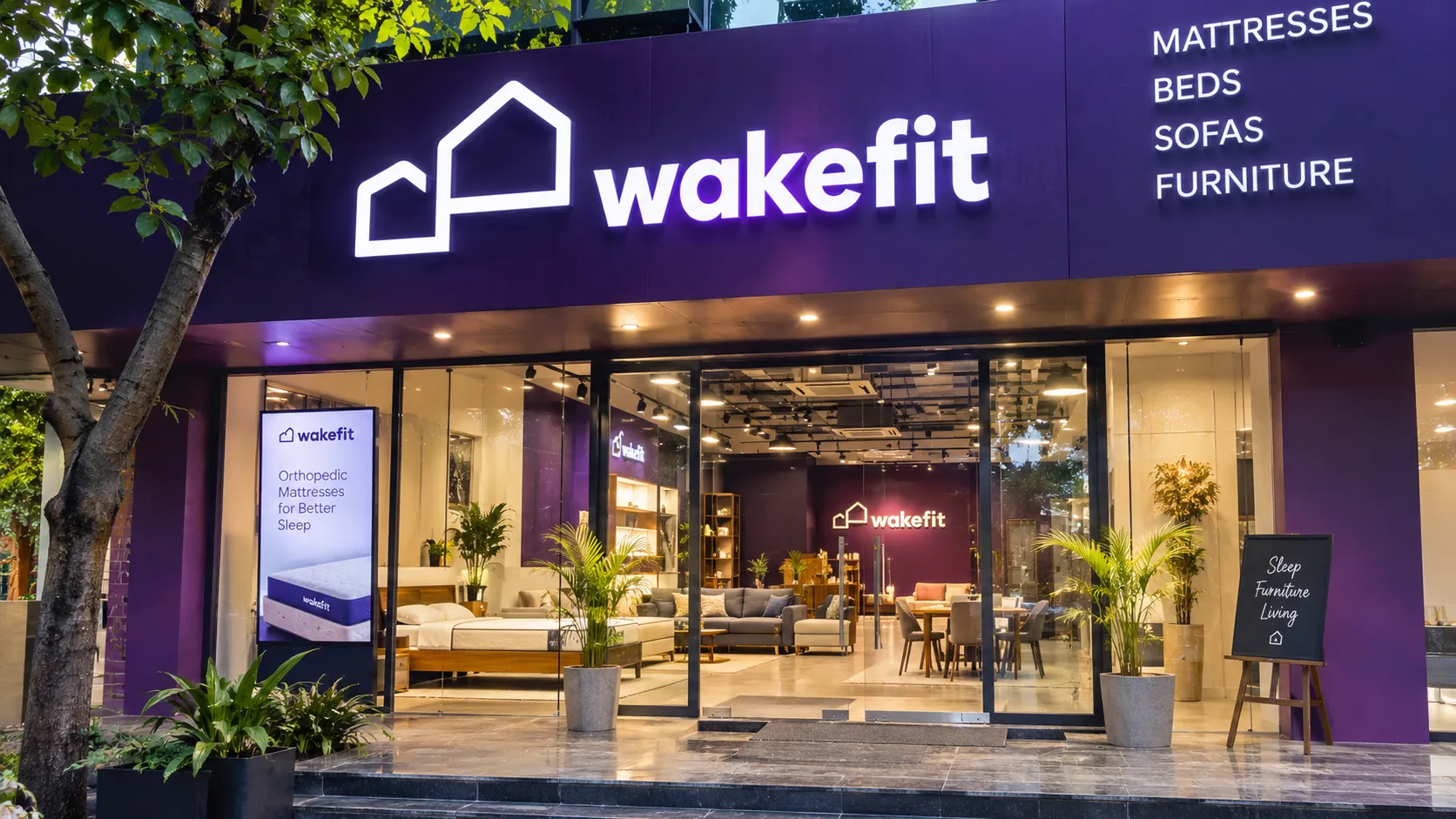
Wakefit has been rapidly expanding its physical retail presence. It opened 41 new stores in the quarter, bringing its company-owned stores to 205 across 137 cities, according to Inc42. Its products are also sold through 2,589 multi-brand outlets in 787 towns and cities.
Own channels, including its website, app and stores, accounted for 70% of sales, with external channels such as marketplaces and multi-brand outlets contributing the remaining 30%.
The shift from online to omnichannel retail reflects the reality that many customers want to see and test furniture and mattresses before buying. Large purchases such as sofas, beds and wardrobes are particularly suited to physical showrooms.
Capital spending
Wakefit plans capital expenditure of ₹100 crore to ₹120 crore in the 2026-27 financial year, with about 80% going towards retail expansion. "Our planned FY27 capex of around ₹100 Cr to ₹120 Cr remains on track," Ramalingegowda said, according to Inc42.
The company plans to open its first jumbo store in Bengaluru in the second quarter of the 2027-28 financial year.
Wakefit's supply chain includes a 1.6 lakh sq ft mother warehouse in Hosur, Tamil Nadu, 10 inventory holding points and 26 delivery points, as of the end of September.
From mattresses to home solutions
Wakefit was founded in 2016 by Ankit Garg and Chaitanya Ramalingegowda as an online mattress brand, using a direct-to-consumer model to offer quality products at lower prices than traditional brands sold through dealers. It expanded into pillows, bedding, furniture, home furnishings and decor.
Mattresses still account for the majority of its revenue, according to Inc42, but furniture, furnishings and decor are a growing share.
A listed D2C brand
Wakefit is one of a small number of Indian direct-to-consumer brands to list on the stock market, joining companies such as Honasa Consumer, the parent of Mamaearth, and Lenskart. Its shares closed 1.1% lower at ₹138.75 on the BSE on the day of the results, according to Inc42.
Listed D2C brands face scrutiny over their ability to grow profitably as they expand beyond online channels, which requires significant investment in stores, inventory and logistics.
India's home furnishing market
India's home furnishing and furniture market is large and growing, driven by urbanisation, rising incomes, new housing and a growing preference for branded products. The market has traditionally been dominated by unorganised local manufacturers and retailers, but branded players are gaining share.
Wakefit competes with established brands such as Sleepwell, Kurl-on and Duroflex in mattresses, and with Pepperfry, IKEA, Urban Ladder and Godrej Interio in furniture.
The D2C playbook
Wakefit's journey illustrates the evolution of India's direct-to-consumer brands. Many began online, using social media and digital marketing to reach customers directly and avoid the costs of traditional distribution. As online customer acquisition costs rose, many shifted to omnichannel models, opening stores and selling through marketplaces and multi-brand retailers to reach more customers.
Physical stores require significant investment in rent, staff and inventory, and their success depends on location and footfall. Wakefit's capex plans show that it sees retail as central to its growth, despite the costs.
Managing input costs
Mattress makers have limited ways to manage raw material cost spikes. They can raise prices, reformulate products, negotiate with suppliers or accept lower margins. Raising prices risks losing customers to competitors, particularly in a price-sensitive market, while absorbing costs hurts profits.
The direction of crude oil prices will be important. If oil prices ease, foam costs may fall, improving margins for Wakefit and its competitors.
The company has also benefited from the growth of India's housing market, as new homeowners and renters furnish their homes. Rising urbanisation and the growing number of nuclear families have expanded demand for affordable, well-designed furniture and mattresses, a segment that Wakefit has targeted since its founding.
Its results come as investors scrutinise the profitability of listed consumer brands. Many new-age consumer companies have reported strong revenue growth this earnings season, but margins have been squeezed by higher input costs and spending on marketing and retail expansion.
Analysts will also track the performance of the company's newer stores, since store productivity typically improves as locations mature and build local awareness.
What comes next
Investors will watch whether Wakefit can pass on higher raw material costs without hurting demand, how its new stores perform and whether profit growth resumes as the company scales. The direction of crude oil prices will be a key factor for its margins in the coming quarters.