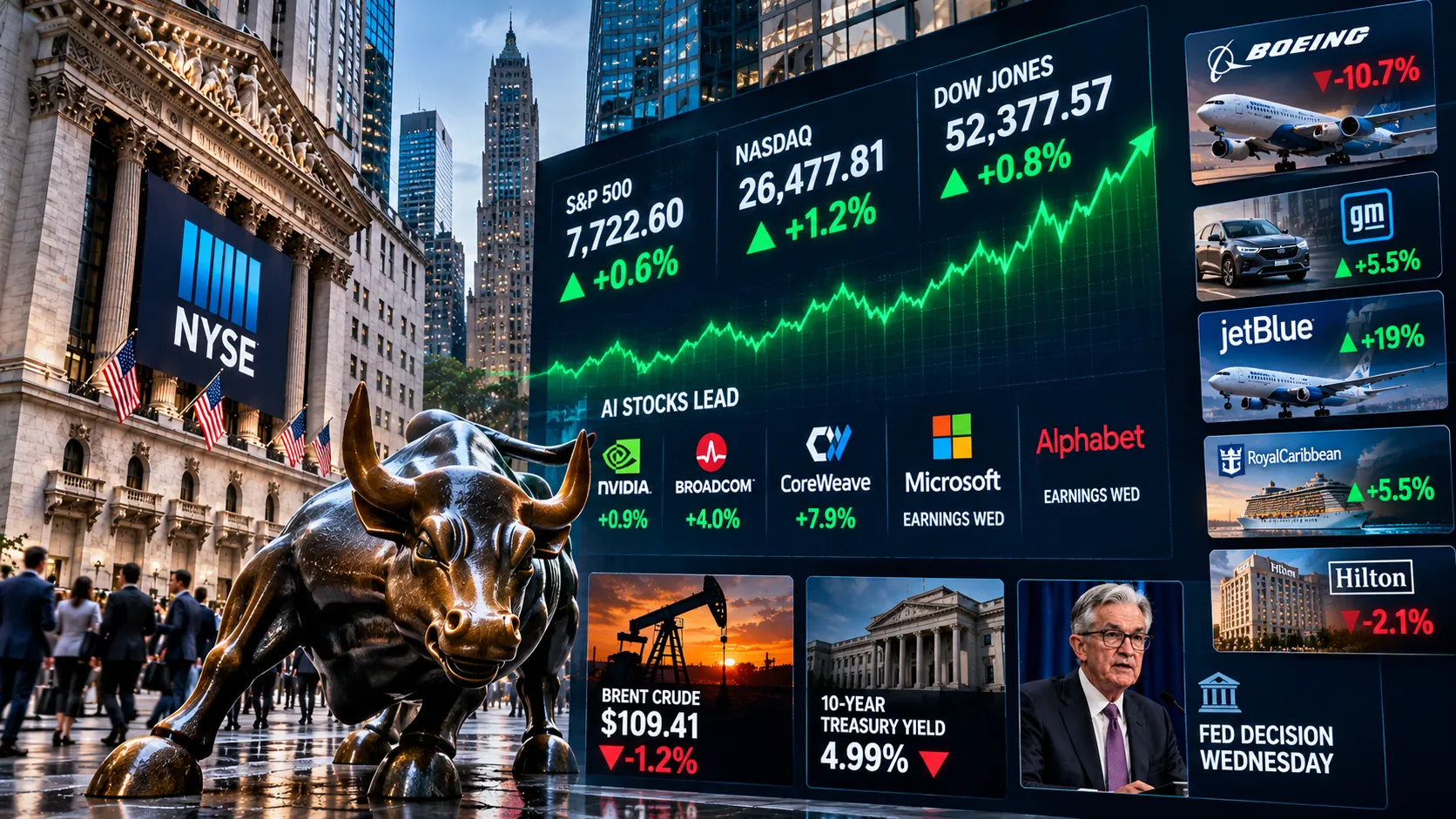
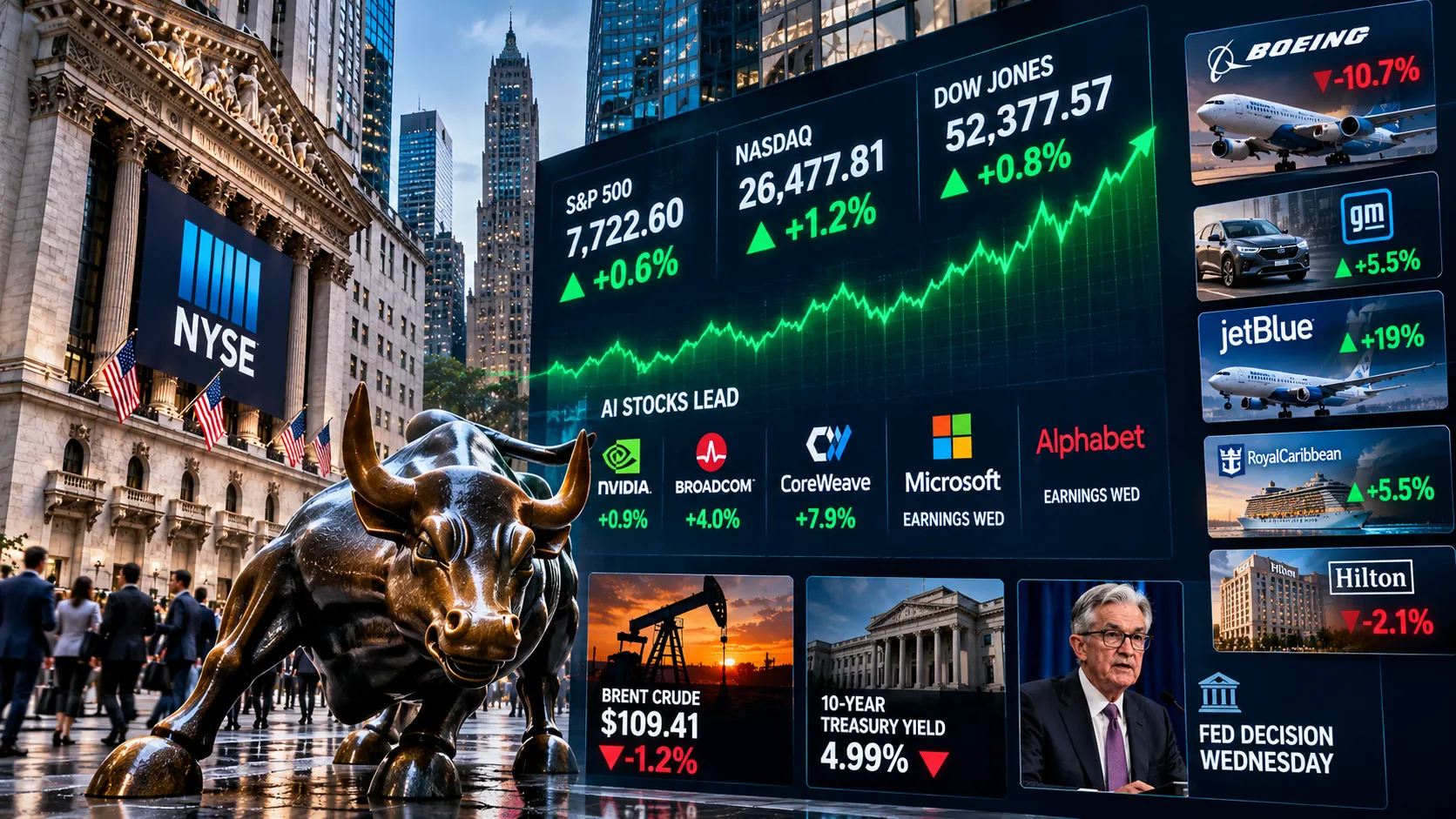
Artificial intelligence stocks regained their footing on Wall Street on Tuesday, lifting US benchmarks back towards record highs after weeks of anxiety about the cost of financing the AI boom.
The S&P 500 rose 0.6% to 7,722.60 on October 27, bringing it within 1.2% of the record it set earlier this month, according to the Associated Press. The Nasdaq Composite gained 1.2% to 26,477.81, while the Dow Jones Industrial Average edged up to 52,377.57.
The gains were narrow. Most stocks in the S&P 500 fell, but advances in influential AI-related companies outweighed the declines.
AI stocks bounce back
AI stocks have swung sharply in recent weeks amid concerns about the rising cost of borrowing to fund data centres and AI chip purchases. On Tuesday, those concerns eased.
Broadcom rose 4% after announcing a $63 billion financing deal, arranged with Blackstone and several Wall Street banks, to help Anthropic access its AI accelerators and networking products. Nvidia gained 0.9%. CoreWeave, which rents out AI chips that it has financed with debt, jumped 7.9%.
The rally carried over into Asia on Wednesday, where South Korea's Kospi jumped more than 5% after SK hynix reported a record quarterly profit.
Boeing slumps
Not all the news was positive. Boeing fell 10.7% after reporting a bigger-than-expected quarterly loss and saying it would miss its targets for 737 production and jet deliveries this year. The plane maker pushed back its free cash flow targets by a year.
Hilton dropped 2.1% after reporting weaker revenue and a profit forecast below analysts' expectations.
Movers on corporate news
General Motors rose 5.5% after announcing that it would move its stock listing from the New York Stock Exchange to the Nasdaq, a move that would make it eligible for inclusion in the Nasdaq-100 index.
JetBlue Airways jumped 19% despite reporting a larger summer loss than expected, as its chief executive projected a return to sustained operating profit next year, according to the AP. Royal Caribbean rose 5.5% after reporting stronger summer profit and raising its full-year forecast.
Sherwin-Williams fell 2.7% after reporting weaker profit, as high mortgage rates weighed on housing demand. "Customer sentiment and the leading indicators we track point to muted demand over the remainder of the year and into 2027," chief executive Heidi Petz said.
Bonds and oil
The 10-year Treasury yield eased to 4.99% from 5.00%. Yields at these levels, the highest in years, raise borrowing costs for households, companies and governments, and weigh on stock valuations.
Brent crude fell 1.2% to $109.41 a barrel, helping keep yields in check. Oil prices remain elevated because of supply disruptions linked to conflict in West Asia.
The economy
US consumer confidence improved in October, defying economists' expectations of a decline, according to the AP. Strong consumer spending has helped the US economy remain resilient despite high interest rates and elevated energy prices.
The Fed in focus
Investors are waiting for the Federal Reserve's interest rate decision on Wednesday. The central bank is widely expected to hold rates steady after raising them last month, its first increase in three years. Investors will look for signals about whether further increases are likely.
Big Tech earnings ahead
The week's most important events for the AI trade are still to come. Microsoft and Alphabet report quarterly results on Wednesday after the market closes, and Amazon on Thursday. Investors will look for evidence that AI investment is translating into revenue growth, particularly in cloud computing.
What it means for India
Movements on Wall Street have a direct effect on Indian markets. A rally in US technology stocks tends to support global risk appetite, which can encourage foreign investment in emerging markets such as India. However, high US Treasury yields make US assets more attractive and can draw money away from emerging markets.
Indian IT companies, which earn most of their revenue from US clients, are particularly sensitive to US economic conditions and corporate technology spending.
Why AI financing matters to markets
The concerns that weighed on AI stocks in recent weeks centred on the cost of borrowing. Building data centres and buying AI chips requires enormous amounts of capital, much of it raised through debt. As Treasury yields have climbed towards 5%, borrowing costs have risen, raising questions about the returns on AI investments.
The Broadcom financing deal, with major banks and Blackstone committing $63 billion, appeared to reassure investors that capital remains available for large, creditworthy AI projects. At the same time, smaller companies that depend on borrowing, such as some AI cloud providers, remain more vulnerable to tightening credit conditions.
A narrow rally
The fact that most S&P 500 stocks declined even as the index rose highlights how concentrated the US market has become. A handful of large technology companies account for a significant share of the index's value, so their movements can lift or drag the overall market regardless of how other stocks perform. That concentration has been a recurring concern for investors worried about the market's dependence on the AI theme.
Earnings season so far
The US earnings season has been broadly positive, with many companies reporting profits above analysts' expectations. But reactions have been mixed, as investors focus on guidance for the coming quarters and the impact of high energy costs, elevated interest rates and trade policy on business conditions. Companies exposed to consumer spending on travel and leisure, such as Royal Caribbean, have generally reported strong results, while those tied to housing and big-ticket purchases, such as Sherwin-Williams, have been more cautious.
What comes next
The direction of US markets in the coming days will depend on the Fed's decision, Big Tech earnings and oil prices. Strong results from the largest AI spenders could extend the rally and push the S&P 500 to new records, while disappointing numbers could revive concerns about the sustainability of AI investment. Market participants will also watch whether the rally broadens beyond a handful of technology giants, since wider participation across sectors would suggest a healthier and more durable advance than one dependent on a narrow group of AI leaders. Volatility measures and bond yields will offer additional signals about investor confidence as the busy week unfolds. Investors in India and other emerging markets will watch these developments closely, since shifts in US risk appetite often ripple quickly through global capital flows and currency markets.