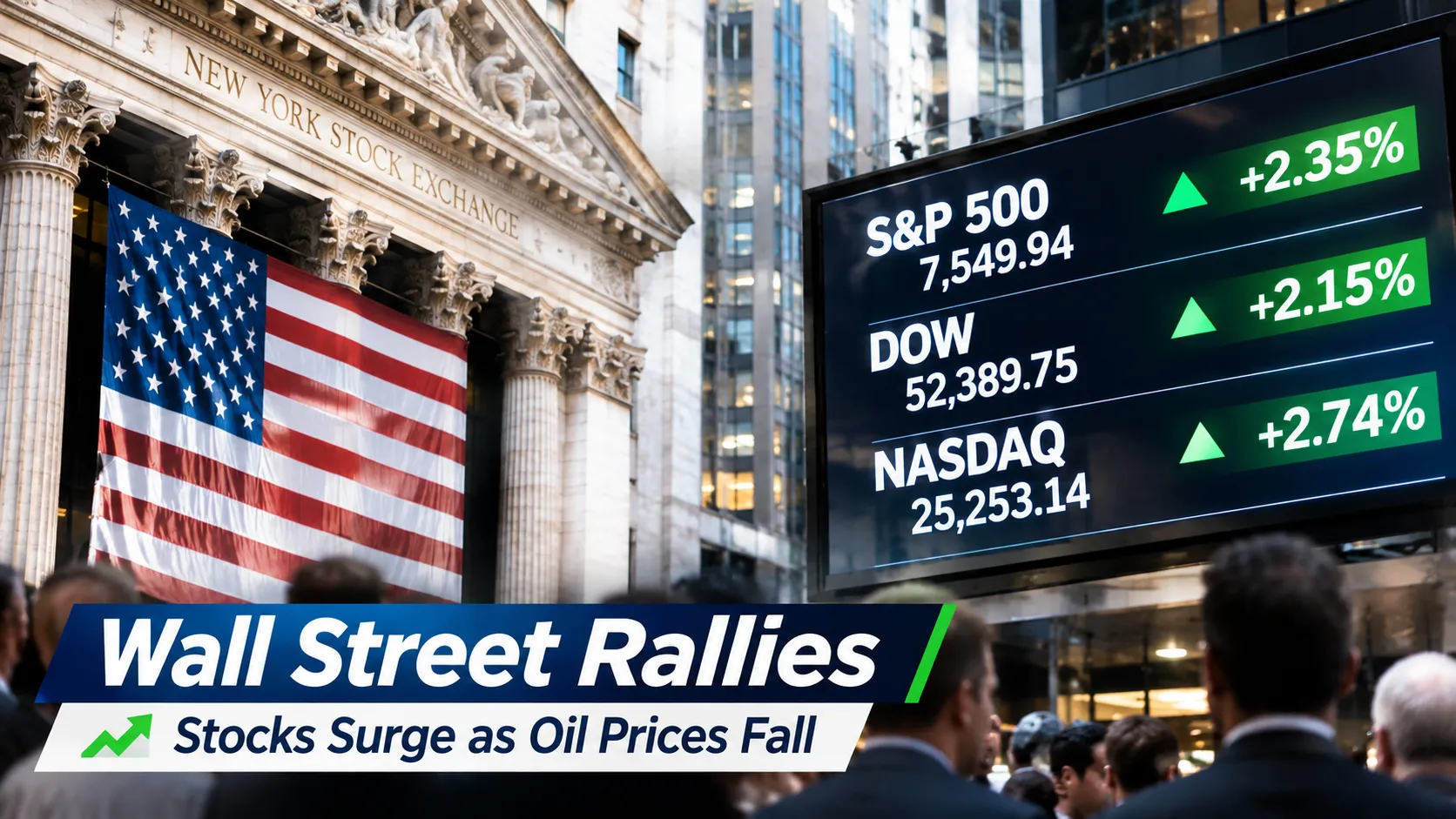
Wall Street staged its strongest rally in seven months on Monday, November 9, as falling oil prices and bargain hunting in technology stocks lifted markets after one of the most turbulent weeks of the year.
The S&P 500 rose 2.35% to 7,549.94, its best day since April 8, according to StockTitan and TheStreet. The Dow Jones Industrial Average gained 2.15%, or about 1,104 points, to 52,389.75, and the Nasdaq Composite climbed 2.74% to 25,253.14. The small-cap Russell 2000 rose 3.15% to 2,840.81, and the Nasdaq-100 gained 3.40%.
The rally was broad. About 75% of stocks rose, with 4,221 advancing and 1,240 declining, according to TheStreet. By late morning, nearly every sector of the S&P 500 was higher.
Oil retreats
A key driver was a sharp fall in oil prices. Brent crude fell about 3.6% to $94.75 a barrel in early trading, and US West Texas Intermediate crude dropped about 3% to $88.11, according to TheStreet. Prices had recently traded above $100 a barrel.
Oil fell after President Donald Trump said fresh strikes on Iran were unlikely while talks continue, according to TheStreet. Ole Hansen of Saxo Bank said oil was falling "on hopes of a US-Iran peace deal rather than concrete signs of progress."
Lower oil prices ease pressure on inflation and reduce costs for businesses and consumers, which is generally positive for stocks. High energy prices linked to the conflict involving Iran have pushed central banks, including the Bank of England, to raise interest rates.
Tech bounces back
Technology stocks led the rebound after a severe sell-off the previous week, when fears that the midterm election results would slow data centre construction triggered heavy losses in chip and AI stocks. Investors bought the dip on Monday.
AMD jumped 13.26% after Oppenheimer upgraded it to outperform, with a price target of $600, according to StockTitan and TheStreet. Broadcom rose 8.78%. Taiwan's main stock index, which is heavily weighted towards chipmakers, closed up 4.94% overnight.
Other notable gainers included Coherent, up about 18%, Bloom Energy, up 13.5%, Flex, up 12.86%, and Ferguson, up 12.53%, according to TheStreet.
Nvidia bucks the trend
Nvidia was a notable exception. The chipmaker's shares fell 4.27% to $178.67, erasing about $192 billion of market value, according to StockTitan, after its board launched an independent investigation into reports that chief executive Jensen Huang had been the target of a foreign intelligence effort. The board said it has no reason to believe company secrets or national security were compromised.
"The impact is currently contained to Nvidia," said Joachim Klement of Panmure Liberum, according to CNBC.
Company news drives big moves
Several stocks moved sharply on company-specific news. Telos rose 48.76% after raising its 2026 revenue forecast, and Delcath gained 35.77% after doing the same, according to StockTitan. Greenfire Resources jumped 38.21% after Canadian oil producer Strathcona agreed to buy it.
On the downside, Faeth Therapeutics fell 42.49% after early trial results, Janux dropped 27.62% after early data, and Ionis fell 21.36% after cutting its 2026 sales forecast for Tryngolza to about $50 million from $100 million to $110 million. Software company monday.com fell 9.10% after forecasting slower fourth-quarter revenue growth.
A note of caution
Analysts warned that the rally may not signal a lasting recovery. "The rebound looks more like a tentative recovery in risk appetite than a clear reversal of the downtrend," said Daniela Hathorn, senior market analyst at Capital.com, according to TheStreet.
Citi downgraded US stocks and global technology to neutral from overweight, and upgraded European equities excluding the United Kingdom to overweight, according to TheStreet. Citi strategist Beata Manthey warned that positioning in the Nasdaq could reset lower "into net-short territory."
Political backdrop
The markets are digesting the results of the November 3 midterm elections, in which Democrats won the House and Senate, according to TheStreet. Investors are watching for potential regulatory changes, particularly regarding data centres and AI. The previous week's sell-off was driven partly by fears that new state governments could restrict data centre construction.
Corporate layoffs also made headlines. Boeing plans to cut about 5% of its staff, and PepsiCo is cutting about 1,000 jobs in North America, according to TheStreet.
Inflation data ahead
Investors are awaiting the October consumer price index, due on Tuesday, November 10, at 8:30 a.m. Eastern time. Economists polled by Dow Jones expect a 0.3% monthly rise in headline prices, and 0.2% excluding food and energy, according to CNBC as cited by StockTitan.
The data will influence expectations for the Federal Reserve. Traders had priced in a significant chance of an interest rate increase in December, reflecting concerns about inflation driven by high energy prices. Lower oil prices, if sustained, could ease those concerns.
Other assets
Gold futures rose 1.17% to $4,122.60 an ounce in early trading, while silver fell 1.52% to $52.73, according to TheStreet. Bitcoin fell 1.40% to about $74,810.
What it means for India
The rally in US stocks and the fall in oil prices are positive for Indian markets. Lower oil prices reduce India's import bill and inflation, while a recovery in global risk appetite can support foreign investment flows. Indian markets also rallied on November 9, with the Nifty 50 touching a nine-month high.
Breadth returns
One encouraging sign for investors was the breadth of the rally. Small-cap stocks, represented by the Russell 2000, rose more than the S&P 500, suggesting that buying extended well beyond the largest technology companies. A market rally led by a broad range of companies is generally seen as healthier than one driven by a handful of giants.
The equal-weighted performance of the market has been a focus for investors this year, as concerns about the concentration of gains in AI-related stocks have grown.
Energy stocks lag
The energy sector was a notable laggard. Energy stocks started the day higher but slipped as oil prices fell, ending nearly flat, according to TheStreet. The decline in oil wiped out the sector's gains for the quarter to date. Energy companies had benefited from high oil prices earlier in the year, but hopes for a resolution of the conflict involving Iran have weighed on the outlook for crude.
What comes next
The US inflation report and Nvidia's third-quarter results, due on November 17, will be the next major tests for markets. Investors will also watch oil prices, US-Iran talks and any policy developments affecting AI and data centres. After a week of extreme volatility, Monday's rally offered relief, but analysts caution that the path ahead remains uncertain.