FundingMarket Data Women5 MIN READ

Wall Street Ends Volatile Week Higher as Oil Retreats and Big Tech Returns to Favour, Despite 5% Treasury Yields

US stocks rose on Friday, September 25, with the Dow gaining 479 points and the S&P 500 climbing 0.5% to within 0.7% of its record, as oil fell on hopes of a Strait of Hormuz reopening. Stocks posted their first winning week in three even as 10-year Treasury yields held near their highest since 2007.

By Shaym Kumar · Author26 September 2026New
Wall Street Ends Volatile Week Higher as Oil Retreats and Big Tech Returns to Favour, Despite 5% Treasury Yields

Wall Street closed out a turbulent week on a positive note on Friday, September 25, as a pullback in oil prices eased some of the pressure that had built up in financial markets and investors returned to large technology stocks.

The Dow Jones Industrial Average rose 478.64 points, or 0.93 per cent, to close at 51,828.62. The S&P 500 gained 39.28 points, or 0.51 per cent, to 7,743.41, leaving it within 0.7 per cent of the all-time high it set last month. The Nasdaq Composite added 129.34 points, or 0.48 per cent, to 27,068.72. The small-cap Russell 2000 edged up 0.07 per cent to 2,837.55.

According to the Associated Press, it was the first winning week for US stocks in three weeks.

Oil provides the relief

The biggest macro driver on Friday was energy. Oil prices fell as optimism grew that the Strait of Hormuz, the narrow waterway through which a large share of the world's seaborne oil passes, could reopen to normal traffic. CNBC reported that Iran had asked the United States to return to a memorandum of understanding from June that had failed to end the Middle East conflict.

West Texas Intermediate crude futures fell 2.33 per cent to settle at $92.41 a barrel, while Brent, the international benchmark, declined 2.14 per cent to $104.32, according to CNBC.

Lower oil prices matter for stocks in several ways. They ease inflation pressure, reduce costs for consumers and businesses, and can take some of the upward pressure off bond yields, which have been the market's biggest concern.

Yields remain the elephant in the room

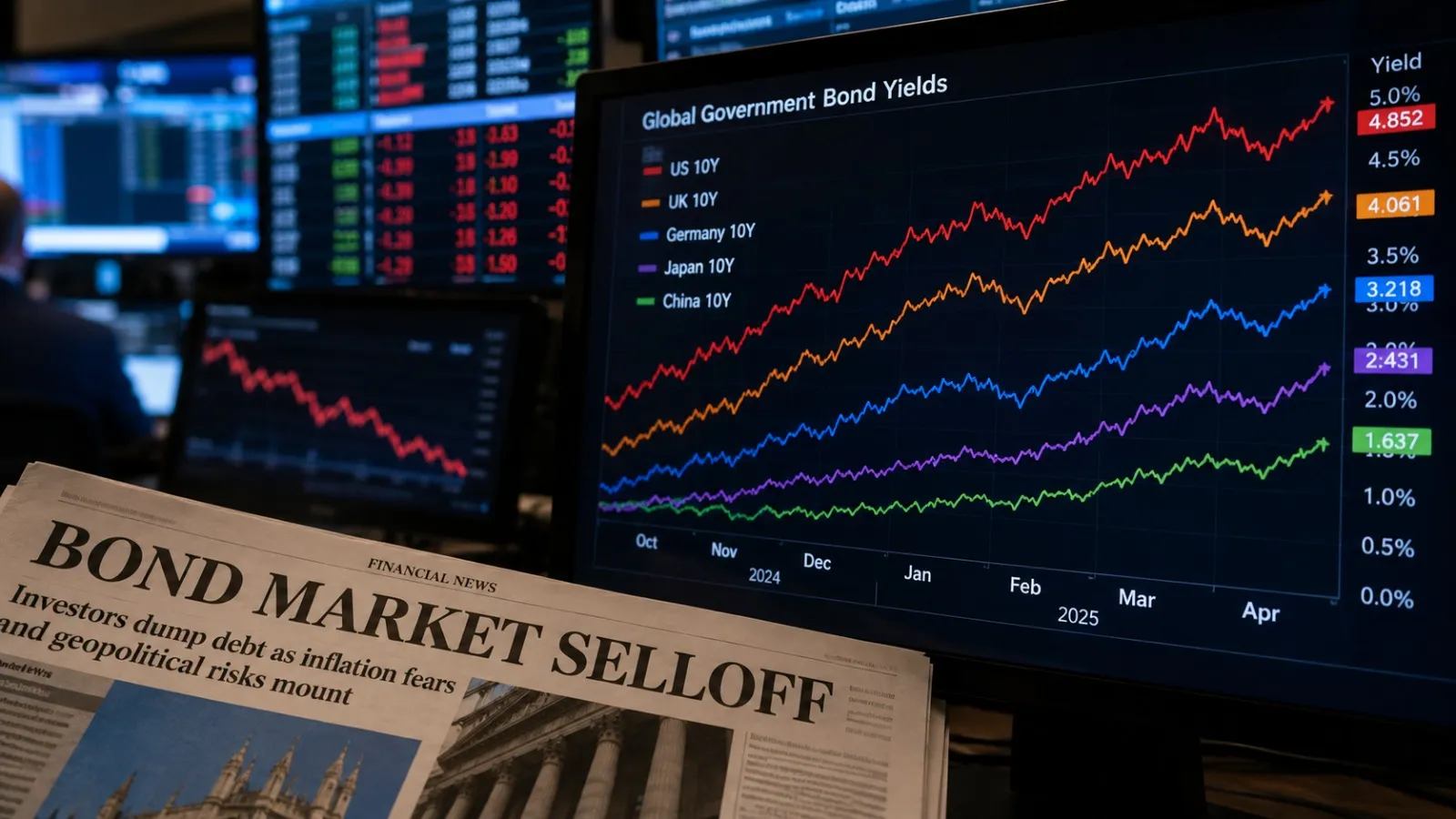
Even with Friday's gains, the bond market continues to cast a shadow. According to TheStreet, the yield on the 10-year Treasury note stood at about 5.23 per cent, near its highest level since 2007, while the 30-year yield was around 5.50 per cent, the highest since 2004. The Associated Press noted that yields eased after the 10-year briefly jumped near its 2007 high during the session.

Higher yields raise borrowing costs across the economy, from mortgages to corporate loans, and make bonds more attractive relative to stocks. They also reduce the present value of future earnings, which weighs most heavily on growth companies whose profits lie further in the future.

Wall Street strategists disagree about what is driving the rise in yields. Some point to stubborn inflation, others to strong economic growth, and others to the scale of US government borrowing. Whatever the cause, the prospect that high interest rates may persist has unsettled investors who fear that something in the financial system could eventually break.

"Geopolitical risk and bond market volatility continues to roil markets, although Wall Street remains remarkably resilient amidst the tumult," said Kyle Rodda of Capital.com, quoted by TheStreet. He added: "Corporate profitability is providing the floor supporting the market while geopolitical and policy uncertainty are creating a ceiling."

Big Tech back in the lead

Technology stocks dominated the day's gains. Microsoft rose about 4 per cent after unveiling a revamp of its Copilot AI assistant focused on enterprise customers, including new coding and agentic tools. Oppenheimer raised its price target on the stock.

Richard Reyle of Questar Capital Partners summed up the shift in sentiment toward the market's largest companies. "The Mag 7 had been the Lag 7 all year," he said, adding that the Magnificent Seven names are "back en vogue".

“Corporate profitability is providing the floor supporting the market while geopolitical and policy uncertainty are creating a ceiling.”
— Kyle Rodda, Senior Financial Market Analyst, Capital.com (via TheStreet)

The session's standout performer among large companies was Akamai Technologies. The cloud and security company surged as much as 15 per cent after announcing an $11.6 billion, seven-year cloud infrastructure agreement with AI developer Anthropic, before closing up about 8.8 per cent, according to TheStreet. Datadog also rallied, gaining about 7.3 per cent.

ChatGPT Image Sep 26, 2026, 01_05_06 PM.png

The losers

Not every stock joined the rally. Zscaler was among the biggest decliners, falling about 8.6 per cent after the cybersecurity company announced that its chief revenue officer, Mike Rich, was stepping down and would be replaced by Ross Tackett. Twilio fell about 6.2 per cent after HSBC downgraded the stock to reduce, and fertiliser maker Mosaic dropped about 4 per cent.

Sectors including biotech, oil and gas, software and capital markets lagged the broader market, according to TheStreet.

The economic data

Friday's economic releases painted a mixed picture of the US economy.

The University of Michigan's final reading of consumer sentiment for September came in at 48.1, down about 7 per cent from August but slightly better than the consensus forecast. Year-ahead inflation expectations rose to 4.6 per cent, the highest since June. Survey director Joanne Hsu said interviews revealed broad agreement across the political spectrum that the economic outlook had weakened since the start of the year.

Separately, the Census Bureau's advance report on durable goods showed that new orders for long-lasting manufactured goods were essentially flat in August at $338.6 billion, beating expectations for a small decline. Orders excluding transportation rose 0.3 per cent, below the 0.6 per cent that economists had expected.

The combination of weak consumer confidence and resilient business investment reflects the unusual mix of forces shaping the US economy: high energy costs and interest rates on one side, and strong spending on technology and AI infrastructure on the other.

Why it matters for global investors

Wall Street's direction has a strong influence on markets around the world, including India. Higher US yields have pulled capital away from emerging markets in recent weeks, contributing to a seven-week losing streak for India's Nifty 50. A stabilisation in US bond markets and a sustained fall in oil prices would be welcome news for Indian equities and the rupee.

Friday's price action offers some encouragement on both fronts, but it is too early to call a turning point. Oil remains sensitive to every development in the Middle East, and bond investors are still searching for a level at which yields stabilise.

What to watch next week

The coming week brings important data, including the US jobs report and readings on manufacturing and services activity. Investors will also be watching Treasury auctions for signs of demand for government debt, and any progress in talks over the Strait of Hormuz.

For now, the market's resilience stands out. Despite 10-year yields near 5.2 per cent, oil above $90 and consumer sentiment near historic lows, the S&P 500 sits within a whisker of its record high. As Rodda put it, corporate profits are providing the floor. The question for the weeks ahead is whether geopolitics and the bond market will keep the ceiling in place.

TagsWall StreetS&P 500Dow JonesNasdaqStock Market TodayTreasury YieldsOil PricesStrait of HormuzAkamaiMicrosoftZscalerMarket Data

Reader reviews

Sign in to rate and review this article.
Loading reviews…