FundingMarket Data Women5 MIN READ

Wall Street Ends Mixed as Nvidia Slips 2.9% Despite Beating Forecasts, While AMD Jumps 5% and the Dow Drops 1.1%

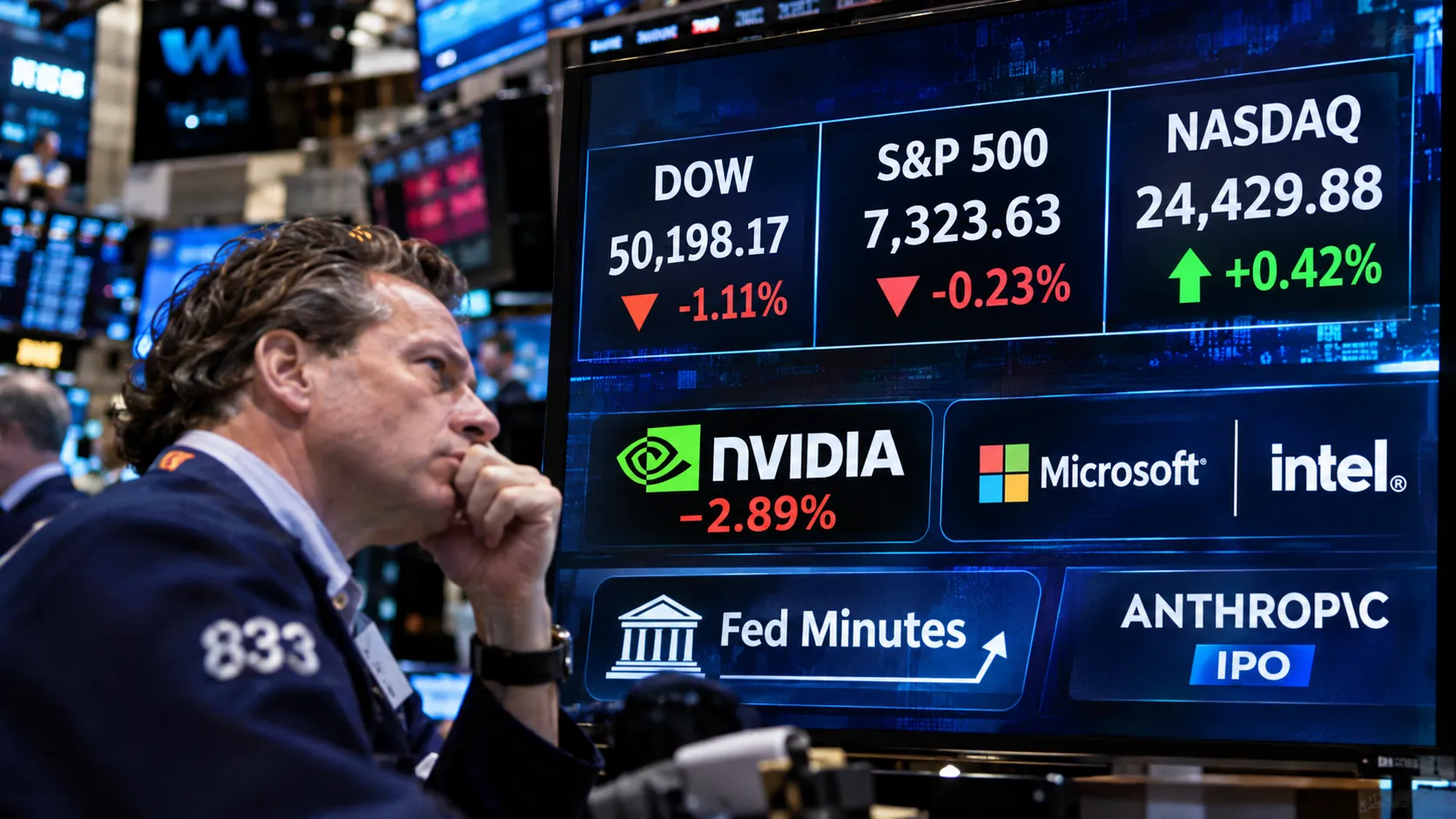
US stocks ended mixed on November 18. The Dow fell 1.11% to 50,198.17 and the S&P 500 slipped 0.23% to 7,323.63, while the Nasdaq rose 0.42% to 24,429.88. Nvidia closed down 2.89% despite beating expectations, AMD rose 5.31% and Broadcom 3.65%, as Fed minutes signalled further rate increases and Anthropic priced its record IPO.

By Shaym Kumar · Author19 November 2026New
Wall Street Ends Mixed as Nvidia Slips 2.9% Despite Beating Forecasts, While AMD Jumps 5% and the Dow Drops 1.1%

Wall Street's most anticipated earnings report of the season delivered blockbuster numbers, but investors were in no mood to celebrate.

US stocks ended mixed on Wednesday, November 18, according to TradingKey. The Dow Jones Industrial Average fell 1.11% to 50,198.17, the S&P 500 slipped 0.23% to 7,323.63, and the technology-heavy Nasdaq Composite rose 0.42% to 24,429.88.

The session was shaped by three major events: Nvidia's reaction to its quarterly results, the minutes of the Federal Reserve's October meeting and the pricing of Anthropic's record initial public offering.

Nvidia gives up early gains

Nvidia reported third-quarter revenue of $115.8 billion, up 103%, after the market closed on Tuesday, and raised its full-year growth outlook for fiscal 2028 to about 75% from 70%. The stock rose as much as 2.7% early on Wednesday but closed down 2.89%, according to TradingKey. "Nvidia's earnings beat expectations, but its shares opened higher and trended lower," TradingKey noted.

Investors focused on leadership uncertainty after the departure of Jensen Huang. Board chairman Harvey Jones said the board would not reinstate Huang and had hired a search firm to find a permanent chief executive, according to TradingKey. Interim chief executive Colette Kress addressed staff at the company's first all-hands meeting since Huang's departure.

Rivals rally

While Nvidia fell, other chip stocks gained. AMD jumped 5.31%, Broadcom rose 3.65%, Astera Labs gained 2.43% and Entegris rose 2.13%, according to TradingKey. The Philadelphia Semiconductor Index edged up 0.1% to 9,652.8, with 15 of its 30 constituents rising.

The divergence suggests some investors are rotating within the semiconductor sector, betting that Nvidia's competitors could gain ground as large customers diversify their chip suppliers and as Nvidia navigates its leadership transition.

The Fed turns hawkish

The minutes of the Federal Reserve's October meeting, released on Wednesday, showed that almost all participants saw further rate increases as likely to be needed to bring inflation back to the 2% target in a timely way, according to TradingKey. Officials voted 10 to 2 to keep the federal funds rate at 3.75% to 4.00%, with Governor Lisa Cook and Cleveland Fed President Beth Hammack favouring a quarter-point increase.

Two participants raised the possibility of an increase larger than 25 basis points at the next meeting if inflation data disappoints, and many flagged the buildout of AI infrastructure as a significant inflation risk. Governor Christopher Waller advocated considering a half-point increase at the December 8-9 meeting.

The prospect of higher rates weighed on interest-rate-sensitive stocks and pushed the US dollar to a 19-month high, according to Benzinga.

Anthropic prices its IPO

After the close, Anthropic priced its IPO at $83 per share, above its marketed range of $70 to $78, valuing the company at about $1.5 trillion, according to reports. The offering, the largest on record, drew indications of interest of about $400 billion from institutional investors and nearly $100 billion from retail investors, according to TradingKey. Trading begins Thursday on the Nasdaq.

The size of the offering meant some investors may have sold other holdings to free up cash, adding pressure on parts of the market.

Microsoft and Intel

In corporate news, Microsoft and Intel announced an expanded long-term partnership. Microsoft will use Intel Foundry's EMIB advanced packaging technology for its in-house Azure chips, and the two confirmed a multi-year supply agreement for Intel Xeon server processors, including the next-generation Diamond Rapids chips.

“Nvidia's earnings beat expectations, but its shares opened higher and trended lower.”
— TradingKey market analysis

Why the Dow underperformed

The Dow, which includes fewer technology companies and more industrial, financial and consumer stocks, fell more than the Nasdaq. Rising interest rate expectations and a stronger dollar tend to weigh on companies with large international sales and those sensitive to borrowing costs. Inflation concerns also affected consumer-facing companies.

The S&P 500 has fallen for several consecutive sessions amid a broader sell-off in AI-related stocks, which have pulled back from their peaks on concerns about valuations, leadership turmoil at Nvidia and rising interest rates.

Global implications

Wall Street's moves ripple through global markets. Indian stocks fell on Wednesday, with the Sensex down 500 points, as investors booked profits after a sharp November rally. A stronger dollar and rising US rates can draw capital away from emerging markets, including India, although India has benefited this month from a rotation away from AI-heavy markets.

What it means for investors

For investors, the session highlighted the market's sensitivity to interest rates and AI sentiment. Even strong earnings from the world's most important AI company were not enough to lift its shares, suggesting expectations were already high and that investors are weighing broader risks.

1089394f-cd51-4f33-961d-065000b95ece.png

Rotation within technology

The divergence between Nvidia and other chip stocks reflects a broader rotation within technology. After Nvidia's dominance of the AI trade for several years, investors have been spreading their bets across companies that supply custom chips, networking, memory and packaging. Broadcom, which designs custom AI chips for large cloud providers, and AMD, which competes directly with Nvidia, have benefited from this shift.

Some analysts see this as a healthy broadening of the AI trade, while others view it as a sign of growing doubts about Nvidia's leadership.

The dollar's rise

The US dollar's climb to a 19-month high reflects expectations that US interest rates will rise further, increasing the return on dollar assets. A stronger dollar can reduce the overseas earnings of US multinational companies when converted back into dollars, and can weigh on commodity prices and emerging market currencies.

Analysts say high expectations ahead of Nvidia's results meant that even strong numbers were unlikely to produce a large rally, a pattern seen after several of its recent reports. Investors have increasingly focused on forward guidance, margins and leadership rather than headline revenue growth.

Trading volumes were elevated across technology stocks as investors repositioned ahead of Anthropic's debut and the December Fed meeting.

Market strategists cautioned that volatility could remain elevated in the coming weeks as investors digest the Fed's hawkish signals, absorb the supply of new shares from the Anthropic offering and await further clarity on Nvidia's leadership. Some recommended reducing exposure to the most richly valued technology stocks while others saw recent declines as a buying opportunity.

What comes next

Investors will watch Anthropic's trading debut on Thursday, upcoming inflation and employment data, and signals from Federal Reserve officials ahead of the December meeting. Nvidia's leadership search and the performance of AI stocks will remain central to market sentiment.

TagsWall StreetDow JonesS&P 500NasdaqNvidiaAMDBroadcomsemiconductorsFed minutesinterest ratesAnthropic IPOUS dollarChristopher WallerinflationAI stocksMicrosoftIntelchip stocksglobal marketsinvestors

Reader reviews

Sign in to rate and review this article.
Loading reviews…

