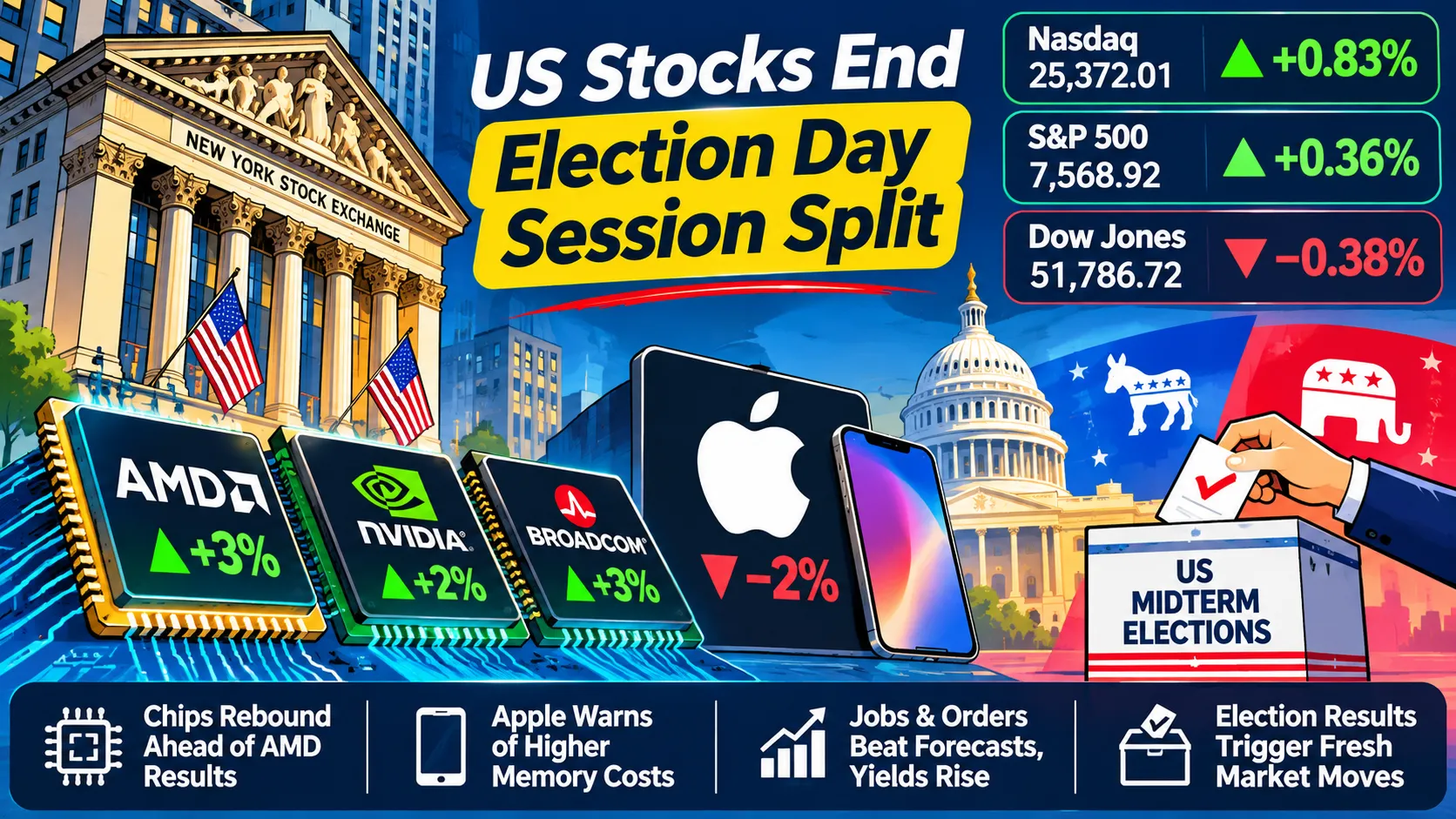
US stocks ended a tense US Election Day session split. A rebound in semiconductor shares lifted the Nasdaq and the S&P 500, while Apple's warning about rising costs dragged the Dow Jones Industrial Average lower.
The Nasdaq Composite rose 0.83% to close at 25,372.01 on Tuesday, November 3. The S&P 500 gained 0.36% to 7,568.92, snapping a three-day losing streak. The Dow fell 197.26 points, or 0.38%, to 51,786.72, weighed down by Apple, a heavyweight in the price-weighted index.
The session came as American voters went to the polls in midterm elections that would decide control of Congress, adding a layer of political uncertainty to a market already unsettled by questions over technology valuations and the cost of the artificial intelligence build-out.
Chips lead the rebound
Semiconductor stocks did the heavy lifting. Investors bought into the sector ahead of AMD's quarterly results, scheduled for after the closing bell. By the close, AMD had gained more than 3% and Broadcom 3%, while Micron and Nvidia each added more than 2%, CNBC reported.
The rally partly reversed a sharp sell-off a day earlier. On Monday, November 2, the Nasdaq had fallen about 1.1% as worries about expensive AI infrastructure spending, stretched valuations and disappointing outlooks hit technology shares. The Nasdaq-100 rose 0.68% on Tuesday to 28,180.26 but remained in correction territory, about 10% below its recent high.
The chip rebound was vindicated after the bell. AMD reported record quarterly revenue of $13.4 billion, with Data Center sales up 97%, and its shares rose in after-hours trading.
Apple's memory problem
The day's biggest drag came from Apple. The iPhone maker's shares fell about 2% after it reported better-than-expected quarterly results but gave a disappointing profit margin forecast, citing rising memory costs.
The issue has hung over Apple for most of 2026. The cost of memory chips, especially the DRAM used in smartphones and computers, has surged as AI data centres absorb huge volumes of high-performance memory, tightening supply for consumer electronics makers. Industry research firm IDC estimates that memory accounts for 10–20% of the cost of building a smartphone, and has described the price rise as a "crisis" for hardware companies.
Apple reported record revenue in India for its fiscal fourth quarter, ended September 26. That extends a run of records in the country, where it has been expanding retail stores and local iPhone production. Global revenue rose 12% to $114.5 billion. But investors focused on the margin outlook, which signalled that Apple will not be able to fully offset higher component costs through pricing and product mix in the near term.
The quarter was also the first earnings call for John Ternus as Apple's chief executive, following Tim Cook's planned handover in September.
Palantir and the AI valuation debate
Data analytics company Palantir was among the most notable decliners. Its shares fell sharply despite third-quarter results that beat expectations, as traders focused on a slowdown in the growth of new US commercial deal bookings. The reaction illustrated how high expectations have become for AI-linked stocks: strong results are no longer enough if any metric suggests momentum is slowing.
Economic data pushes yields higher
Economic data added to the mix. Job openings and factory orders both beat forecasts, pointing to continued resilience in the US economy. The data pushed Treasury yields higher across the curve, with the benchmark 10-year yield rising about 5.8 basis points to roughly 4.95%.
Higher yields are a double-edged sword for equities. They reflect a strong economy, which supports corporate earnings. But they also raise borrowing costs and reduce the present value of future profits, which tends to weigh most heavily on high-growth technology stocks whose valuations depend on earnings far in the future.
Breadth was weaker than the headline
Beneath the index gains, the market was less healthy than it looked. Decliners outnumbered gainers, and the equal-weighted S&P 500, which gives every company the same weight regardless of size, fell about 0.33%, lagging the market-cap-weighted index by roughly seven-tenths of a percentage point. Six of the S&P 500's 11 sectors fell, with materials and consumer staples leading losses at 1.5% and 1.3% respectively, according to CNBC.
That pattern, a handful of large technology and semiconductor stocks carrying the index while many others decline, has been a recurring feature of the AI-driven market. Analysts say it leaves indices vulnerable if sentiment towards a small group of mega-cap stocks turns.
The CBOE Volatility Index (VIX), Wall Street's "fear gauge", stayed above 20 during the session and closed at 20.83, signalling elevated anxiety among investors.
The election overhang
Investors spent much of the day positioning for the midterm results. Prediction markets had pushed the odds of a Democratic sweep of both chambers of Congress above 75% early on Tuesday, according to market reports. Analysts noted that changes in congressional control could have implications for areas such as technology regulation, data-centre policy, energy and fiscal spending, all of which matter for markets.
The tension was resolved overnight. As results came in showing strong Democratic gains, US stock futures and Asian equities fell sharply in early Wednesday trading.
Earnings season keeps the spotlight on AI spending
The session also highlighted how the third-quarter earnings season has become a referendum on artificial intelligence. Investors are rewarding companies that can show AI-driven demand turning into revenue today, as the chipmakers have, and punishing those where the path from AI investment to profit looks longer or less certain. Big Tech capital spending plans, which have climbed to unprecedented levels in the race to build data centres, are being scrutinised for signs of overreach. Every major earnings release in the coming weeks is likely to be read through that lens, adding to day-to-day volatility.
What it means for Indian investors
For Indian markets, Wall Street's moves matter through several channels. Global technology sentiment influences Indian IT stocks, many of which earn a large share of revenue from US clients. Higher US Treasury yields can draw foreign portfolio investment away from emerging markets, including India, and put pressure on the rupee. Volatility in US markets also tends to spill over into risk appetite on Dalal Street.
Tuesday's session captured a market in transition: still committed to the AI story, increasingly sensitive to costs and valuations, and bracing for political change in Washington. With US election results, central bank policy and a heavy earnings calendar ahead, volatility is likely to remain elevated in the weeks to come.


