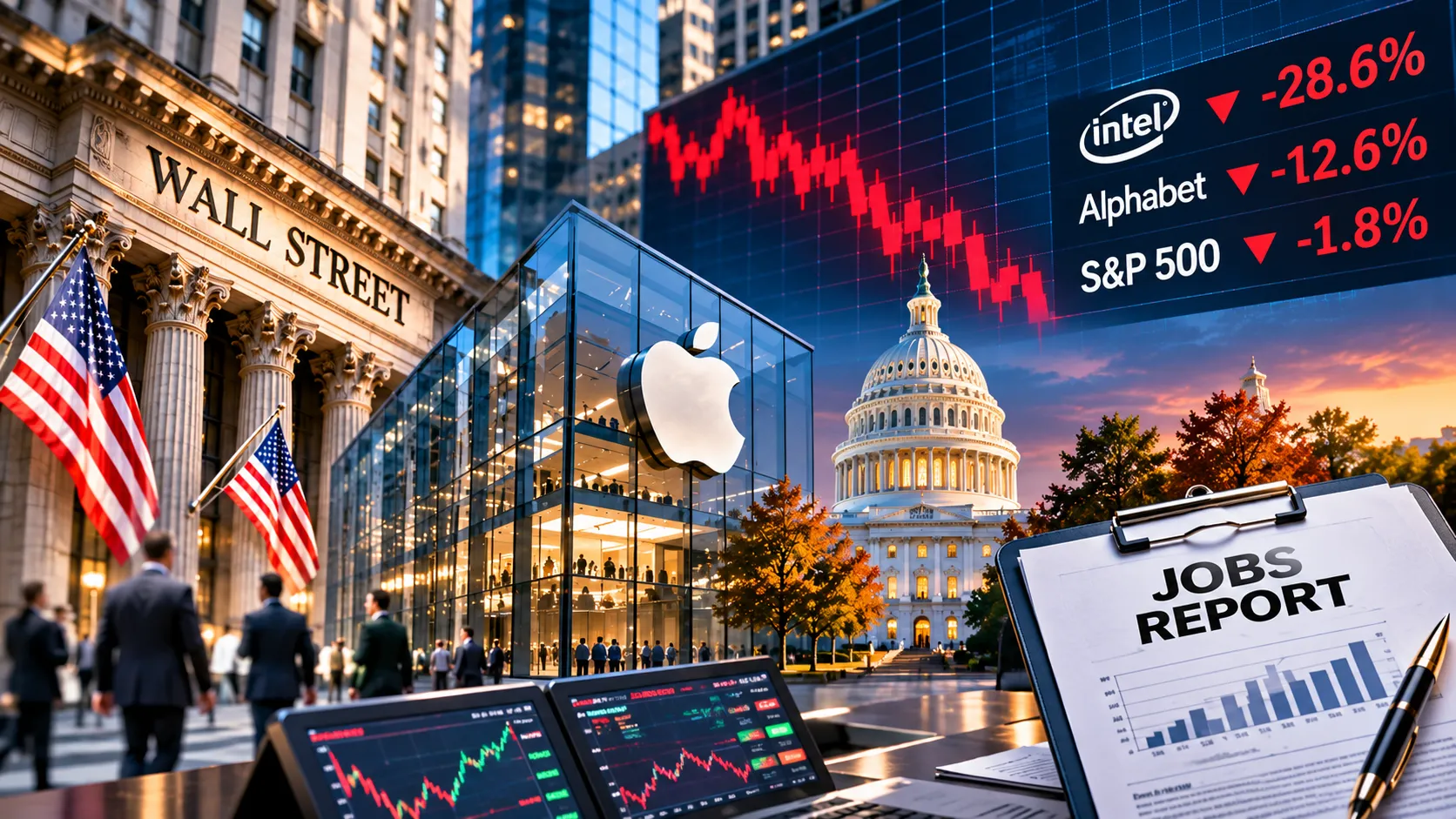
After one of the roughest days for technology stocks in months, Wall Street enters a week packed with events that could set the direction of markets for the rest of the year: earnings from Apple and other technology giants, US midterm elections and a crucial jobs report.
US stock futures ticked higher on Sunday, November 1, as investors prepared for the busy week, according to CNBC. The modest rebound followed a sharp decline on Friday, October 30, when the S&P 500 fell about 1.8%, hitting an intraday low of 7,527.56 and closing at 7,580.07, according to TheStreet Pro. It was the first close below the index's 100-day moving average since April 8.
The AI sell-off
Technology stocks led Friday's losses. Intel fell 28.6% after its outlook disappointed investors, and Alphabet dropped 12.6% after missing expectations, according to TheStreet Pro. ServiceNow, F5, Fortinet and Twilio were among the S&P 500's weakest performers for the week.
The sell-off reflected growing investor concern about the returns on massive AI investments. Technology companies are spending hundreds of billions of dollars on data centres, chips and power, and investors have become more sensitive to signs that spending is outpacing revenue or that growth is slowing.
Goldman Sachs' derivatives desk said that "for the first time, we are now seeing flows catch up to the bear thesis," with Friday's trading focused on downside protection for the index and semiconductor stocks, according to TheStreet Pro. The VIX volatility index closed at 19.42 after touching 23.93 during the day.
A narrowing market
The S&P 500 has fallen about 3% since the third-quarter earnings season began, while the equal-weight version of the index, which gives every company the same weight regardless of size, has outperformed, according to TheStreet Pro. In October, the equal-weight index returned 5.0%, compared with a 0.9% decline for the standard S&P 500.
This divergence suggests that while the largest technology stocks have struggled, many other companies have performed well, reflecting a rotation away from the AI giants that dominated market gains in recent years.
Strong earnings, slowing momentum
Corporate earnings have been strong overall. FactSet puts blended third-quarter S&P 500 earnings growth at 30.2%, with 82% of companies beating estimates, according to TheStreet Pro. However, earnings growth for the "Magnificent Seven" technology giants has trailed the other 493 companies, largely because of accounting charges at Meta and Alphabet.
"Earnings growth is strong, but it's no longer accelerating," Goldman Sachs said.
Monday: Apple's moment
Apple reports results on Monday, November 2, the first earnings call hosted by new chief executive John Ternus, who succeeded Tim Cook in September. Analysts expect revenue to rise nearly 11% to $113.39 billion, but rising memory chip costs are expected to slow profit growth. Palantir, Vertex Pharmaceuticals, Progressive and Marriott also report on Monday.
Apple's shares have outperformed other Big Tech stocks this year, rising about 27%, partly because it has spent less heavily on AI infrastructure.
Tuesday: the midterms
The US midterm elections on Tuesday, November 3, will determine control of Congress. The outcome could affect policy on taxes, spending, trade and regulation. A Democratic win would change the trade debate in Congress but would not fully roll back US tariffs, according to Reuters analysis. Markets typically experience some volatility around elections, but historically stocks have often performed well in the months following midterms as uncertainty fades.