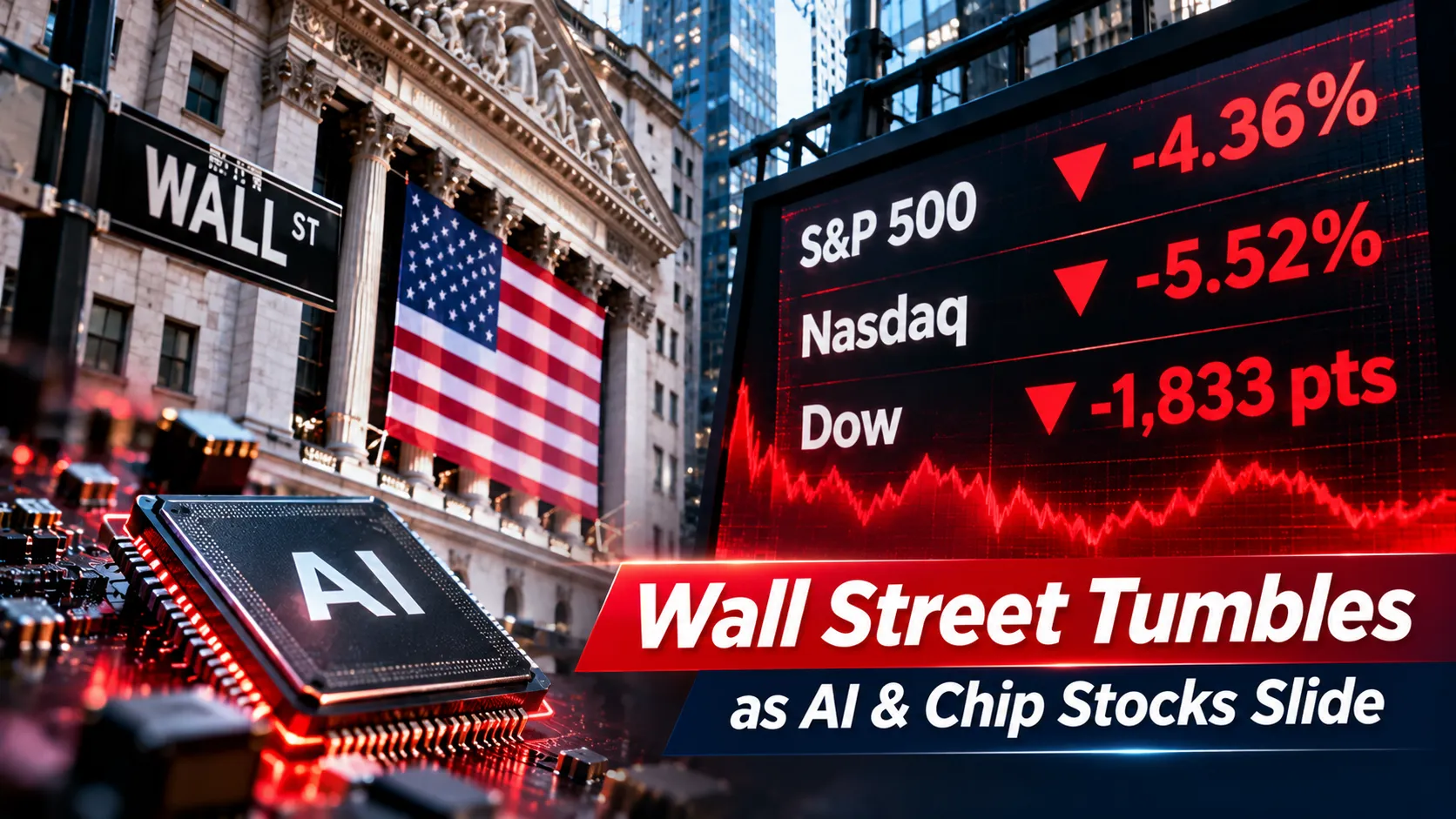
Wall Street suffered its heaviest losses in 19 months on Thursday, November 5, as a sell-off in artificial intelligence and semiconductor stocks spread across the market, driven by fears that the results of the US midterm elections will slow the construction of the data centres that have powered the AI boom.
The S&P 500 fell 4.36%, its worst day since April 2025, according to StockTitan, citing CNBC. The Nasdaq Composite dropped 5.52%, closing more than 10% below its record high set last month and officially entering a correction. The Dow Jones Industrial Average lost about 1,833 points, giving back nearly all of the gains it made on Wednesday after the election. The small-cap Russell 2000 also fell into correction territory.
Roughly $3 trillion of value was wiped from the S&P 500, according to Tech Times. The Nasdaq fell below its 200-day moving average for the first time since April.
Chip stocks collapse
Semiconductor stocks bore the brunt of the selling. The iShares Semiconductor ETF fell more than 12%, its worst day since March 2020, according to StockTitan.
Micron Technology fell 17.46%, Advanced Micro Devices dropped 17.26% and Marvell Technology lost 16.43%. Arm Holdings fell 13.08%, Broadcom 10.43%, Intel 10.33%, Qualcomm 9.49% and Nvidia 9.26%. The eight chip stocks tracked by StockTitan fell an average of nearly 13%. Seven of the 15 biggest pre-market losers were chip companies.
The VIX volatility index, often called Wall Street's "fear gauge," briefly hit 28.09, its highest level since March 31.
Why investors are selling
The trigger was the outcome of Tuesday's midterm elections. Democrats won majorities in both the House and the Senate, according to reports by Fox Business and others, and made significant gains at the state level, including in states that host large shares of planned data centre capacity.
In Texas, Democrat Gina Hinojosa unseated Governor Greg Abbott after pledging to halt data centre approvals until the state legislature passes new protections, according to Tech Times. Wells Fargo estimates that 27% of planned US data centre capacity is in Texas.
Investors fear that new state governments could impose moratoriums or tougher approval requirements on data centres, which have faced growing local opposition over their electricity and water use and their impact on power bills. UBS estimates that about 30% of expected 2028 data centre capacity additions are now at risk.
"The U.S. mid-term election results will add to headwinds for big tech and the data center buildout," MRB Partners said in a note, according to StockTitan.
A two-day rout
The sell-off marked a sharp reversal. On Wednesday, stocks initially rallied after the election, as investors welcomed the end of political uncertainty and a sharp fall in oil prices. But chip and AI stocks began to slide on Wednesday and the selling accelerated on Thursday.
The Philadelphia Semiconductor Index fell almost 16% for the week, its worst weekly performance since April 2025, according to FinancialJuice. Concerns about data centre construction added to existing worries about the enormous amounts AI companies are spending on infrastructure and whether those investments will pay off.
Winners amid the losses
Not every stock fell. AppLovin rose 31.04% after its results, Krispy Kreme gained 30.68% and Portillo's climbed 28.81%, according to StockTitan. After the close, Cloudflare rose 14.57% on strong results, Airbnb gained 11.02% after announcing a $12 billion share buyback, and Lam Research rose 6.26% after announcing a $25 billion buyback.
Among the biggest losers were MNTN, down 54.68%, and Veracyte, down 54.30%. After the close, DraftKings fell 22.24% after lowering its guidance.
Crypto feels the pain
The sell-off spread to cryptocurrencies. Bitcoin fell about 6% to roughly $75,700, and ether dropped more than 7% to about $2,247, according to Tech Times. About $880 million of leveraged positions were liquidated in four hours, according to CoinGlass data.
Bitcoin miners that have pivoted to providing power and space for AI data centres were hit particularly hard. Bitdeer fell about 20%. Bernstein analyst Gautam Chhugani said more than half of the power capacity held or planned by miners turned AI developers is in Texas, according to Tech Times.
The economic backdrop
The market turmoil came despite relatively solid economic data. Initial jobless claims fell to 189,000 from 195,000, and productivity grew 3.6% in the third quarter, faster than economists expected, according to StockTitan.
Interest rates remain a concern. Traders see a roughly 70% chance that the Federal Reserve will raise interest rates in December, down from about 83% on Wednesday, according to StockTitan. The Bank of England raised its key rate to 4% on Thursday, as central banks grapple with inflation driven by high energy prices linked to the conflict involving Iran.
Is a moratorium likely?
Analysts are divided on how much the election will actually slow data centre construction. Any federal moratorium would face a veto from President Donald Trump, who has prioritised AI development. A national moratorium bill introduced by Senator Bernie Sanders and Representative Alexandria Ocasio-Cortez has attracted only limited support, according to Tech Times.
J.P. Morgan noted that most states have not banned data centres outright, and that "any new projects are expected to have higher hurdles for approval," according to a Reuters factbox. Goldman Sachs expects Democrats in Texas, Georgia and Michigan to impose temporary pauses, but not long-lasting ones.
Nomura said a federal data centre moratorium looks unlikely, given divisions within the Democratic Party and the presidential veto, although a state-level temporary pause is possible, according to Business Today.
Global contagion
The sell-off spread to Asia on Friday. South Korea's Kospi fell as much as 8.8%, triggering a circuit breaker, and Japan's Nikkei 225 dropped about 5.8%. Taiwan's benchmark fell 4.5%, entering a bear market. US stock futures recovered somewhat on Friday morning, with Nasdaq 100 futures up 0.8%, according to FinancialJuice.
Why it matters for India
India's markets proved remarkably resilient. The Sensex edged higher on Friday morning as IT stocks rallied, with investors betting that a slowdown in AI infrastructure spending could benefit Indian IT services companies. Foreign portfolio investors bought ₹13,802 crore of Indian stocks on Thursday, according to provisional data reported by Business Today. "The bloodbath in the US markets impacted most other markets today, but India was least impacted," said V K Vijayakumar, chief investment strategist at Geojit Investments.
The AI trade under scrutiny
The rout reflects a broader reassessment of the AI trade that has dominated markets for more than three years. Chip companies, data centre operators and power companies have soared on expectations of years of rapid growth in AI infrastructure spending. Any threat to that spending, whether from politics, financing constraints or doubts about returns, now triggers sharp reactions.
What comes next
The October jobs report, due on Friday, November 6, will be the next major test for markets. Investors will also watch for details of any state-level data centre restrictions, as well as commentary from technology companies about their spending plans. After a week of extraordinary volatility, the question is whether the sell-off marks a healthy correction in an overheated sector or the start of a deeper reassessment of the AI boom.