StartupsLatest5 MIN READ

Warp Sciences Raises $215 Million, With Lightspeed and Premji Invest, to Automate Drug Chemistry With AI and Robots

San Francisco-based Warp Sciences has raised $215 million led by Lightspeed, with participation from Premji Invest, Mayfield, IVP, Lux and others, to build US chemistry labs that combine expert chemists, AI and robotics to make and test research compounds for drug developers. The company is led by chief executive Kevin Weil, formerly a senior OpenAI executive.

By Nisha Omkumar · Author26 October 2026New
Warp Sciences Raises $215 Million, With Lightspeed and Premji Invest, to Automate Drug Chemistry With AI and Robots

A new startup aiming to use artificial intelligence and robotics to accelerate drug discovery has raised one of the largest early funding rounds in the AI-for-science sector, drawing backing from some of Silicon Valley's best-known investors and India's Premji Invest.

Warp Sciences, a San Francisco-based company, announced on Friday, October 23, that it had raised $215 million in a round led by Lightspeed, FinSMEs reported. Other investors include Premji Invest, Mayfield, IVP, Lux, Conviction, Menlo Ventures, 01 Advisors, Standard, Lowercarbon Capital, Gigascale Capital, Angular Ventures, Scribble Ventures, Uncork Capital, Innovation Endeavors, Matter VP, Zero Shot Fund, SignalFire and Moxxie Ventures, along with individual angels.

The company is led by chief executive Kevin Weil. TechCrunch reported earlier in the week that a former OpenAI science lead had launched Warp to automate wet labs with robots. Weil previously served as a senior executive at OpenAI and earlier held leadership roles at Instagram and Twitter.

What Warp Sciences does

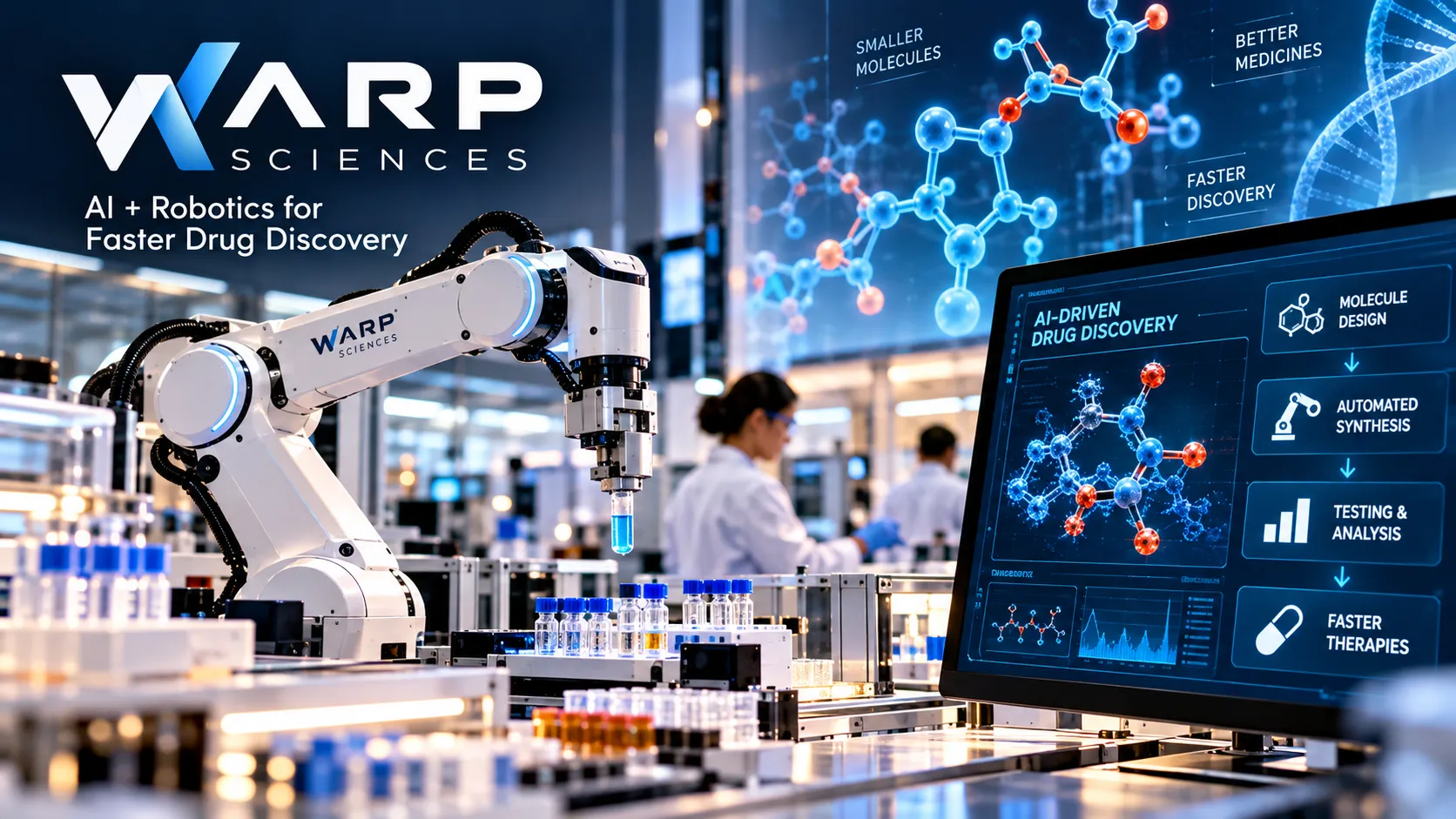
Warp describes itself as a domestic chemistry contract research organisation (CRO) platform. It combines expert chemists, AI and robotics to make and test research compounds for biotech and pharmaceutical companies.

The company focuses on lead optimisation analogue synthesis, a crucial and time-consuming stage of drug discovery. After researchers identify a promising compound, or "lead," they typically synthesise many variations, called analogues, to improve its potency, safety and other properties. Each round of design, synthesis and testing can take weeks.

By using AI to design and prioritise compounds and robots to carry out experiments, Warp aims to dramatically speed up this cycle. Customers can run physical experiments while retaining full intellectual property protection and control over their drug discovery programmes.

Use of funds

Warp plans to use the funding to build chemistry laboratories in the United States, advance its AI and robotics automation, expand its research and engineering teams and accelerate the discovery of new medicines.

The emphasis on US-based labs is notable. Much of the world's outsourced chemistry work for drug discovery has historically been done in China and India, where large contract research organisations offer skilled chemists at lower cost. Policy shifts in the United States, including legislation targeting certain Chinese biotech companies and concerns about supply chain security, have increased interest in domestic alternatives.

The AI-for-science wave

Warp is part of a wave of companies applying AI to scientific research. AI models can now predict protein structures, design molecules and analyse experimental data, while robotics can automate laboratory work. Combining the two in "self-driving labs" could compress research timelines from years to months.

Investors have poured money into the field. Several startups founded by former researchers from OpenAI, Google DeepMind and other AI labs have raised large rounds to build AI-driven scientific discovery platforms. Major pharmaceutical companies are also partnering with AI firms to accelerate their pipelines.

However, drug discovery remains difficult and expensive. Most drug candidates fail in clinical trials, and AI cannot yet predict how compounds will behave in the human body with high accuracy. Speeding up early-stage chemistry is valuable, but it addresses only part of the challenge.

“The next big leap for AI may happen not on a screen but at the lab bench.”
— TIGI Startups Desk
ec1d591d-587d-4b8c-a353-b65a6c200c40.png

The Premji Invest connection

The participation of Premji Invest, the investment arm of Wipro founder Azim Premji, highlights the growing role of Indian capital in global technology investing. Premji Invest has backed a range of US and Indian companies, from technology to healthcare, and has been an active investor in AI.

The firm's portfolio returns help fund the Azim Premji Foundation's philanthropic work in education and other areas in India.

What it means for India's CRO industry

India has a large and established contract research and manufacturing services industry, including companies such as Syngene, Aragen, Sai Life Sciences and Jubilant, which provide chemistry, biology and manufacturing services to global pharmaceutical companies. The industry has benefited from global companies seeking alternatives to China, a trend often called "China plus one."

The rise of AI- and robotics-driven labs presents both an opportunity and a challenge for Indian CROs. Those that adopt automation and AI could increase productivity and win more business. But if US-based automated labs can match Indian costs, the labour-cost advantage that has underpinned India's industry could erode.

Indian companies are already investing in digital and automation capabilities, and some are partnering with AI firms.

How drug discovery works

Discovering a new drug typically takes many years and costs well over a billion dollars when the cost of failures is included. The process begins with identifying a biological target linked to a disease, then finding molecules that interact with it. Promising "hit" compounds are refined into "leads," which are then optimised through many rounds of chemical modification to improve their effectiveness, reduce side effects and ensure they can be absorbed and processed by the body.

Lead optimisation is labour-intensive. Medicinal chemists design new variations of a compound, synthesise them in the lab, and test them in assays. The results inform the next round of designs. Each cycle can take weeks, and a programme may require hundreds or thousands of compounds before a candidate is ready for preclinical testing.

AI can help by predicting which variations are most likely to succeed, reducing the number of compounds that need to be made. Robotics can speed up synthesis and testing by running experiments continuously and in parallel. Together, they could compress timelines and reduce costs, though the impact on overall drug development success rates remains to be proven.

Kevin Weil's journey

Weil has had a varied career in technology, having led product at Instagram and Twitter and worked on Facebook's Libra digital currency project before joining OpenAI, where he served as chief product officer and later led its science efforts. His move to found a lab automation company reflects a broader trend of AI leaders seeking to apply the technology to scientific discovery.

What comes next

Warp will now build out its labs and team. Its success will depend on whether its AI and robotics can deliver faster, cheaper and better results than traditional CROs, and on winning the trust of pharmaceutical customers who are often cautious about new suppliers.

For the broader industry, Warp's large funding round is another sign that investors believe AI's next major impact will be in the physical sciences. The scale of its funding means expectations are high.

TagsWarp SciencesKevin Weildrug discoveryAI chemistrylab automationroboticscontract research organizationCROLightspeedPremji InvestMayfieldIVPLux CapitalbiotechpharmaceuticalsAI for sciencestartup fundingmedicinal chemistryIndia CROlife sciences

Reader reviews

Sign in to rate and review this article.
Loading reviews…

