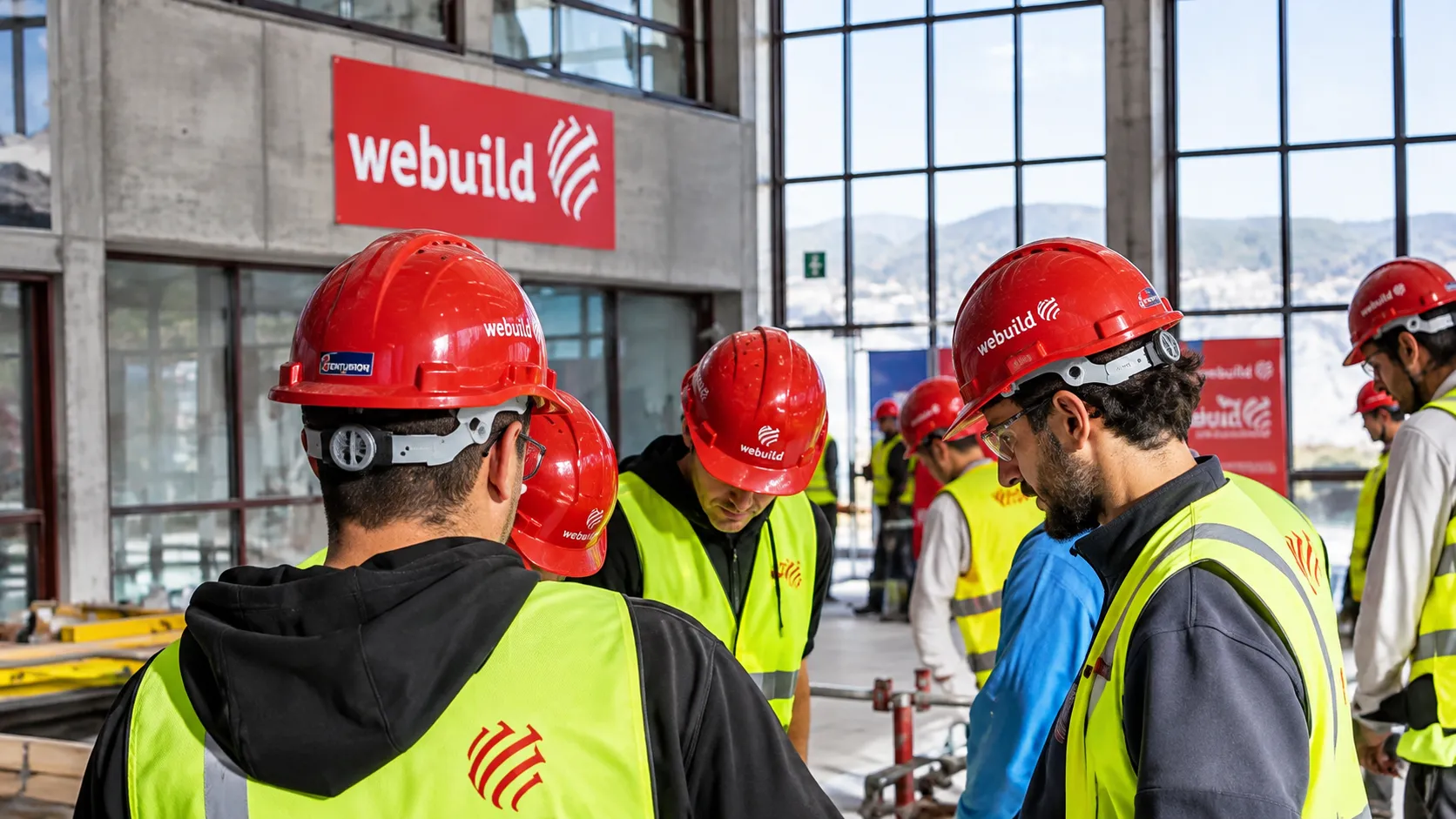
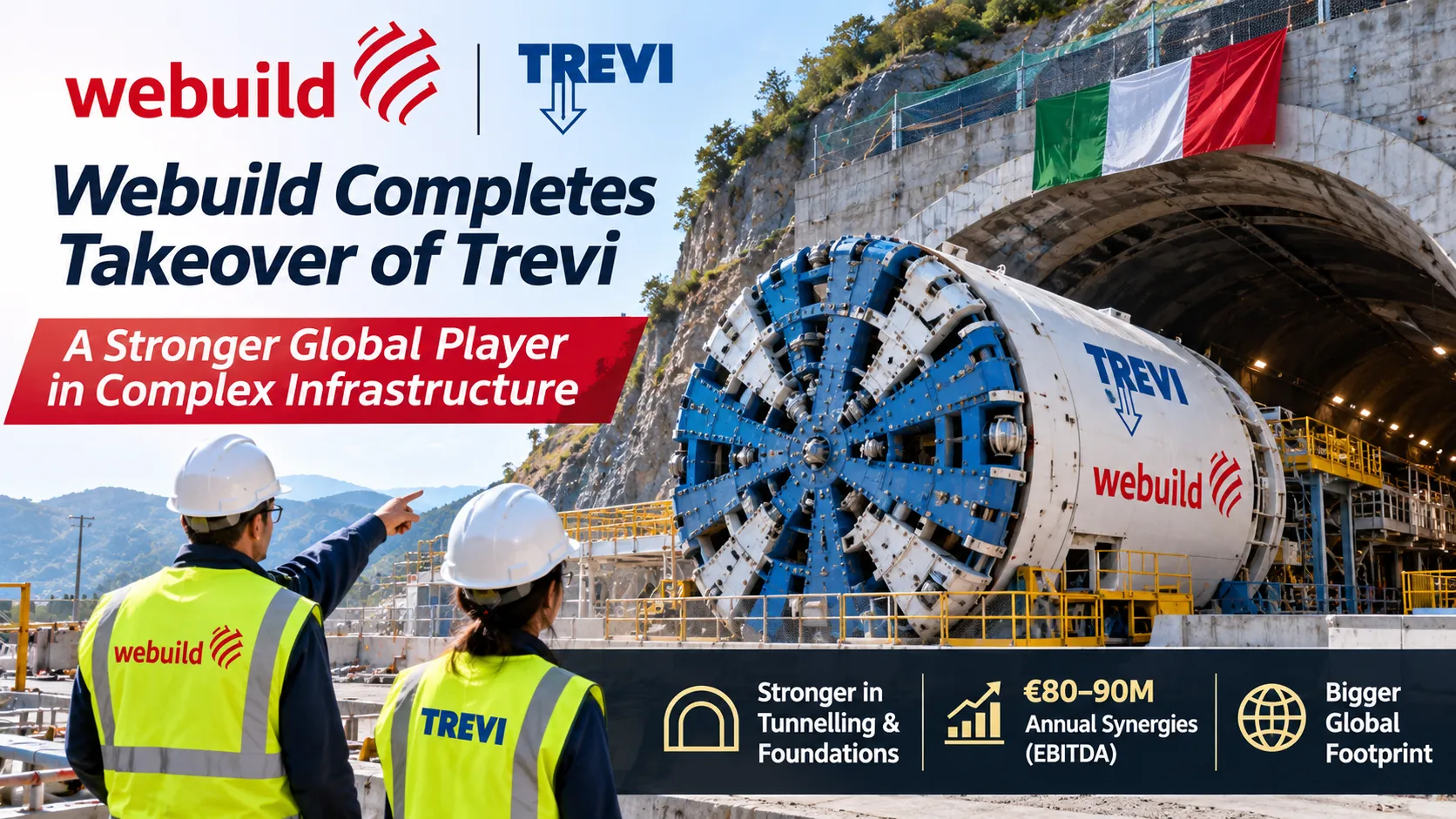
Webuild, Italy's largest construction and infrastructure group, has completed its takeover of Trevi, a specialist in foundations and underground engineering, Bloomberg reported on November 21. The acquisition ends a contested bidding battle for one of Italy's best-known engineering companies.
The deal brings Trevi's expertise into one of the world's largest infrastructure contractors, strengthening Webuild's capabilities in complex projects such as tunnels, metro systems, dams, bridges and port works.
How the takeover unfolded
The contest for Trevi began in June 2026, when Icop, a construction company from the Friuli region in north-eastern Italy, announced an offer for Trevi.
On July 29, Webuild launched a rival voluntary takeover offer, proposing €4.50 per share in cash. That valued Trevi at about €295 million, higher than the Icop offer, and represented a premium of 29.8% over Trevi's share price on June 26, the last trading day before the Icop offer was announced.
Webuild's offer received approval under Italy's "golden power" rules, which allow the government to scrutinise deals involving strategic companies, at the end of September. The acceptance period began on September 28.
In late October, Webuild crossed the 30% threshold of Trevi's capital through market purchases, which under Italian law triggered a mandatory offer for all remaining shares. The mandatory offer, priced at €5.165 per share and no longer subject to conditions, ran until November 20.
Webuild steadily increased its stake through market purchases and acceptances. By November 19, after receiving antitrust clearance, it held about 52.53% of Trevi. Payment for shares tendered in the offer is scheduled for November 27.
Who is Trevi
Trevi Group, based in Cesena in Italy's Emilia-Romagna region, specialises in special foundations and underground engineering. Its work includes deep foundations for buildings and bridges, ground consolidation, tunnelling support, and the construction of diaphragm walls and piles. Through its Soilmec division, it also manufactures drilling rigs and foundation equipment used by contractors around the world.
Trevi has worked on major infrastructure projects internationally. Its expertise is particularly valuable in complex geological conditions, where foundation engineering can make or break a project.
Trevi went through a difficult period in the late 2010s, when it faced financial distress and underwent a restructuring. It has since stabilised its business.
Why Webuild wanted Trevi
Webuild, led by chief executive Pietro Salini, is one of the world's largest infrastructure contractors. It closed 2025 with about €13.6 billion in revenue and a large order book spanning projects in Europe, the Americas, the Middle East, Africa and Australia. Its projects include high-speed rail lines, metro systems, dams and hydroelectric plants, and major bridges.
Webuild has said that integrating Trevi's specialist skills in special foundations into its global industrial platform would strengthen its competitive position in bids for large, complex projects and generate significant industrial and commercial synergies. It estimated potential synergies of €80-90 million in EBITDA per year.
Webuild has also said that Trevi will maintain its own identity and keep its headquarters in Italy.
Consolidation in construction
The deal reflects a broader trend of consolidation in the global construction and engineering industry. Large contractors are seeking to bring specialist capabilities in-house, both to control costs and to strengthen their ability to win and deliver complex projects.
Global infrastructure spending is rising, driven by urbanisation, energy transition projects, transport investment and climate adaptation. Projects are becoming larger and more technically demanding, which favours contractors with deep engineering expertise.
Italy's infrastructure push
Italy has been investing heavily in infrastructure, supported by funds from the European Union's post-pandemic recovery programme. Projects include rail upgrades, metro extensions and water infrastructure. Webuild has been a major beneficiary of this spending.
The company is also involved in large international projects, including in the United States, Saudi Arabia and Australia.
The India connection
India is one of the world's largest infrastructure markets, with heavy government investment in roads, railways, metro systems, ports and urban infrastructure. Foundation engineering and tunnelling are critical to many of these projects, from metro lines in Mumbai and Delhi to Himalayan rail and road tunnels.
International engineering firms with specialist foundation and tunnelling expertise have worked on Indian projects, often in partnership with Indian contractors. Indian construction companies such as Larsen & Toubro have also competed for international projects, including in the Middle East.
A larger, more integrated Webuild could become a stronger competitor or partner in international tenders, including in markets where Indian companies are active.
What comes next
With the takeover complete, Webuild will focus on integrating Trevi and realising the expected synergies. Investors will watch for progress on combined bids, cost savings and the performance of Trevi's equipment business.
The outcome of the bidding contest also leaves Icop without the acquisition it had sought, though the company may pursue other growth opportunities.
For The Impactful Global Indian's readers, the Webuild-Trevi deal is an example of how specialist engineering expertise has become a strategic asset in the global infrastructure race. As projects grow larger and more complex, companies that combine scale with deep technical capabilities are well placed to win.
Why foundations engineering matters
Foundations engineering is one of the most critical, and least visible, parts of major infrastructure projects. Before a skyscraper, bridge or metro line can be built, engineers must ensure that the ground beneath can support it. In difficult conditions, such as soft soils, high groundwater, seismic zones or coastal areas, specialist techniques are needed to stabilise the ground and build deep foundations.
Mistakes in foundation work can be extremely costly, causing delays, cost overruns or even structural failures. That makes specialist expertise highly valuable, and it explains why large contractors want to control these capabilities directly rather than relying on subcontractors.
Trevi's equipment business adds another dimension. Soilmec's drilling rigs are used by foundation contractors around the world, giving Webuild exposure to a manufacturing business that serves the wider construction industry, including companies that compete with Webuild.
Large tunnelling and metro projects, which are booming in many countries, often require extensive foundation and ground improvement work. Webuild's combined capabilities could give it an edge in bidding for such projects, particularly in markets with challenging geology.


