While the WeWork brand became a symbol of the excesses of the startup boom in the United States, its Indian franchise has quietly built a profitable, growing business. The latest results underline the strength of India's flexible office market.
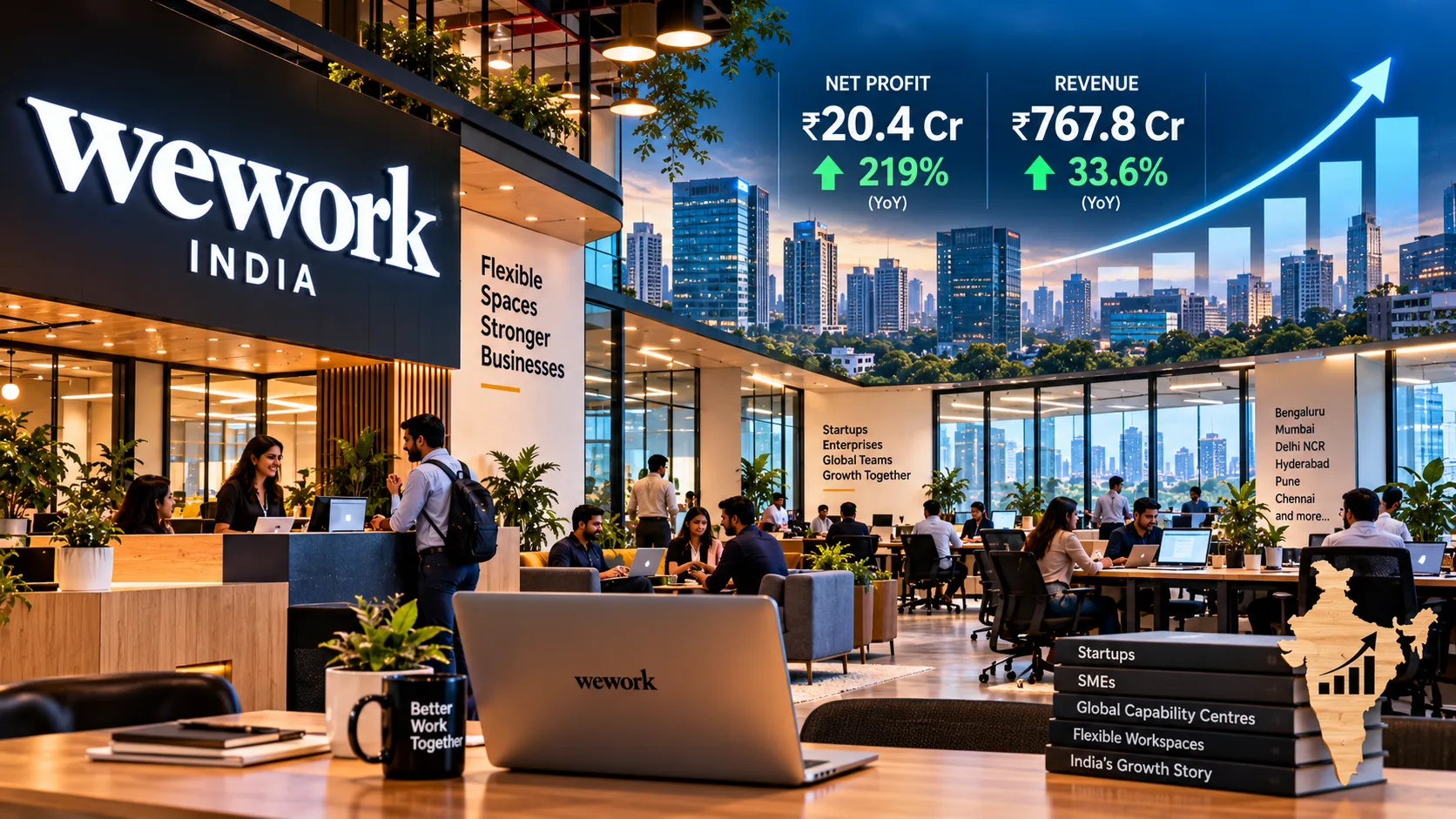
WeWork India Management reported net profit of ₹20.4 crore for the July-September quarter, up 219% from ₹6.4 crore in the same quarter a year earlier, according to StartupTalky on October 27. Operating revenue rose 33.6% to ₹767.8 crore.
A year of growth
The year-earlier comparison underlines the progress. In the September quarter of 2025, WeWork India had swung to a profit of ₹6.4 crore from a loss, on operating revenue of ₹574.7 crore, according to Inc42. At the time, it operated 7.7 million square feet across 70 centres in eight cities, with about 1.15 lakh desks under management at 80.2% occupancy.
The latest quarter's revenue growth of about a third suggests that the company has continued to add space and fill desks as demand for flexible offices grows.
The company's profit has been volatile from quarter to quarter. It reported a small loss in the April-June quarter of the current financial year, before returning to profit in the September quarter.
How WeWork India differs
WeWork India operates as a separate company from the global WeWork, which went through bankruptcy proceedings in the United States in 2023. The Indian business is controlled by Embassy Group, a Bengaluru-based real estate developer, and operates under a licence for the WeWork brand.
Unlike the global business, which was criticised for signing expensive long-term leases while offering short-term memberships, WeWork India has focused on enterprise clients that sign longer commitments, and on partnerships with landlords that reduce risk.
WeWork India listed on Indian stock exchanges in 2025, joining a growing number of flexible workspace operators that have tapped the public markets.
The flexible office boom
India has become one of the world's strongest markets for flexible workspaces. Several factors drive demand.
Global capability centres, offices set up by multinational companies to handle technology, finance, research and other functions, have expanded rapidly in India. Many prefer flexible or managed offices that allow them to start quickly and scale up without committing to long leases or building out their own space.
Startups and growing companies value flexibility as their headcount changes. Large Indian enterprises have also adopted flexible workspaces as part of hybrid working strategies, using them to provide offices closer to employees' homes or in new cities.
A competitive market
WeWork India competes with other flexible workspace operators, including Awfis, Smartworks, IndiQube, Table Space and Bhive. Several of these companies have listed or are preparing to list on Indian stock exchanges, reflecting investor interest in the sector.
Competition for prime office space and enterprise clients is intense, and operators must balance growth with occupancy and profitability.
Real estate tailwinds
India's office market has been strong, with leasing activity in major cities such as Bengaluru, Hyderabad, Pune, Mumbai, Delhi NCR and Chennai reaching high levels. Flexible workspace operators account for a significant share of office leasing.
The strength of the office market contrasts with weakness in some other countries, where remote work has reduced demand for office space. In India, many employers have encouraged a return to the office, and the growth of the technology and services sectors has supported demand.
Risks to watch
Flexible workspace businesses carry risks. Operators typically lease space from landlords and rent it to clients, so they can be exposed if demand falls and occupancy drops while lease obligations remain. Economic slowdowns or a decline in hiring by technology companies could affect demand.
Profitability is also sensitive to occupancy rates, rental costs and pricing. Investors will watch whether WeWork India can sustain growth while improving margins.
What it means for investors
WeWork India's results suggest that the flexible office sector in India has matured into a viable business. The company's profit growth and strong revenue increase may reassure investors who were cautious about the WeWork brand's history.
For investors in India's new-age companies, WeWork India is an example of a business with tangible assets and recurring revenue, which may be viewed as less risky than consumer internet companies that are still burning cash.
The GCC engine
Global capability centres have become one of the strongest drivers of office demand in India. Multinational companies in technology, banking, healthcare, retail and manufacturing have set up or expanded centres in Indian cities to handle work ranging from software development and data analytics to finance and research. India hosts a large and growing number of such centres, employing a significant number of professionals.
Many GCCs prefer flexible or managed offices when they first enter India or expand into new cities, because these spaces can be occupied quickly and adjusted as headcount changes. Flexible workspace operators have built dedicated offerings for this segment, including fully customised private offices.
The listed flex peers
The listing of several flexible workspace operators on Indian exchanges has created a new category of real estate-linked stocks. Investors compare these companies on occupancy, revenue per desk, margins and the share of revenue from long-term enterprise contracts, which provide more stable income than short-term memberships.
Hybrid work and the office
The global debate over remote and hybrid work has played out differently in India. While many companies in the United States and Europe have reduced office space, Indian employers have generally encouraged a return to offices, and the growth of the services sector has supported demand. Flexible workspaces have benefited from companies seeking to provide offices in multiple locations, closer to where employees live, as part of hybrid strategies that combine central headquarters with satellite offices.
What comes next
WeWork India will continue to expand its portfolio and target large enterprise clients, particularly global capability centres. Investors will watch occupancy trends, new centre openings and margins in the coming quarters.
The broader question is whether India's flexible office boom can be sustained as the sector grows and competition intensifies. For now, WeWork India's results suggest that demand remains strong. Analysts will also track the company's pipeline of new centres, the share of revenue from enterprise clients on longer contracts and its ability to keep occupancy high as new supply enters key markets such as Bengaluru, Hyderabad and Pune. Steady execution on these measures would support the case that the business can sustain profitable growth through different economic conditions.