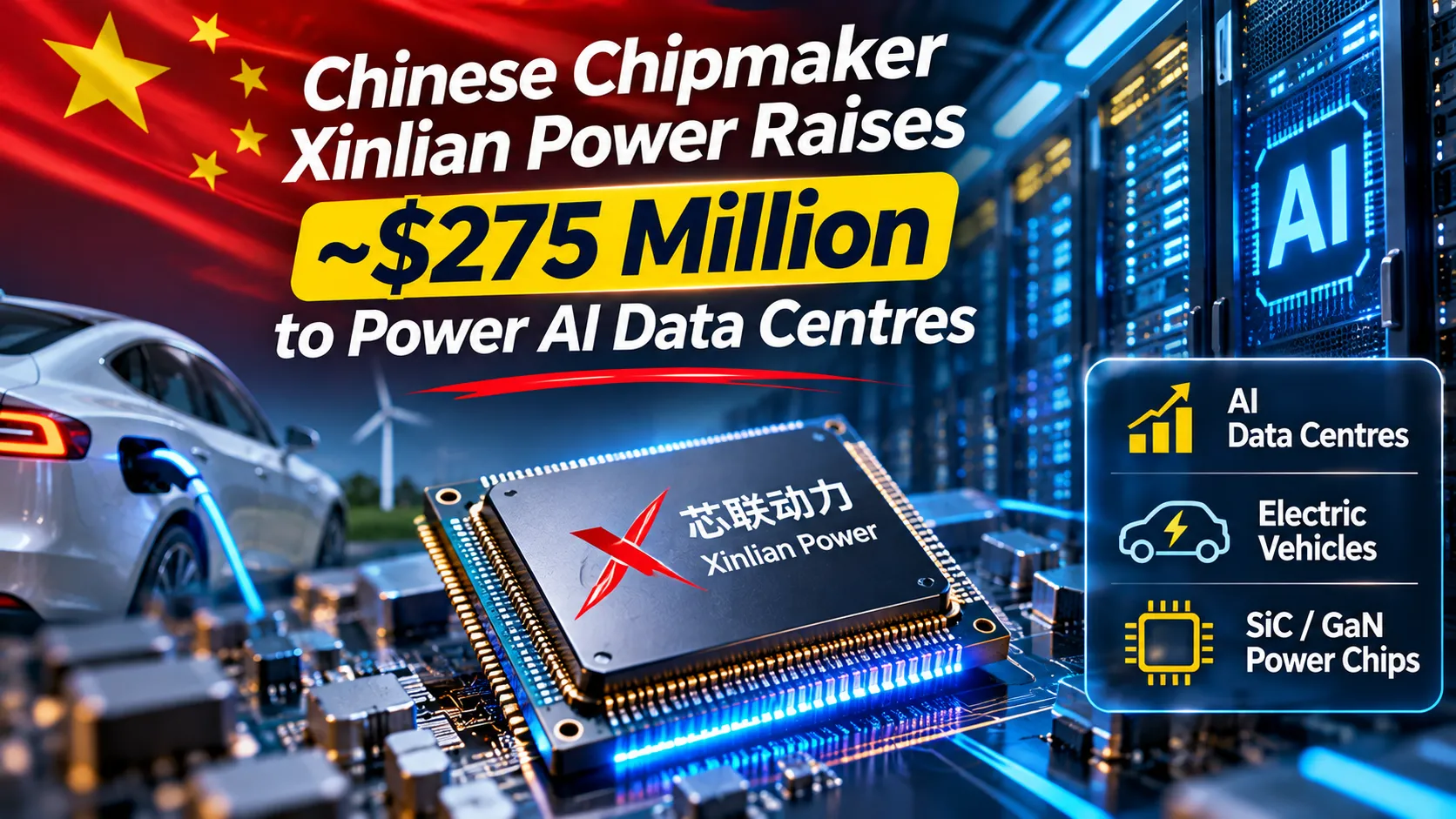
A fast-growing Chinese maker of advanced power chips has raised nearly 2 billion yuan from a roster of state-linked and strategic investors, as it seeks to redirect technology developed for electric cars towards the booming market for powering artificial intelligence data centres.
Xinlian Power raised the Series C round, led by a fund affiliated with state-owned telecom giant China Mobile, according to Tech Startups and Dealroom, which reported the deal on Monday, November 2. Dealroom put the amount at nearly $275 million and said the round lifted the company's valuation above $2 billion.
Other investors included server maker Inspur, a hydrogen energy fund affiliated with state oil company Sinopec, Jiangfeng Electronics and a number of other strategic and financial investors, according to Tech Startups. Dealroom also listed Changzhou Xingyu, Cathay Capital, CCB Equity, CITIC Securities and a state power grid group among the participants. The round attracted more than $550 million of interest despite a limited, targeted fundraising process, according to Dealroom.
Tech Startups reported that the company is controlled by listed semiconductor maker United Nova Technology, making it effectively an operating subsidiary.
What Xinlian Power makes
Founded in 2023, Xinlian Power designs, manufactures and packages silicon carbide (SiC) and gallium nitride (GaN) chips and power modules, according to Dealroom. These "compound semiconductors" can handle higher voltages, temperatures and switching speeds than traditional silicon chips, making them more efficient for converting and managing electrical power.
The company was initially backed by carmakers and built its business supplying power chips for electric vehicles, where silicon carbide is used in inverters that convert battery power to drive electric motors. Its silicon carbide business ranks first in China and among the top five globally, according to a 2025 Yole report cited by Dealroom.
Rapid growth
Xinlian Power's revenue reached $162.3 million in the first half of 2026, up about 106% from a year earlier, according to Dealroom, and the company expects full-year revenue to exceed $412.5 million.
The pivot to AI
The company is now shifting its focus towards supplying power chips for AI data centres. The same properties that make silicon carbide useful in electric vehicles, its ability to handle high voltages efficiently, are increasingly valuable in data centres, where power demand has surged with the growth of AI.
Data centres are shifting towards 800-volt high-voltage direct current power distribution, and in the longer term towards solid-state transformers, both of which require advanced power semiconductors, according to Dealroom. Some of Xinlian Power's high-voltage silicon carbide products have entered sampling and verification with potential customers.
The participation of China Mobile and Inspur, both major operators and suppliers of data centre infrastructure in China, signals strategic interest in securing domestic supplies of power chips for AI.
The risks
The AI power market is still emerging, and the transition to new power architectures will take time. Designs based on 800-volt power distribution are only now reaching production, and solid-state transformers are years away from mass deployment, according to Dealroom. Xinlian Power will need to win new customers, adapt to new architectures and build new supply relationships.
"Industry backing does not guarantee orders or commercial success," Dealroom noted in its analysis.
China's chip self-sufficiency drive
Xinlian Power's fundraising is part of China's broader push for self-sufficiency in semiconductors, which has intensified as the United States has restricted China's access to advanced chips and chipmaking equipment. While US export controls have focused primarily on the most advanced logic chips and the equipment used to make them, China is seeking to build domestic capabilities across the entire semiconductor supply chain.
Power semiconductors, which are generally made using less advanced manufacturing processes than leading-edge processors, are an area where Chinese companies have made significant progress. China's dominance in electric vehicle production has given its silicon carbide makers a large domestic market, allowing them to scale rapidly and reduce costs.
Global competition
The global silicon carbide market has been dominated by companies such as STMicroelectronics, Infineon, Wolfspeed, onsemi and Rohm. However, Chinese companies have rapidly expanded their production capacity, putting pressure on prices and on Western competitors. Wolfspeed, a US silicon carbide pioneer, went through a financial restructuring in 2025 amid weak demand and intense competition.
The AI data centre opportunity has become a focus for all of these companies. On the same day as Xinlian Power's announcement, US chipmaker onsemi agreed to acquire Ferric, a power delivery technology company, for up to $775 million, and reported that its AI data centre revenue had risen 175% from a year earlier.
A busy day for Chinese hardware deals
Xinlian Power's round was one of several large Chinese hardware deals announced on November 2. Robotics company RoboScience raised several hundred million yuan, automotive electronics maker Gelubo Technology raised more than 600 million yuan, and brain-computer interface startup Junrou Technology raised nearly 100 million yuan, according to Tech Startups. The deals reflect strong investor interest in China's advanced manufacturing and deep technology sectors.
The India angle
India is also seeking to build a presence in compound semiconductors. The government has approved semiconductor projects under the India Semiconductor Mission, including a compound semiconductor facility, and power semiconductors are a priority given their importance for electric vehicles, renewable energy and data centres. Chinese companies' rapid progress highlights both the opportunity and the competitive challenge facing Indian efforts in this area.
Who is investing
The investor list for Xinlian Power's round reads like a map of China's strategic industries. China Mobile operates one of the world's largest telecommunications and data centre networks, Inspur is one of China's largest server makers, and Sinopec is the country's largest oil refiner, which is investing in hydrogen and other new energy businesses. A state power grid group also participated, according to Dealroom.
Such strategic investors can provide not only capital but also customers, testing opportunities and supply chain relationships, which are particularly valuable for a company seeking to enter new markets such as data centre power.
The combination of state-linked capital, industrial customers and financial investors is typical of large Chinese semiconductor financings, reflecting the government's priority on building domestic capabilities in strategic technologies.
What comes next
Xinlian Power will use the new capital to expand production and develop products for AI data centres. Its success will depend on how quickly data centre power architectures evolve and whether it can win orders from data centre operators and equipment makers. With strong backing from strategic investors and rapid revenue growth, the company is positioned as one of China's leading contenders in the race to power the AI era.