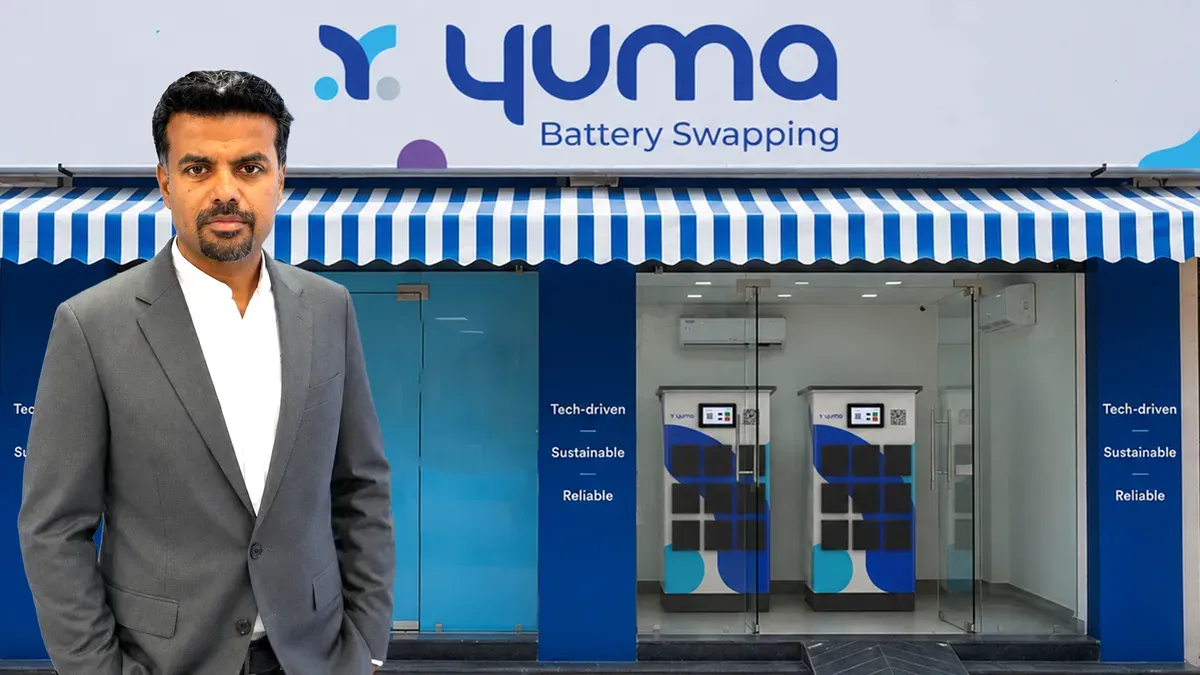
India's electric-mobility infrastructure sector notched one of its most significant transactions of the year on September 1, as battery-swapping startup Yuma Energy announced it has closed a $35 million Series A financing round led by Magna International, the Canadian automotive supplier best known for its global manufacturing footprint. The round marks one of the largest single checks written into India's battery-swapping ecosystem this year and signals growing institutional confidence in infrastructure plays that support the country's rapidly electrifying two- and three-wheeler fleets.
Alongside the fundraise, Yuma Energy confirmed the acquisition of Grinntech, a battery-technology company known for its cell-to-pack engineering capabilities and thermal-management systems. The move allows Yuma to bring critical components of its battery stack in-house rather than relying entirely on third-party cell integrators, a strategic shift that mirrors similar vertical-integration bets made by EV players in China and the United States over the past three years.
Battery swapping has emerged as a pragmatic alternative to plug-in charging in India's dense urban centres, where delivery riders, ride-hailing drivers and last-mile logistics fleets require rapid turnaround times that conventional charging infrastructure struggles to match. Rather than waiting for a battery to charge, riders exchange a depleted pack for a fully charged one at a swapping station in under two minutes — a model that has attracted comparisons to fuel-station economics rather than traditional EV charging.
For Magna International, the investment extends a broader strategic interest in electrified mobility supply chains beyond its traditional automotive parts business. The company has been selectively deploying capital into infrastructure and component businesses that sit adjacent to its core manufacturing operations, and India's two- and three-wheeler electrification wave — the largest such market globally by volume — represents a natural extension of that thesis.
Industry observers note that the timing of the round coincides with a broader consolidation phase in India's battery-swapping sector, where several smaller players have struggled to achieve the network density required for unit economics to work. By combining fresh capital with an in-house battery manufacturing capability through the Grinntech acquisition, Yuma is positioning itself to control costs more tightly across its stack — a critical advantage as competition intensifies and margins across the sector remain thin.
The transaction also reflects a wider trend across Indian climate-tech and mobility financing, where investors are increasingly rewarding companies that demonstrate operational proof points — commercial deployments, recurring revenue and defensible technology — over pure growth narratives. Yuma's ability to combine a scaled swapping network with proprietary battery technology gives it a differentiated position as India's EV ecosystem matures beyond its early hypergrowth phase into a period defined by consolidation, capital discipline and infrastructure ownership.
With the fresh capital, Yuma is expected to expand its swapping station footprint across additional Indian metros while integrating Grinntech's manufacturing capabilities into its supply chain over the coming quarters. The deal adds to a growing list of significant funding events in Indian mobility infrastructure this year, as the sector moves from experimentation toward large-scale commercial deployment backed by increasingly sophisticated institutional capital.

India's two- and three-wheeler segment remains the largest electrified vehicle category globally by unit volume, and the swapping model has found particular traction among commercial riders for whom vehicle downtime translates directly into lost income. This economic sensitivity has made reliability and network density the two most important competitive variables in the sector, ahead of factors such as brand recognition or subscription pricing that dominate consumer-facing EV marketing elsewhere.
Analysts tracking the space note that capital efficiency has become the defining differentiator between swapping operators likely to survive the sector's ongoing shakeout and those likely to be acquired or wound down. Networks that can lower their per-swap cost basis through vertically integrated manufacturing, as Yuma is now attempting through the Grinntech acquisition, are better positioned to sustain aggressive geographic expansion without requiring successive dilutive funding rounds simply to stay operationally solvent.
The broader implications extend to India's climate commitments as well. Two- and three-wheelers account for a disproportionate share of urban transport emissions and particulate pollution relative to their vehicle-kilometre contribution, making their electrification a comparatively high-leverage lever for improving urban air quality. Investors backing companies like Yuma are increasingly framing these transactions not purely as mobility plays but as infrastructure investments with measurable environmental and public-health dividends attached.
Looking ahead, Yuma's competitive position will hinge on how quickly it can translate Grinntech's manufacturing capability into a genuine cost advantage over rivals still dependent on third-party cell suppliers. Battery costs typically represent the single largest line item in a swapping network's unit economics, meaning even modest improvements in cell sourcing or pack design can compound meaningfully across a network operating tens of thousands of daily swaps. Founders across the sector have increasingly acknowledged that the businesses most likely to consolidate the market over the next two to three years will be those combining dense urban station networks with defensible control over their underlying hardware costs, rather than those competing purely on station count or app-based user experience.
The transaction also illustrates a broader financing pattern taking hold across India's climate-tech sector, in which growth-stage rounds increasingly bundle primary capital with M&A activity rather than treating fundraising and acquisitions as sequential, separate events. This combined structure allows founders to present investors with a single, integrated growth thesis — new capital funding both organic expansion and inorganic capability acquisition simultaneously — rather than requiring separate justification for each. As more Indian climate-tech and mobility startups reach the scale where vertical integration becomes commercially rational, similar combined financing-and-acquisition structures are likely to become increasingly common across the sector.
For India's electric-mobility sector as a whole, transactions of this scale continue to validate the country's status as one of the most closely watched EV infrastructure markets globally, drawing sustained attention from strategic industrial investors such as Magna who see India's two- and three-wheeler electrification wave as a template that may eventually inform comparable strategies in other large, price-sensitive emerging markets across Southeast Asia, Africa and Latin America.