Zetwerk, the Bengaluru-founded manufacturing services company that has become one of the most closely watched bets on India's industrial ambitions, opened its initial public offering to investors on 15 October, after drawing strong interest from global and domestic institutions in its anchor allocation.
The ₹5,012 crore issue is priced in a band of ₹143 to ₹151 a share. It closes on 19 October, with allotment expected on 21 October and listing on the BSE and NSE scheduled for 23 October.
On 14 October, the eve of the opening, Zetwerk raised ₹2,251.23 crore from 99 anchor investors at the top of the price band, allocating about 14.91 crore shares. The anchor book included international names such as BlackRock, Goldman Sachs, Nomura, Capital Group and Norway's Government Pension Fund Global, alongside 22 Indian mutual funds including SBI Mutual Fund, HDFC Mutual Fund, ICICI Prudential Mutual Fund and Mirae Asset Mutual Fund.
A Slow Start on Day One
Despite the strong anchor demand, the public issue began quietly. The offer was subscribed 23 per cent by the end of the first day, according to Inc42. Subscription commonly accelerates on the final day of Indian IPOs, as institutional investors typically place bids late in the process.
The issue structure reflects Zetwerk's status as a loss-making company. Under Indian rules, companies that do not meet profitability criteria must reserve at least 75 per cent of the net offer for qualified institutional buyers. Up to 15 per cent is available to non-institutional investors and up to 10 per cent to retail investors.
Inside the Offer
The IPO comprises a fresh issue of up to ₹2,830 crore and an offer for sale of about ₹2,182 crore, or roughly 14.45 crore shares, by existing shareholders. Proceeds from the fresh issue will support purposes set out in the offer documents, including debt repayment and business requirements, while the offer for sale proceeds go to the selling shareholders.
The minimum bid is 99 shares, which works out to about ₹14,949 at the upper end of the price band. Employees are being offered a discount of ₹14 a share. Promoter holding will fall from 15.86 per cent before the issue to 11.36 per cent afterwards. KFin Technologies is the registrar.
The Business: Manufacturing Without Owning Most Factories
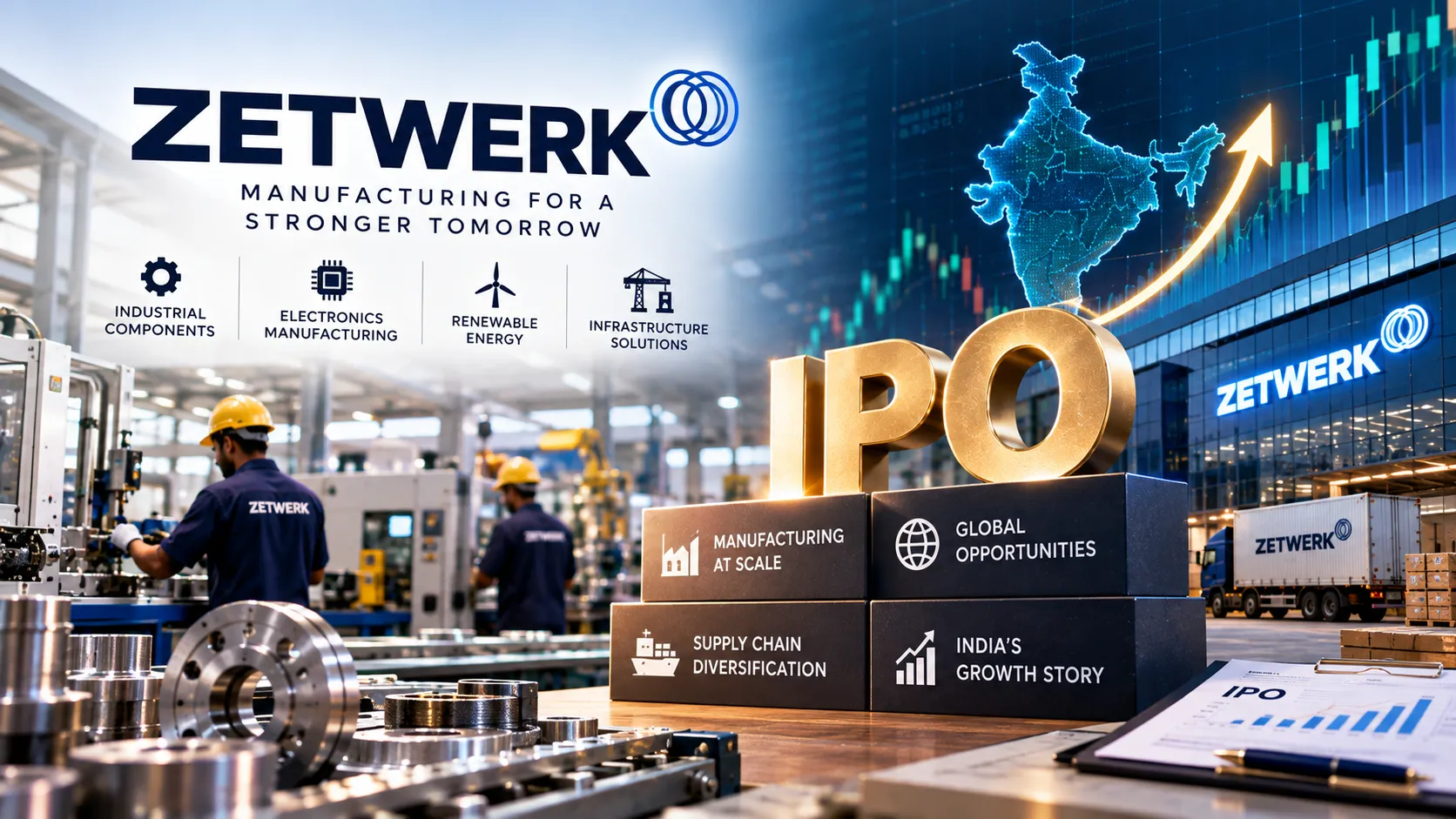
Founded in 2018, Zetwerk built its business by connecting customers that need manufactured goods with a network of manufacturing partners, managing design, sourcing, quality and delivery. Over time it has expanded into industrial components, electronics manufacturing, renewable energy components and infrastructure-related products, serving customers in India and abroad.
The model positions Zetwerk as a beneficiary of global supply chain diversification. Multinationals seeking alternatives to China have looked to India for manufacturing capacity, and the Indian government has backed domestic production through production-linked incentive schemes in sectors from electronics to solar modules.
The Numbers Behind the Story
Zetwerk's financials show rapid scale but persistent losses. Total income rose to ₹16,100.63 crore in fiscal 2026 from ₹11,492.23 crore in fiscal 2025, after dipping from ₹12,523.46 crore in fiscal 2024, according to offer document figures summarised by Univest.
Losses, however, widened significantly in the latest year. The company reported a loss after tax of ₹1,606.17 crore in fiscal 2026, compared with ₹370.71 crore in fiscal 2025 and ₹917.95 crore in fiscal 2024. Adjusted EBITDA has been positive and rising, reaching ₹421.34 crore in fiscal 2026 from ₹322.59 crore a year earlier.
The gap between positive adjusted EBITDA and a large net loss is a key issue for investors to examine in the offer documents, as it may reflect one-off charges, finance costs, depreciation or other items that are excluded from the adjusted measure.
Why Global Funds Showed Up
The breadth of the anchor book is significant. Long-only global investors and sovereign wealth funds do not typically participate in Indian IPOs unless they see a company with scale and a credible long-term story. Their presence suggests that institutions view Zetwerk as a way to gain exposure to India's manufacturing build-out, a theme that has attracted strong interest as investors look for growth outside China.
Domestic mutual funds, flush with steady inflows from systematic investment plans, have become a stabilising force in Indian IPOs, often absorbing a large share of anchor allocations.
A Crowded IPO Calendar
Zetwerk's listing comes during one of the busiest periods for Indian primary markets. Defence electronics maker Tonbo Imaging opened its own IPO the same day, and Jio Platforms, the Reliance telecom and digital services unit, is preparing what would be India's largest-ever IPO later in the month.
A crowded calendar can work both ways. Strong demand across issues signals investor confidence, but large offerings arriving together compete for the same pool of capital, particularly among retail and high-net-worth investors.
The Manufacturing Platform Model
Zetwerk's business sits at the intersection of technology and heavy industry, a combination that makes it harder to value than a pure software company. Its revenue depends on executing physical projects: fabricating components, managing suppliers, ensuring quality and delivering on time to customers in sectors ranging from energy to infrastructure. Margins in such businesses are typically far lower than in software, and working capital requirements can be substantial, as the company often needs to finance materials and production before customers pay.
At the same time, the platform approach gives Zetwerk flexibility that traditional manufacturers lack. By coordinating a network of partner factories and investing selectively in its own capacity, it can scale across product categories and geographies more quickly than a company that builds every plant itself. Investors in the IPO are, in effect, being asked to judge whether that flexibility, combined with India's cost advantages and supply chain diversification away from China, can eventually translate into the consistent profitability that the company has yet to demonstrate.
What Investors Should Weigh
For investors, Zetwerk offers exposure to a structural theme: India's ambition to become a global manufacturing hub. Its scale, diversified customer base and asset-light origins are strengths. The quality of its anchor book provides a measure of institutional endorsement.
The risks are equally clear. The company remains loss-making, and its losses widened sharply in the latest year. Manufacturing services is a competitive, lower-margin business exposed to commodity prices, customer concentration and execution risk across many sites and partners. The offer for sale component means part of the proceeds will go to existing investors rather than into the business.
The subscription figures over the coming days, especially from qualified institutional buyers, will show how the broader market weighs those factors. A strong listing would reinforce confidence in India's new wave of industrial technology companies; a weak one would suggest investors want clearer evidence of profitability before backing the manufacturing story at scale.