StartupsUnicorns Tech5 MIN READ

Zetwerk's Q2 Loss Widens 43% to ₹88 Crore as Revenue Rises 18% to ₹4,599 Crore, Ahead of Its Planned Stock Market Debut

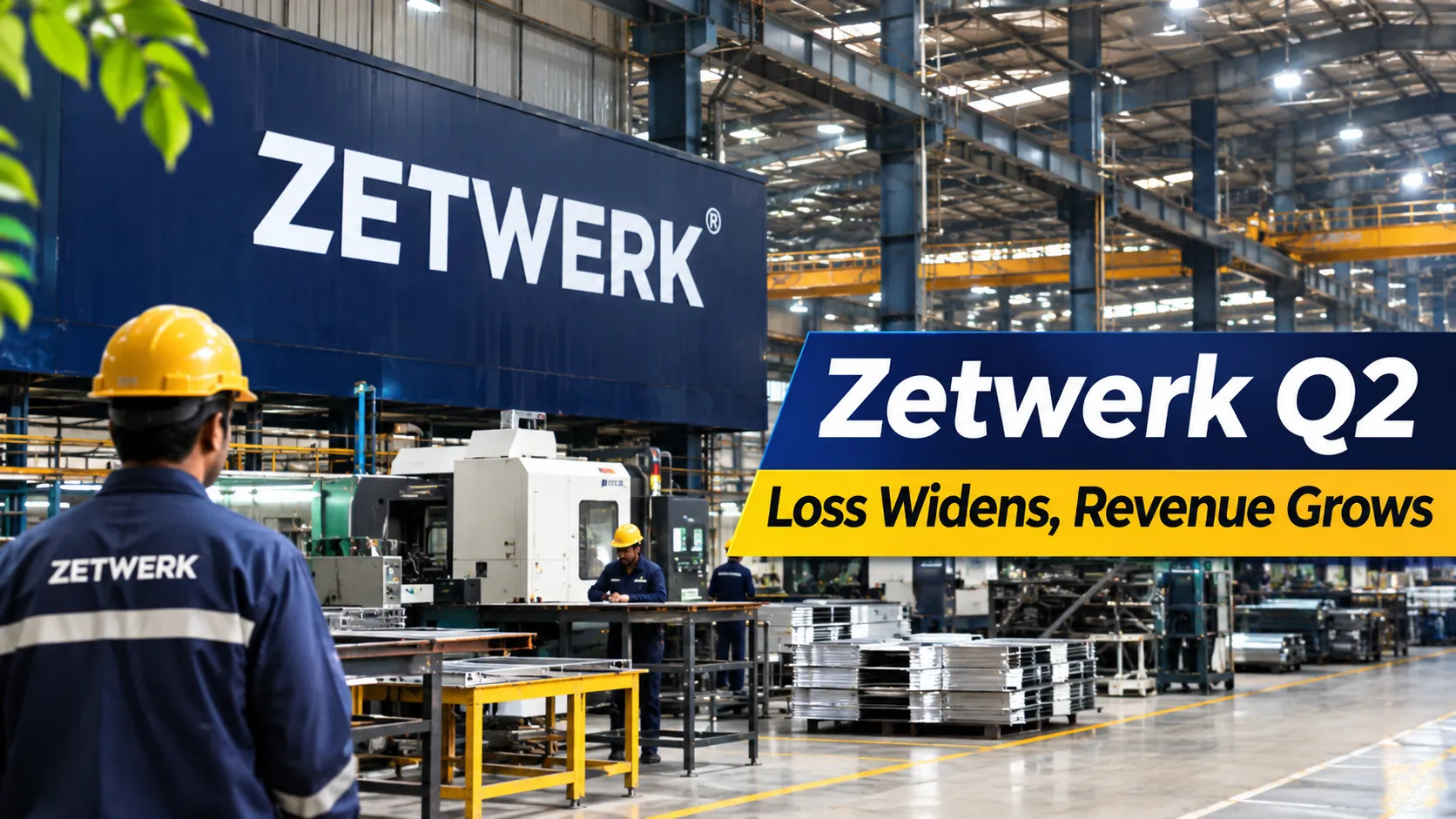
Manufacturing marketplace Zetwerk's consolidated net loss rose 43% year-on-year to ₹88.1 crore in the September quarter, Inc42 reported on November 13, while operating revenue rose 18.3% to ₹4,599.4 crore. The loss narrowed sharply from ₹733 crore in the June quarter, and losses from continuing operations were ₹53.8 crore.

By Nisha Omkumar · Author14 November 2026New
Zetwerk's Q2 Loss Widens 43% to ₹88 Crore as Revenue Rises 18% to ₹4,599 Crore, Ahead of Its Planned Stock Market Debut

Zetwerk, one of India's most valuable manufacturing startups, reported a wider year-on-year loss in the September quarter, though its losses narrowed dramatically from the previous quarter as revenue continued to grow.

The Bengaluru-based company's consolidated net loss rose 43.2% year-on-year to ₹88.1 crore in the July-September quarter, the second quarter of the 2026-27 financial year, from ₹61.6 crore a year earlier, according to Inc42, which reported the results on Friday, November 13. The loss narrowed 88% from ₹733 crore in the April-June quarter.

Operating revenue rose 18.3% year-on-year to ₹4,599.4 crore from ₹3,889.3 crore, and was up 11.7% from ₹4,117.9 crore in the previous quarter.

Breaking down the loss

The loss from continuing operations was ₹53.8 crore, up 161% year-on-year, while the loss from discontinued operations was ₹34.3 crore, down 16%, according to Inc42. The separation suggests that Zetwerk has exited or is winding down some businesses, and that these are weighing on overall results.

Total expenses rose 19.6% year-on-year to ₹4,689.5 crore, slightly faster than revenue, according to Inc42. Other income was ₹53.3 crore, bringing total income to ₹4,652.7 crore. The company recorded net exceptional gains of ₹1.3 crore and a net tax expense of ₹11.9 crore on continuing operations. Its total comprehensive loss was ₹91 crore.

The large loss in the first quarter likely included significant one-time items, which explains the sharp sequential improvement.

What Zetwerk does

Founded in 2018 by Amrit Acharya and Srinath Ramakrishnan, Zetwerk operates a platform that connects companies needing manufactured goods with a network of factories. It handles sourcing, quality control and logistics for products ranging from steel structures and machine components to electronics, apparel and renewable energy equipment.

The model allows customers to outsource manufacturing without building their own factories, while giving small and medium-sized manufacturers access to larger orders. Zetwerk has also built its own manufacturing capabilities in some sectors, including electronics and renewable energy.

Riding the China-plus-one trend

Zetwerk has benefited from the global trend of companies diversifying their supply chains away from China, known as China-plus-one. As multinational companies look for alternative manufacturing locations, India has positioned itself as a key destination, supported by government incentives such as production-linked incentive schemes.

Zetwerk serves customers in India and abroad, including in the United States and Europe, and has expanded into sectors such as electronics manufacturing services, where demand has grown as global brands increase production in India.

A thin-margin business

Contract manufacturing and sourcing are typically low-margin businesses. Zetwerk's revenue is large, but its profits depend on maintaining tight control of costs and earning a margin on the goods it sources and makes. Expenses rising slightly faster than revenue, as in the September quarter, can quickly push the company into losses.

The company has been working to improve profitability by focusing on higher-margin segments and exiting less profitable businesses, which may explain the discontinued operations.

IPO ambitions

Zetwerk is one of several Indian startups preparing for a stock market listing. The company has been reported to be working towards an IPO, and its quarterly results are being closely watched by investors evaluating its prospects. Public market investors in India have rewarded profitable growth, and Zetwerk's ability to show a clear path to profitability will be important for its valuation.

“Zetwerk is betting that the world's search for factories outside China runs through India.”
— TIGI Startups Desk

Zetwerk Manufacturing Businesses was among the companies scheduled to report results on November 13, according to Upstox.

e219159e-7020-43fa-a578-68383d7edf1f.png

Investors and valuation

Zetwerk has raised substantial funding from investors including Lightspeed, Greenoaks, Avenir and others, and became a unicorn in 2021. Its valuation has been among the highest for a B2B startup in India, reflecting investor enthusiasm for the country's manufacturing opportunity.

Make in India

Zetwerk's growth is closely linked to the government's Make in India initiative, which aims to increase manufacturing's share of the economy. The government has offered incentives for manufacturing in sectors such as electronics, solar modules, automobiles and pharmaceuticals, and has invested in infrastructure such as highways, ports and industrial corridors.

However, Indian manufacturing still faces challenges, including high logistics costs, complex regulations and gaps in skilled labour, which companies such as Zetwerk aim to help customers navigate.

What it means for India's manufacturing startups

Zetwerk's results reflect both the opportunity and the challenge for India's manufacturing-focused startups. Demand is strong, but turning that demand into consistent profits requires discipline in pricing, cost management and capital allocation.

The path to profitability

For Zetwerk, the key question for investors is when the company can turn its large revenue base into consistent profits. Manufacturing services businesses typically earn modest margins because they compete on price and rely on third-party factories. Profitability depends on scale, efficient use of working capital and a shift towards higher-value products where customers are willing to pay more for quality and reliability.

The company has been expanding into areas such as electronics manufacturing and renewable energy components, which could offer better margins than its traditional fabrication business if it can build the necessary capabilities.

Working capital pressures

Businesses like Zetwerk often need significant working capital, because they pay suppliers before receiving payment from customers, particularly in large industrial projects. Managing receivables and inventory efficiently is critical to avoiding cash shortfalls. Public market investors will scrutinise the company's cash flow statements as closely as its profit and loss account.

Strong cash generation would reassure investors that the business model is sustainable, while heavy cash consumption would raise questions about the capital it needs to keep growing.

Lessons from listed peers

Several Indian startups that listed in recent years have seen volatile share price performance, with investors rewarding companies that show a clear path to profit and punishing those that continue to burn cash. Zetwerk's management will be aware that public investors tend to be less patient than private ones.

Zetwerk's progress will also be watched by policymakers, who see contract manufacturing platforms as important for building India's industrial supply chains. If the company can demonstrate that a technology-led model can operate profitably at scale, it could encourage further investment in manufacturing startups and strengthen India's position as an alternative to China for global buyers seeking diversified sources of supply.

What comes next

Investors will watch whether Zetwerk can return to profitability, the progress of its IPO preparations and its growth in electronics and renewable energy. The company's performance will be an important indicator of how India's manufacturing ambitions are translating into business results.

TagsZetwerkAmrit AcharyaSrinath Ramakrishnanmanufacturingcontract manufacturingB2B marketplaceelectronics manufacturingrenewable energyQ2 FY27 resultsIndian startupsunicornsIPOMake in Indiasupply chainChina plus oneBengaluru startupsindustrial goodsexportsventure capitalinvestors

Reader reviews

Sign in to rate and review this article.
Loading reviews…

