Results (122 found)

The Bottle That Broke Bollywood: How One Star's Year-Long Quest to Launch a Tequila Brand Exposed Every Structural Barrier Keeping Indian Celebrities Out of the $55 Billion Liquor Market
MagazineMay 29, 2026

The Bottle That Broke Bollywood: How One Star's Year-Long Quest to Launch a Tequila Brand Exposed Every Structural Barrier Keeping Indian Celebrities Out of the $55 Billion Liquor Market

On a Thursday morning in January 2026, a Bollywood actor whose last three films had together grossed over ₹1,200 crore sat across a table from the managing director of one of India's largest spirits companies and made his pitch. He wanted to launch a tequila brand. Not an endorsement deal. A brand. His own capital. His own name on the label. His own equity in the company. He had been studying the Casamigos playbook for months—George Clooney, Rande Gerber, Mike Meldman, the four‑year build, the billion‑dollar exit—and he believed he could replicate it in India. The spirits executive listened politely, nodded at the appropriate moments, and then asked three questions that the actor had not anticipated.

The Satellite Sunset: How the Quiet Collapse of TV Rights Revenue Is Rewriting the Economics of Indian Cinema—And Nobody Is Talking About It
MagazineMay 29, 2026

The Satellite Sunset: How the Quiet Collapse of TV Rights Revenue Is Rewriting the Economics of Indian Cinema—And Nobody Is Talking About It

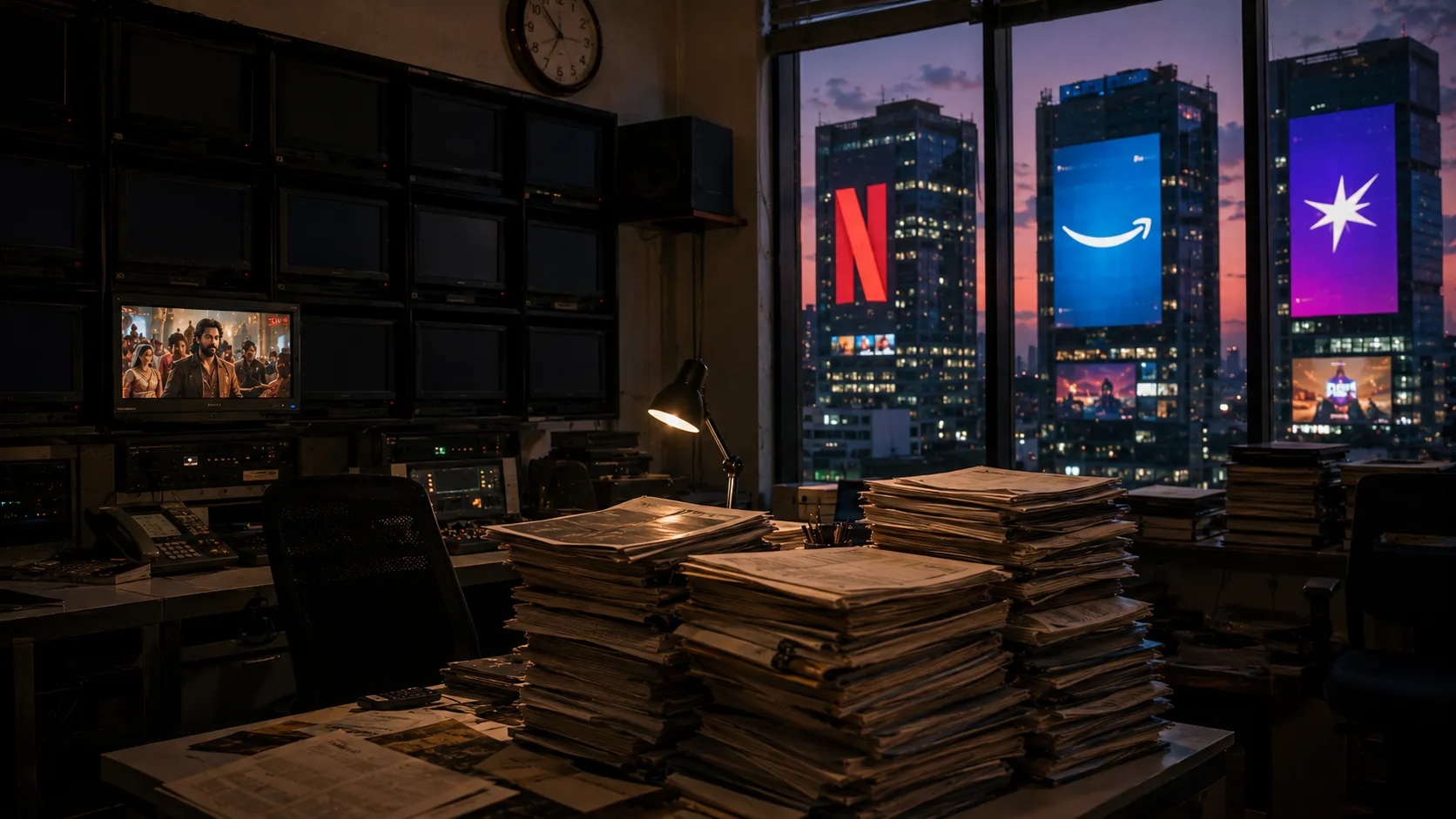
Sometime in 2018, a major Bollywood studio sold the satellite rights to a moderately successful star vehicle for approximately ₹55 crore. The film had performed respectably at the box office—not a blockbuster, but profitable—and the satellite deal, which granted a national television network the exclusive right to broadcast the film for ten years, was the largest single revenue line item in the film's post‑theatrical lifecycle. The studio booked the revenue, the network scheduled the premiere, and the model—theatrical first, satellite second, digital third—continued to function as it had functioned for a generation.

The Streaming Checkbook: How Netflix, Amazon, and JioHotstar's Billion‑Dollar Bidding War for Post‑Theatrical Rights Is Quietly Reshaping the Risk Calculus of Every Film You Watch
MagazineMay 29, 2026

The Streaming Checkbook: How Netflix, Amazon, and JioHotstar's Billion‑Dollar Bidding War for Post‑Theatrical Rights Is Quietly Reshaping the Risk Calculus of Every Film You Watch

Sometime in the spring of 2025, a negotiation took place in a Bandra‑Kurla Complex boardroom that, in retrospect, will be remembered as the moment the Indian film industry's financial centre of gravity permanently migrated from the box office to the streaming platform. The producers of Dhurandhar 2 were selling the post‑theatrical digital rights to their film—the right to stream it, exclusively, after its theatrical run ended. Three bidders were at the table: Netflix, Amazon Prime Video, and JioHotstar. The opening bid was ₹180 crore. The final price, after a week of escalating offers, exceeded ₹350 crore—a figure that, by itself, would have made the film profitable before a single ticket was sold.

The Pixel War: How Shah Rukh Khan and Ranbir Kapoor Are Building Competing VFX Empires—And Why the Future of Indian Cinema Will Be Rendered, Not Filmed
MagazineMay 29, 2026

The Pixel War: How Shah Rukh Khan and Ranbir Kapoor Are Building Competing VFX Empires—And Why the Future of Indian Cinema Will Be Rendered, Not Filmed

Sometime in the summer of 2025, two conversations took place in two different corners of the Indian film industry, neither of which was reported in the press, and both of which, in retrospect, will be understood as the opening moves in a battle that will define the visual language of Indian cinema for a generation. In the first conversation, Shah Rukh Khan met with the leadership team of Red Chillies VFX, the visual‑effects division of his production company, and approved a ₹300 crore expansion plan that would more than double the studio's capacity—adding new motion‑capture stages, expanding its team of artists, and investing in the proprietary rendering technology that had already made Red Chillies one of the most respected VFX houses in Asia. In the second conversation, Ranbir Kapoor met with the leadership of DNEG India, the Indian arm of the London‑headquartered visual‑effects giant that has won seven Academy Awards for its work on films like Dune, Tenet, and Blade Runner 2049. Ranbir, who had quietly acquired a substantial stake in DNEG India over the preceding two years, approved a plan to position the studio as the primary VFX partner for Ramayana, the ₹4,000 crore epic in which he also stars as Lord Ram, and to compete directly with Red Chillies for the most technically demanding projects in the Indian pipeline.

How Shah Rukh Khan, Salman Khan, and Bollywood's Quietest Tycoons Built Property Empires That Out‑Earn Their Film Careers
MagazineMay 29, 2026

How Shah Rukh Khan, Salman Khan, and Bollywood's Quietest Tycoons Built Property Empires That Out‑Earn Their Film Careers

Sometime in 2019, a company called Aryan Realty—registered in Mumbai, directors drawn from a famous family, its name a tribute to a star's eldest son—quietly purchased a 99‑year lease on a plot of land in Dubai's exclusive Palm Jumeirah district. The transaction was not announced to the press. There was no filmi launch event, no celebrity photo‑op, no red‑carpet spectacle. It was a property deal, conducted with the same discretion that the world's wealthiest families have always brought to their most significant investments. The company paid approximately ₹120 crore for the land. It is now developing a luxury residential tower on the site, with units expected to sell for between ₹15 crore and ₹60 crore each. When completed, the project's total sale value will comfortably exceed ₹500 crore—a return that is larger than the global box‑office gross of most Bollywood blockbusters.

The Reel Estate: How Shah Rukh Khan, Salman Khan, and Bollywood's Quietest Tycoons Built Property Empires That Out‑Earn Their Film Careers
MagazineMay 29, 2026

The Reel Estate: How Shah Rukh Khan, Salman Khan, and Bollywood's Quietest Tycoons Built Property Empires That Out‑Earn Their Film Careers

Sometime in 2019, a company called Aryan Realty—registered in Mumbai, directors drawn from a famous family, its name a tribute to a star's eldest son—quietly purchased a 99‑year lease on a plot of land in Dubai's exclusive Palm Jumeirah district. The transaction was not announced to the press. There was no filmi launch event, no celebrity photo‑op, no red‑carpet spectacle. It was a property deal, conducted with the same discretion that the world's wealthiest families have always brought to their most significant investments. The company paid approximately ₹120 crore for the land. It is now developing a luxury residential tower on the site, with units expected to sell for between ₹15 crore and ₹60 crore each. When completed, the project's total sale value will comfortably exceed ₹500 crore—a return that is larger than the global box‑office gross of most Bollywood blockbusters.

The ₹1,700 Crore Blueprint: How the Dhurandhar Duology Became Bollywood's Most Profitable Franchise—and What It Reveals About the Science of Sequel Economics
MagazineMay 29, 2026

The ₹1,700 Crore Blueprint: How the Dhurandhar Duology Became Bollywood's Most Profitable Franchise—and What It Reveals About the Science of Sequel Economics

In the winter of 2025, a spy thriller starring an actor whose commercial appeal was still being debated by the trade released to an opening weekend that exceeded every pre‑release projection. By the time it finished its theatrical run, Dhurandhar had grossed approximately ₹878 crore worldwide—the highest‑grossing Hindi film in history at the time of its release. Four months later, its sequel, Dhurandhar 2: The Revenge, opened even larger and ran even longer, crossing ₹1,789 crore globally and establishing the franchise as the most commercially potent intellectual property in the history of Hindi cinema. Together, the two films have grossed over ₹1,700 crore at the global box office, on combined production budgets of approximately ₹550 crore. The return on investment is not merely impressive. It is structural. And the franchise's performance has already begun to reshape how every major Indian studio thinks about sequel economics, star compensation, and the value of intellectual property.

The Star Who Writes the Cheque: How Ranveer Singh, Allu Arjun, and a New Generation of Actor‑Producers Are Rewriting the Risk‑Reward Equation of Indian Cinema
MagazineMay 29, 2026

The Star Who Writes the Cheque: How Ranveer Singh, Allu Arjun, and a New Generation of Actor‑Producers Are Rewriting the Risk‑Reward Equation of Indian Cinema

In the winter of 2025, as Dhurandhar completed its record‑breaking rampage through the global box office, Ranveer Singh sat down with his financial team and made a decision that would, in retrospect, mark the moment the Indian film industry's oldest hierarchy was formally inverted. He would no longer be merely the star of his films. He would be their primary financier. His production company, Ma Kasam Films—launched quietly during the pandemic and previously limited to smaller, experimental projects—would now co‑finance every film he starred in, committing tens of crores of his own capital to each production, assuming a share of the risk in exchange for a larger share of the upside. The actor who had spent his career as the highest‑paid employee on every set he worked on was now becoming the employer. The distinction was not merely financial. It was structural. And it represented the culmination of a shift that has been building for years and that is now, unmistakably, reshaping the power dynamics of the Indian film industry.

The ₹200 Crore Trailer: How Indian Films Started Spending More on Marketing Than on Stars—And Why That Changes Everything
MagazineMay 29, 2026

The ₹200 Crore Trailer: How Indian Films Started Spending More on Marketing Than on Stars—And Why That Changes Everything

In the spring of 2024, a film released in India that spent approximately ₹80 crore on prints and advertising. The figure was not remarkable—the largest Hindi releases had been crossing the ₹50 crore P&A threshold for years. What was remarkable was the line item that had disappeared from the budget. The film's lead actor, one of the most recognisable faces in the country, had taken no upfront fee. His compensation was structured entirely as a share of the film's profits, and the money that would have been allocated to his salary—approximately ₹60 crore—had been redirected into the marketing campaign instead. The film was Jawan. The actor was Shah Rukh Khan. And the decision to swap star fee for marketing spend was, in retrospect, the moment the Indian film industry's centre of economic gravity shifted from the face on the poster to the machinery that sold it.

The ₹50 Crore Debut: Why Bollywood Studios Are Betting on Complete Strangers—And What It Reveals About the Death of the Star System
MagazineMay 29, 2026

The ₹50 Crore Debut: Why Bollywood Studios Are Betting on Complete Strangers—And What It Reveals About the Death of the Star System

In the summer of 2024, a 21‑year‑old woman with no film lineage, no social‑media following, and no prior acting experience walked into a casting office in Andheri and auditioned for a role that would, within eighteen months, make her one of the most talked‑about faces in the country. The film was Saiyaara, a romantic drama produced by Dharma Productions and directed by a debutant. Its budget was approximately ₹60 crore. Its lead actor, who had appeared in two moderately successful films, was paid ₹3 crore. Its lead actress, the 21‑year‑old who had walked into the casting office, was paid ₹35 lakh. The film grossed nearly ₹500 crore worldwide, and the actress is now negotiating her fourth film, with offers that reportedly exceed ₹8 crore per project. The studio that bet on her—that bet on an unknown face, a modest budget, and a script that had been rejected by three established stars—has earned a return on investment that no star‑driven blockbuster of the same period has matched.

Load More Results